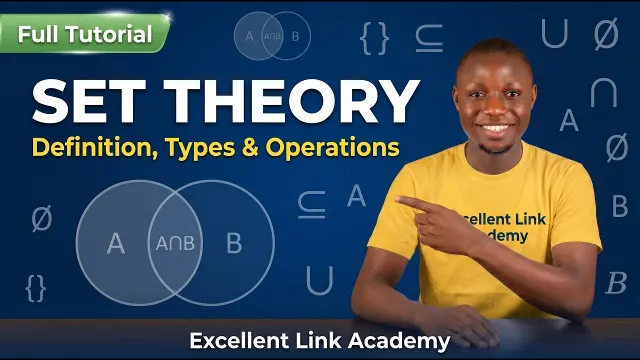
 Set Theory Explained: Definitions, Types, Operations and Examples
#Mathematics Tutorial
1 ideas
Set Theory Explained: Definitions, Types, Operations and Examples
Get new #Mathematics Tutorial ideas by email
Every Thursday: the week's best ideas, with the newest from #Mathematics Tutorial.
Related tags
Mathematics Tutorial: A Beginner's Guide to Learning Math
A mathematics tutorial is a structured piece of teaching that walks you through a mathematical idea step by step, from the definition to worked examples and practice. Unlike a textbook chapter, which is written to be read, a tutorial is written to be followed: it assumes you want to do something with the idea by the end, whether that is solving an equation, reading a proof, or understanding why a rule works.
Mathematics itself is the study of number, quantity, structure, space and change. It is one of the oldest intellectual traditions we have, grown from practical needs such as counting, measuring land, tracking seasons and keeping accounts, and refined over centuries into an abstract and highly organised discipline. What makes it unusual among subjects is that its claims are not settled by experiment but by proof: a statement is accepted because it follows logically from agreed starting points.
The main branches
Maths is usually divided into a few broad areas. Arithmetic and algebra deal with numbers and the rules for combining them, including unknowns and equations. Geometry concerns shape, size and space. Calculus studies continuous change, rates and accumulation. Probability and statistics describe uncertainty and data. Beyond these lie areas such as set theory, logic, number theory and discrete mathematics, which underpin much of computing. Most tutorials sit inside one of these areas, and most of them quietly rely on the ones before.
Read more
What a good tutorial looks like
A well-built tutorial moves through four stages. It introduces the idea in plain language and says what problem it solves. It gives a formal definition, because precision is what makes mathematics work. It shows worked examples, ideally including one that fails, since mistakes teach the boundaries of a rule. Finally it sets exercises, because mathematics is learned by doing rather than by reading.
Practical tips for beginners
Start with the prerequisites and be honest about them. If a tutorial assumes fractions or functions you are shaky on, go back and fix that first; gaps compound quickly.
Work with a pencil and paper. Copying a step by hand forces you to notice what is happening, in a way that reading never does. Try the example yourself before the solution is revealed.
When you get something wrong, do not just find the right answer. Locate the exact line where your reasoning diverged, and name the rule you misapplied. That single habit does more for progress than any amount of extra practice.
Do not skip the definitions. In mathematics, almost every confusion traces back to a word being used loosely. Read the definition slowly, test it against examples, and check its edge cases.
Finally, expect to feel stuck. Being stuck is not evidence that you cannot do mathematics; it is the ordinary state of doing mathematics. Take a break, try a smaller version of the problem, explain it aloud, and come back.
#Mathematics Tutorial: frequently asked questions
How should a complete beginner start with a mathematics tutorial?
Begin at the prerequisites rather than at the topic that caught your eye. Read the opening section honestly and check whether the fractions, functions or notation it assumes are things you can already use comfortably. If they are not, work through the earlier material first, because gaps in the foundations compound quickly once the tutorial moves on.
Do I need any special tools or background before following one?
Nothing beyond pencil and paper, plus a willingness to write steps out by hand instead of only reading them. Copying a line of working forces you to notice what changed, which reading silently never does. The real requirement is the assumed background knowledge, so treat the stated prerequisites as a checklist rather than a formality.
Which kind of mathematics tutorial should I choose?
Pick by the problem you actually want to solve, not by which title sounds most impressive. Tutorials generally sit inside one broad area such as algebra, geometry, calculus, or probability, and each area quietly relies on the ones before it. A good sign is a tutorial that states up front what you will be able to do by the end.
How do I make the ideas actually stick?
Attempt each worked example yourself before the solution is shown, then set the exercises and finish them. Mathematics is learned by doing, so reading a tutorial straight through feels productive without being productive. Going back to fix a weak prerequisite later is far harder than doing it at the start.
What is the most common mistake people make with these tutorials?
Skipping the definitions and then getting lost, since almost every confusion in mathematics traces back to a word being used loosely. Read each definition slowly, test it against examples, and check its edge cases. When an answer is wrong, do not simply copy the correct one; find the exact line where your reasoning diverged and name the rule you misapplied.
What should I do when I feel completely stuck?
Expect it, because being stuck is the ordinary state of doing mathematics rather than a sign you cannot manage it. Take a break, try a smaller version of the same problem, explain the idea aloud, and then return to it. If you are still blocked, go back and check whether an earlier definition or prerequisite is the real obstacle.
Videos come from YouTube and posts from Instagram; titles and summaries are our own. All rights belong to their creators.