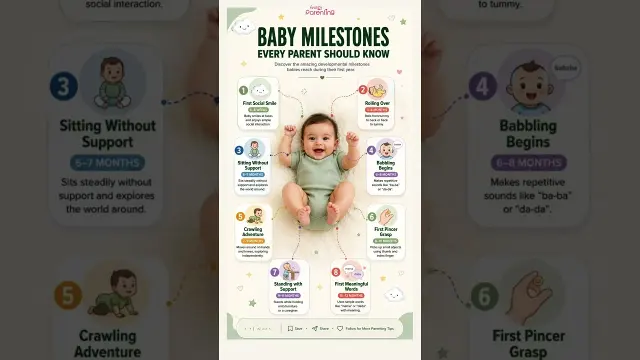
 8 Key Baby Milestones Every Parent Should Know in the First Year
#Milestones
1 ideas
8 Key Baby Milestones Every Parent Should Know in the First Year
Get new #Milestones ideas by email
Every Thursday: the week's best ideas, with the newest from #Milestones.
Related tags
Baby Milestones: What to Expect in the First Years
Milestones are the small but important steps children take as they grow. They can include rolling over, sitting up, crawling, walking, speaking first words, and many other signs of physical, social, and emotional development. Every child develops in their own way, so milestones are best seen as a broad guide rather than a strict timetable.
What milestones are
Developmental milestones are skills most children tend to reach within a certain range of age. They help you understand how a child is progressing in areas such as movement, communication, learning, and interaction. Some milestones are easy to notice, like taking a first step. Others are quieter, such as responding to a voice, making eye contact, or showing interest in people and objects.
Milestones are often grouped into a few main areas:
- Gross motor skills, such as lifting the head, crawling, standing, and walking
- Fine motor skills, such as grasping, reaching, and using the hands with more control
- Language and communication, such as babbling, saying words, and following simple directions
- Social and emotional skills, such as smiling, copying expressions, and enjoying interaction
Read more
Why milestones matter
Milestones give you a simple way to notice growth and to support it with everyday care. They can also help you spot when a child may need a little extra encouragement or guidance. At the same time, a milestone chart should never be used to compare children too closely. Some children focus first on movement, while others seem to spend more time on language or social skills.
Common kinds of milestones
In the early months, babies often begin with basic control of their body. You may notice stronger head control, more purposeful hand movements, and growing interest in faces and sounds. Later, many babies begin to roll, sit, move around, and eventually stand or walk with increasing confidence.
As children grow, milestones become more varied. They may learn to point, name objects, imitate actions, build simple play routines, and express feelings more clearly. Language often develops gradually, moving from sounds to words, then to short phrases and fuller conversation.
How to support healthy development
You do not need special equipment to encourage milestones. Simple, repeated interactions matter most.
- Talk, sing, and read to your child often
- Give your child safe floor time to move freely
- Offer age-appropriate toys that invite grasping, stacking, or exploring
- Respond to cues, sounds, and gestures
- Keep routines steady, with time for rest, play, and feeding
- Give lots of calm attention and encouragement
What beginners should remember
If you are new to milestones, focus on progress over perfection. A child may reach one skill early and another later, and that can still be completely normal. If something feels uncertain, it is always reasonable to ask a healthcare professional for reassurance. Watching milestones is simply one way to understand your child better and enjoy each new stage as it unfolds.
Videos come from YouTube and posts from Instagram; titles and summaries are our own. All rights belong to their creators.