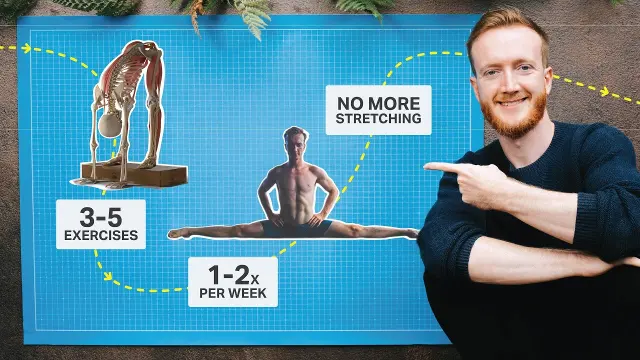
 The Blueprint to Sustainable Mobility and Flexibility
#Mobility Training
1 ideas
The Blueprint to Sustainable Mobility and Flexibility
Get new #Mobility Training ideas by email
Every Thursday: the week's best ideas, with the newest from #Mobility Training.
Related tags
Mobility Training: A Beginner's Guide to Moving Well
Mobility training is the practice of building usable range of motion — not just the ability to reach a position, but the strength and control to move into it and back out again under your own power. It sits somewhere between stretching and strength training, and it borrows from both.
The distinction matters. Flexibility describes how far a joint or muscle can be taken passively, often with gravity, a partner or a prop doing the work. Mobility describes what you can do actively, with your own muscles driving the movement. Someone can be very flexible and still struggle to control that range, which is why the two are trained differently.
Where it comes from
The ideas behind mobility work are older than the name. Gymnastics, dance, martial arts and yoga have all cultivated controlled range for centuries, and rehabilitation has long used similar drills to help people recover movement after injury. What is newer is the way strength coaches have folded those practices into general training, treating range of motion as something to be built and loaded rather than simply stretched.
Read more
What it is used for
People come to mobility training for different reasons. Some want to move more comfortably in daily life — getting up from the floor, reaching overhead, turning to look behind them. Some want to squat, lift or run with better positions. Others use it to prepare for sport, to balance long hours sitting, or simply because moving through a full range feels good. It is also a common companion to strength work, since a joint that moves well can often be loaded more effectively.
The main approaches
- Dynamic drills: controlled movements through range, often used as a warm-up. Leg swings, arm circles, hip openers and spinal rotations belong here.
- Active or controlled rotations: slow, deliberate circles at a single joint, performed with tension rather than momentum, to teach the body to own its range.
- Loaded mobility: taking a joint to the edge of its range and adding weight or tension there, which builds strength in the end position.
- Contract-and-relax methods: gently contracting the muscle being stretched before releasing deeper, a technique borrowed from rehabilitation.
- Static stretching: still useful, especially as a cool-down, though it works best alongside the approaches above rather than instead of them.
What beginners should know
Start with the joints that feel stiffest and the movements you actually use. Consistency matters far more than intensity: short, regular sessions tend to serve better than occasional long ones. Move slowly enough to notice what is happening, breathe rather than hold your breath, and treat mild tension as the signal to stay — sharp pain as the signal to stop. Progress comes gradually, and range gained through force tends not to last.
Practical tips
Warm up briefly before deeper work. Use a wall, chair or floor for support while you build control. Keep sessions short and repeatable so they fit your week. If you have an injury, a joint condition or ongoing pain, work with a qualified professional rather than pushing through it on your own. And remember that mobility is a long game — the goal is a body that moves well for decades, not a dramatic pose this month.
#Mobility Training: frequently asked questions
How do I start mobility training if I'm a complete beginner?
Begin with the joints that feel stiffest and the movements you already use in daily life, such as reaching overhead, turning to look behind you or getting up from the floor. Keep sessions short and repeatable rather than long and occasional, and move slowly enough that you can notice what your body is doing. Mild tension is a signal to stay and breathe; anything sharp is a signal to stop.
Do I need any equipment to work on mobility?
Not much at all — a wall, a chair or the floor is enough to support you while you build control in a new range. Weight or added tension becomes useful later, when you want to build strength at the end of a range rather than just reach it. The main investment is patience and consistency, not gear.
What's the difference between mobility and flexibility, and which should I train?
Flexibility is how far a joint or muscle can be taken passively, often with gravity, a partner or a prop doing the work. Mobility is what you can do actively, with your own muscles driving the movement and controlling the way back out. They're trained differently, so it helps to know which one you're actually after — many people find they can already reach a position but can't yet own it.
Which style of mobility work should I choose?
It depends on when you're training and what you want from it. Dynamic drills like leg swings and arm circles suit a warm-up, loaded work builds strength at the edge of your range, and contract-and-relax methods borrowed from rehabilitation are gentler ways to ease into a stretch. Static stretching still has a place, particularly as a cool-down alongside the others rather than instead of them.
What are the most common mistakes people make?
The usual ones are chasing intensity over consistency, forcing range the body hasn't earned, and holding the breath instead of breathing through the movement. Range gained by force tends not to last, so slow, controlled work pays off better than pushing for a dramatic position. If you have an injury, a joint condition or ongoing pain, work with a qualified professional instead of pushing through it alone.
How does mobility fit alongside strength training?
The two support each other: a joint that moves well can usually be loaded more effectively, which is why strength coaches have folded mobility work into general training. Many people use short mobility sessions as a warm-up before lifting or as a way to balance long hours sitting. Treat range of motion as something to build and load, not just something to stretch.
Videos come from YouTube and posts from Instagram; titles and summaries are our own. All rights belong to their creators.