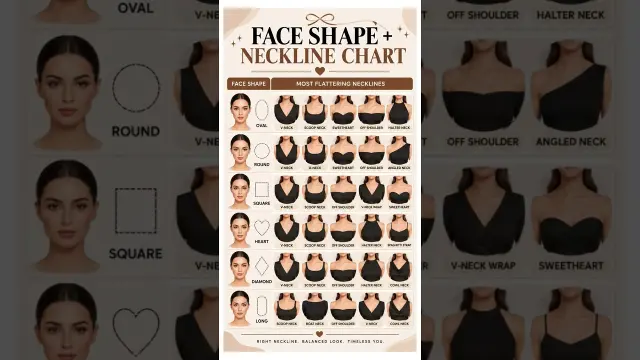
 Face shape and neckline style guide for outfit inspiration
#Neckline Guide
1 ideas
Face shape and neckline style guide for outfit inspiration
Get new #Neckline Guide ideas by email
Every Thursday: the week's best ideas, with the newest from #Neckline Guide.
Related tags
Neckline Guide: Find the Shapes That Suit You
A neckline is the edge of a garment where it meets the neck and shoulders — the line that frames the face before anything else in an outfit is noticed. It is one of the oldest design decisions in clothing: tunics, robes and draped cloth have always had to answer the question of how much to open at the top and in what shape. Today the neckline does practical work as well as decorative work, setting how a garment sits on the shoulders, how cool or covered it feels, and how the eye travels down the body.
The main shapes
Most necklines are variations on a few families.
- Round and scoop: a curved line close to the collarbone. Soft and informal; a deeper scoop draws attention downward.
- V-neck: two straight edges meeting in a point. It lengthens the neck and creates a vertical line through the chest.
- Square: a straight horizontal line across the collarbone with vertical sides. Graphic and structured.
- Boat, or bateau: a wide, shallow curve running almost shoulder to shoulder. It widens the upper body and suits a narrow shoulder line.
- Sweetheart: two curves meeting at the centre, often on dresses. Romantic and softly framed.
- Halter: fabric gathered behind the neck, leaving shoulders and arms bare.
- Off-the-shoulder and one-shoulder: the edge sits below the shoulder line, exposing it.
- Collared and high necklines: shirts, turtlenecks and mock necks, which cover the throat and add a clean band at the top.
Read more
What a neckline does
The shape at the top of a garment changes the proportions of everything below it. A deep V or a long vertical opening makes the upper body read as narrower and taller. A wide horizontal line such as a boat neck or a square neck adds breadth across the shoulders. A high, close neckline concentrates attention on the face and jaw, while an open one spreads it across the chest and collarbone. These are optical effects, not rules about who may wear what — the same neckline reads differently depending on the cut of the rest of the garment, the fabric and how it drapes.
Choosing one
A useful starting point is to notice the shapes already in your face and shoulders, then decide whether you want to echo them or contrast with them. A soft, rounded jawline often sits well beside a V or a square; an angular face can carry a round or sweetheart line. If your shoulders are narrow, a wide neckline balances them; if they are broad, a narrower opening or a V draws the eye inward. A long neck carries a high neckline easily, while a shorter neck often feels freer in a lower, open one.
Practical notes for beginners
- Try garments on rather than judging them on a hanger; a neckline only makes sense on a body.
- Check the neckline against your underwear and layers — straps and edges should sit where you want them.
- Notice whether the edge stays put when you move, reach and sit; a neckline that gapes will keep gaping.
- Consider the occasion: a high neckline reads formal and composed, a wide open one relaxed.
- Trust comfort. If you keep adjusting it, the shape is not working, however good it looks in the mirror.
The best neckline is the one you stop thinking about once you are dressed.
#Neckline Guide: frequently asked questions
Where should I start when choosing a neckline for an outfit?
Begin by looking at the shapes already present in your face and shoulders, then decide whether you want the neckline to echo those shapes or contrast with them. A rounded jawline often sits well beside a V or square opening, while more angular features can carry a soft round or sweetheart line. From there, treat the neckline as the frame for everything else rather than the whole decision.
What should I look at when trying a neckline on?
Judge it on your body rather than on the hanger, because the line only makes sense once it has shoulders and fabric draping under it. Check it against your layers and underwear so straps and edges sit where you want them, then move, reach and sit to see whether the edge stays put. A neckline that gapes while you move will keep gaping, however good it looks standing still.
How do I pick a neckline for my shoulder width?
A wide, shallow line such as a boat or square neck adds breadth across the top, which balances a narrow shoulder line. Broader shoulders tend to read more balanced with a narrower opening or a V, since the vertical edge draws the eye inward. These are optical effects rather than rules, and the cut and fabric of the rest of the garment will change how the same line looks.
Which neckline works for a formal occasion?
A high, close neckline such as a collared shirt or a turtleneck reads composed and formal, and it concentrates attention on the face and jaw. A wide open neckline tends to feel more relaxed and better suited to casual settings. If comfort is a concern, remember that an edge you keep adjusting will distract from the rest of the outfit no matter how formal the shape.
How do I keep a neckline sitting properly over time?
Check the edge early, because a neckline that slips or gapes when new is unlikely to settle into place later. Make sure the garment has room to move with you across the shoulders, and let straps and underlayers sit at the height you actually want them at. Care for the garment as its fabric asks, since a stretched-out edge is hard to bring back once the shape has gone.
What are the most common mistakes people make with necklines?
Buying on sight without trying the piece on is the big one, since a neckline only reveals itself on a body in motion. Another is ignoring the layers underneath, so straps and edges end up sitting somewhere unintended. The last is choosing a shape that looks striking but needs constant adjustment, when the best neckline is the one you stop noticing once you are dressed.
Videos come from YouTube and posts from Instagram; titles and summaries are our own. All rights belong to their creators.