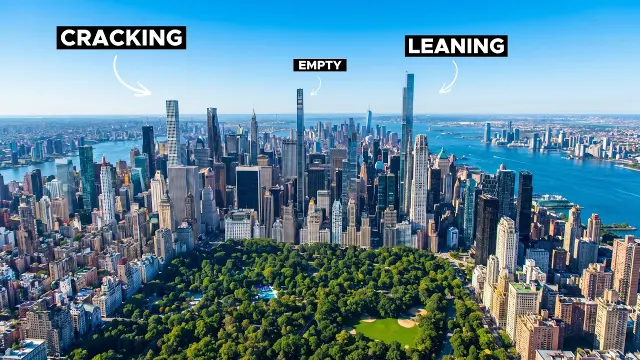
 Five Broken New York Skyscrapers and Their Future
#New York Architecture
1 ideas
Five Broken New York Skyscrapers and Their Future
Get new #New York Architecture ideas by email
Every Thursday: the week's best ideas, with the newest from #New York Architecture.
Related tags
A Beginner's Guide to New York Architecture
New York is one of those cities where architecture is not a background but part of the conversation. Walking a single block can take you past a nineteenth-century row house, a former factory turned apartment building, a church in a European revival style and a glass tower that seems to ignore all of them. Understanding a little about how that mixture came together makes the city far easier to read.
A city built on a grid
Most of Manhattan follows a strict grid of avenues and streets laid out in the early nineteenth century, long before the skyline existed. That regularity is why the city feels navigable, and it also shaped the buildings: narrow lots produced narrow houses, while corner plots and avenue frontages allowed larger, more ornamental facades. Walking east to west across the grid, you cross layers of construction from different eras almost without noticing.
The main building types
Read more
- Brownstones and row houses: attached homes faced in brown or red sandstone, common in Brooklyn, Harlem and the older residential parts of Manhattan. Their stoops, cornices and bay windows do most of the talking.
- Cast-iron and loft buildings: factory and warehouse districts later converted into apartments, studios and shops, with large windows and exposed structure.
- Tenements: dense walk-up housing built for arriving populations, often narrow and deep, now central to debates about preservation and affordability.
- Early skyscrapers: tall buildings that step back as they rise, a shape encouraged by early zoning rules that wanted light and air to reach the street.
- Art Deco and mid-century towers: streamlined ornament, geometric patterns and dramatic crowns on the one hand, plain glass and steel grids on the other.
- Modern and contemporary buildings: glass curtain walls, mixed-use towers and a growing number of conversions and additions to older structures.
What to look for
Look up, but also look at the ground floor. Entrances, shopfronts and the way a building meets the pavement tell you as much as the roofline. Notice the rhythm of windows along a street, the materials, and whether a facade is load-bearing masonry or a thin skin hung over a frame.
Ornament is a good guide to period and ambition: carved stone and terracotta, decorative ironwork, tiled lobbies, then the shift to plain surfaces and glass. Water towers on roofs, fire escapes, and the scars of later alterations all record how a building has been used.
Practical tips for exploring
Pick a neighbourhood rather than a single landmark, and walk it slowly. Compare a historic district with a street of new construction nearby. Read the plaques and the small signs on facades; many buildings quietly announce their architect, builder or original purpose. Look at buildings in different light — morning and late afternoon flatter different materials.
Preservation is a live subject here: not every building survives, and what replaces it is argued over constantly. Learning to see the layers makes you part of that conversation, whether you are admiring a carved cornice or wondering what a plain glass wall will look like in fifty years.
#New York Architecture: frequently asked questions
How should I start exploring New York's architecture if I know nothing about it?
Start with one neighbourhood rather than a checklist of famous landmarks, and walk it slowly enough to notice details. Begin at street level — entrances, shopfronts and how a building meets the pavement — then work your way up to the roofline. That order teaches you more than trying to name styles from a distance.
What details tell me the most about a building's age and purpose?
Materials and ornament are the quickest guides: carved stone, terracotta and decorative ironwork belong to older, more ambitious facades, while plain surfaces and glass arrive later. Look at the rhythm of the windows and whether the wall is thick load-bearing masonry or a thin skin hung over a frame. Rooftop water tanks, fire escapes and patched-over alterations record how the building has been used since.
Which kind of area should I choose for a first architecture walk?
Pick either an older residential district with attached row houses or a former factory and warehouse district converted into lofts, shops and studios — each reads very differently. Better still, walk one of each on the same outing so you can compare how the same city handles old and new side by side. Late afternoon light tends to flatter stone and brick, while morning suits glass and metal.
How can I tell a brownstone row house from a cast-iron or loft building?
Row houses are masonry through and through, usually with a raised stoop, a projecting bay and a decorated cornice at the top. Cast-iron and loft buildings were built for work rather than living, so they show large windows, exposed structural elements and repeating factory-like bays. The giveaway is often the proportion of glass to wall: the industrial building is far more open.
What mistakes do visitors commonly make when looking at New York buildings?
The most common is only looking up at the towers and never noticing the ground floor, where a building reveals its original purpose. Another is rushing a single block instead of staying with it long enough to see how the buildings talk to each other. Finally, don't treat the skyline as fixed — half the interest is in what has been altered, added or replaced.
Why do some old buildings survive here while others get torn down?
Preservation is an ongoing argument in the city, not a settled rule, and older structures are constantly weighed against what could be built in their place. Buildings that anchor a street's character, or that can be adapted to new uses, tend to fare better than ones nobody can find a purpose for. Learning to read the layers of a facade is what lets you follow that debate rather than just watch it.
Videos come from YouTube and posts from Instagram; titles and summaries are our own. All rights belong to their creators.