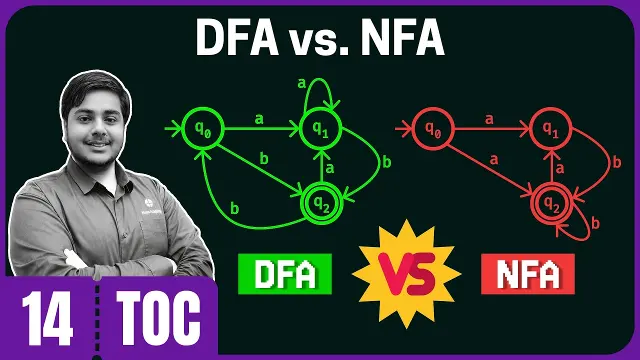
 Comparing Deterministic and Non-Deterministic Automata
#NFA
3 ideas
Comparing Deterministic and Non-Deterministic Automata
 Comprehensive Guide to Finite Automata in Computer Science
 Finite Automata Concepts for Computer Science Exams
Get new #NFA ideas by email
Every Thursday: the week's best ideas, with the newest from #NFA.
Related tags
Nondeterministic Finite Automata Guide
What a nondeterministic finite automaton is
A nondeterministic finite automaton, usually shortened to NFA, is a simple mathematical model used in computer science to describe patterns and processes that can be recognized step by step. It belongs to the family of finite automata, which are machines with a limited number of states. NFAs are especially important in formal language theory, where they help define and study regular languages.
An NFA reads an input string one symbol at a time and moves between states according to its transition rules. What makes it “nondeterministic” is that from a given state and symbol, it may have more than one possible next state, or sometimes no next state at all. In some cases, it can even move without reading a symbol. Because of this, an NFA can be thought of as exploring several possible paths at once.
Where NFAs are used
Read more
NFAs are mainly a theoretical tool, but they are very useful in computer science. They help explain how pattern matching works, how regular expressions are interpreted, and how some kinds of lexical analysis are designed. They also provide a clear way to study the limits of what simple machines can recognize.
In practice, many systems use ideas related to NFAs even if they are not built exactly as NFAs. They are valued because they make it easier to describe languages and patterns in a compact way.
Main ideas and structure
An NFA usually has these parts:
- A finite set of states
- A starting state
- One or more accepting states
- Rules for moving from one state to another based on input symbols
A string is accepted if at least one possible path through the automaton ends in an accepting state after the entire input is read. If no path reaches an accepting state, the string is rejected.
This “at least one path” rule is the key difference from a deterministic finite automaton, or DFA, where there is only one possible move for each symbol in each state.
Deterministic and nondeterministic automata
It helps to compare NFAs with DFAs:
- A DFA has exactly one transition for each symbol from each state
- An NFA may have many transitions, one transition, or none
- Both recognize exactly the same class of languages: regular languages
So even though an NFA seems more flexible, it does not recognize more powerful languages than a DFA. Its value lies in the simplicity and clarity of its design.
What beginners should know
If you are learning NFAs for the first time, focus on tracing paths carefully. It can help to draw the states and follow every possible route the input might take. When epsilon transitions are involved, remember that the machine may change state without consuming a symbol.
A few practical tips:
- Read the input symbol by symbol, but consider all valid transitions
- Keep track of all active states, not just one
- Check whether any path can end in an accepting state
- Practice with small examples before moving to larger ones
Why NFAs matter
NFAs are a core concept in the theory of computation. They help you understand how languages can be recognized with limited memory and how complex-looking patterns can be represented in a compact, formal way. If you are studying automata, formal languages, or compiler design, NFAs are one of the most important building blocks to learn.
Videos come from YouTube and posts from Instagram; titles and summaries are our own. All rights belong to their creators.