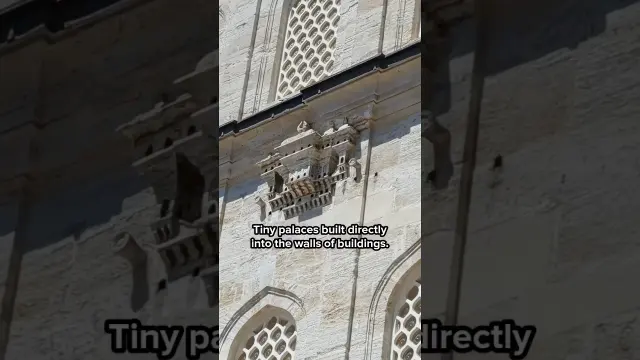
 The Historic Ottoman Bird Palaces Built into Public Buildings
#Ottoman Architecture
1 ideas
The Historic Ottoman Bird Palaces Built into Public Buildings
Get new #Ottoman Architecture ideas by email
Every Thursday: the week's best ideas, with the newest from #Ottoman Architecture.
Related tags
Ottoman Architecture Guide
What Ottoman architecture is
Ottoman architecture is the architectural tradition developed under the Ottoman Empire, beginning in Anatolia and spreading across a wide territory that included parts of Europe, Asia, and the Middle East. It brought together influences from Byzantine, Seljuk, Islamic, and regional building traditions, while creating a clear and recognisable style of its own.
You can see Ottoman architecture in mosques, palaces, baths, caravanserais, bridges, tombs, and public buildings. It is admired for combining monumentality with elegance, and for making practical buildings feel graceful and balanced.
Main features and style
Read more
One of the most familiar features of Ottoman architecture is the central dome, often supported by semi-domes and surrounding smaller domes. This creates a spacious interior and a strong, symmetrical exterior silhouette. Tall minarets are another common feature, especially in mosque design.
Ottoman buildings often use carefully proportioned façades, arches, courtyards, and arcades. Interiors may be decorated with tilework, calligraphy, carved stone, painted ornament, and geometric or floral motifs. Light also plays an important role, with windows arranged to soften the interior and highlight the dome and decorative surfaces.
While some buildings are richly ornamented, others are restrained and refined. The style is not one single look, but a family of approaches that change over time and by region.
Common building types
Mosques are among the most important examples of Ottoman architecture. They were designed not only for prayer, but also as centres of community life, often supported by adjoining schools, kitchens, fountains, or charitable complexes.
Palaces show another side of the tradition, with more emphasis on ceremonial spaces, gardens, pavilions, and layered privacy. Public baths, or hamams, are also a major part of the Ottoman built environment, designed around a sequence of warm, hot, and resting spaces.
Other useful forms include bridges, markets, caravanserais, and tombs. These buildings show how Ottoman architecture was deeply practical as well as artistic.
What to look for as a beginner
If you are learning to recognise Ottoman architecture, start with a few recurring clues:
- large central domes and balanced side volumes
- slender minarets near mosque complexes
- courtyards with arcades or colonnades
- stone or brick construction with elegant proportions
- decorative tilework, calligraphy, and patterned surfaces
- a strong sense of order, harmony, and spatial flow
Try to look at the whole building, not just the ornament. In Ottoman design, structure and decoration usually work together.
How to appreciate it
When you visit or study Ottoman architecture, pay attention to how the building guides movement from outside to inside, from public to private, or from simple forms to more elaborate spaces. Notice how domes shape the room beneath them, how light enters, and how decoration supports rather than overwhelms the structure.
Ottoman architecture is best understood as a living architectural language: practical, spiritual, and visually rich. Once you become familiar with its main forms, you will begin to recognise its influence in many places and in many kinds of buildings.
Videos come from YouTube and posts from Instagram; titles and summaries are our own. All rights belong to their creators.