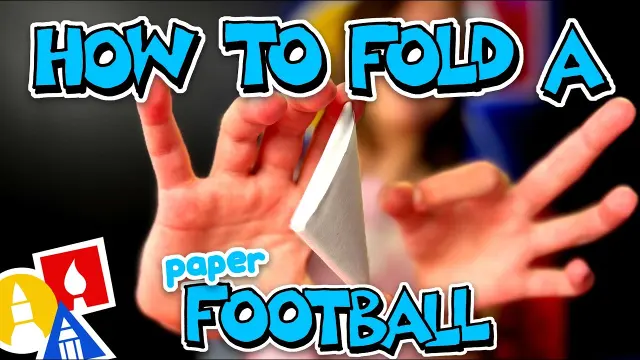
 Origami Tutorial: Folding a Paper Football
#Paper Football
1 ideas
Origami Tutorial: Folding a Paper Football
Get new #Paper Football ideas by email
Every Thursday: the week's best ideas, with the newest from #Paper Football.
Related tags
Paper Football: Folding, Flicking and Tabletop Games
Paper football is one of those small, stubborn games that survives because it costs nothing. All you need is a sheet of paper and a flat surface, and you have a sport. There is no official league, no governing body and no single inventor to point to; it belongs to the long tradition of folk games that children teach each other in classrooms, cafeterias and kitchen tables, and every region seems to have its own house rules.
What the football actually is
The "ball" is a folded paper triangle, usually made from a sheet of notebook paper. The folding is simple: fold the paper in half lengthwise, unfold it, then fold both long edges in to meet that centre crease. Fold the resulting strip in half lengthwise again, then start folding it back on itself in small triangles, like rolling a flag, tucking the final loose corner into the pocket you have created. Done well, the triangle is compact, sits flat and flies straight. Done badly, it is lumpy and veers off the table. Practise the fold a few times and you will feel the difference: crisp creases matter more than force.
How the game is played
Read more
Two players sit across a table. The paper triangle is placed at one edge, and you flick it with a finger, aiming to send it sliding across the surface. The far edge of the table is the goal line. A triangle that comes to rest hanging over the edge counts as a touchdown, worth six points; the player then gets a chance to flick the ball through uprights made by the opponent's fingers for the extra point. If the triangle stops before the edge, play passes to the other player, who flicks it back from where it landed. If it falls off the table, possession changes.
Variations are endless and worth negotiating before you start. Some players allow lifting and tapping the triangle between flicks, some count a touchdown only when the ball overhangs by a certain amount, and some play to a time limit rather than a score.
Tips for beginners
- Fold tightly and symmetrically; a lopsided triangle will not travel straight.
- Flick from the centre of the ball, not the tip, for a controlled push rather than a spin.
- Keep your finger low and follow through gently; brute force usually sends it off the table.
- Use a smooth surface. Rough tabletops grab the paper and kill your shot.
- Agree the rules first, especially what counts as over the edge and whether the ball may be adjusted.
Part of the appeal is that it needs nothing and can be played almost anywhere two people can sit facing each other. Fold a triangle, set your fingers up as goalposts, and the game is already underway.
#Paper Football: frequently asked questions
How do I start playing paper football?
Begin by folding a triangle from a sheet of notebook paper, then sit facing an opponent across a flat table with the ball resting at your edge. Take turns flicking it toward the far edge, and agree on the house rules before the first shot so nobody argues later.
What do I need to play paper football?
Nothing beyond a sheet of paper and a smooth, flat surface like a table or desk. Fingers serve as the goalposts for the extra point, so the whole game fits in whatever space you already have.
Which kind of paper makes the best football?
Ordinary notebook paper is the classic choice because it folds crisply and holds its shape, while flimsy or glossy paper tends to spring open or slide unpredictably. Whatever you use, what matters most is folding tightly and symmetrically so the triangle sits flat and travels straight.
How do I look after a paper football so it lasts?
Keep it flat and unfolded-free rather than crushed in a pocket, since sharp creases are what make it fly true. Once the triangle gets soft, lumpy or lopsided from repeated play, fold a fresh one instead of fighting with the old one.
What are some ideas for when to play paper football?
It suits any stretch of waiting, such as a long meal out, a rainy afternoon indoors or a break between tasks, because it needs no equipment and sets up in seconds. It also works well as a quiet game for keeping younger players entertained without screens.
What mistakes do beginners usually make?
The most common slip is flicking hard from the tip, which sends the triangle spinning off the table instead of sliding forward. Loose, lopsided folds and rough surfaces cause the same problem, and skipping the rule discussion beforehand tends to create confusion mid-game.
Videos come from YouTube and posts from Instagram; titles and summaries are our own. All rights belong to their creators.