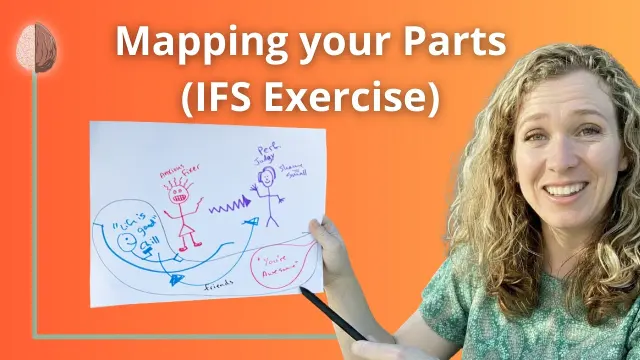
 Mapping Your Parts: An IFS Exercise to Heal Trauma
#Parts Work
7 ideas
Mapping Your Parts: An IFS Exercise to Heal Trauma
 Why You Lose Control of Your Emotions Using IFS Therapy
 Understanding the Science of Parts in IFS Therapy
 Parts Work in IFS: Understanding Protectors and Exiles
 IFS Therapy Blending and Unblending Explained
 How Internal Family Systems Therapy Works
 How to Do Internal Family Systems on Yourself
Get new #Parts Work ideas by email
Every Thursday: the week's best ideas, with the newest from #Parts Work.
Related tags
Parts Work and Internal Family Systems
Parts work is a way of understanding your inner life as made up of different “parts,” each with its own feelings, needs, and protective role. Instead of seeing yourself as inconsistent or broken, this approach invites you to notice that different parts of you may want different things at the same time. One part may want rest, while another pushes you to keep going. One part may feel hurt, while another tries to stay in control.
The best-known form of parts work is Internal Family Systems, often called IFS. It grew out of psychotherapy and draws on the idea that people naturally contain a kind of inner system. In this view, parts are not imaginary in a childish sense; they are a practical way to make sense of inner experience. Many people find the model useful because it creates more curiosity and less self-judgment.
What parts work is for
Parts work can help you notice patterns such as self-criticism, emotional overreaction, avoidance, people-pleasing, or sudden inner conflict. It is often used to explore how protective patterns develop and how they may once have been helpful, even if they feel limiting now. The aim is not to force parts away, but to understand them and respond with more care.
Read more
Main kinds of parts
In IFS language, people often describe three broad kinds of parts:
- Exiles: younger or more vulnerable parts that carry pain, fear, shame, or loneliness
- Managers: parts that try to prevent trouble by keeping life controlled, organized, or approved of
- Firefighters: parts that react quickly when pain breaks through, sometimes through impulsive or numbing behaviors
You do not need to use these exact labels for parts work to be helpful. What matters is noticing that inner reactions often have a purpose.
How to begin
If you want to explore parts work, start gently. You do not need to dig deep all at once. A good first step is to notice a strong reaction and ask:
- What part of me is active right now?
- What is it trying to do for me?
- What is it afraid would happen if it stopped?
- How do I feel toward this part?
Try to listen with curiosity rather than trying to “fix” anything immediately. Many people find it helpful to write down different parts, give them simple names, or notice where they seem to show up in the body.
Practical tips
- Go slowly, especially if a memory or feeling feels intense
- Stay grounded in the present; look around the room and notice your surroundings
- If you feel overwhelmed, pause and return to something steady and familiar
- Remember that compassion matters more than perfect technique
- If parts work brings up distress you cannot manage on your own, consider support from a qualified therapist
Parts work can be a helpful way to relate to yourself with more patience. Over time, it may become easier to understand your inner conflicts not as failures, but as signals from parts of you that want safety, care, and relief.
#Parts Work: frequently asked questions
How do I start parts work if I’m new to it?
Begin by noticing a moment when your feelings seem mixed or intense, and gently ask what part of you is showing up. You do not need to solve anything right away; the first goal is simply to listen with curiosity instead of judgment.
What do I need to practice parts work on my own?
You only need a little quiet time, basic self-reflection, and a willingness to pay attention to your inner reactions. Some people find it helpful to journal, name different parts, or notice where a feeling shows up in the body.
Which type of parts should I pay attention to first?
Start with the part that feels most active in the moment, such as a critical voice, a controlling side, or a part that wants to shut down. From there, you can explore what it is trying to protect and what it fears would happen if it stepped back.
How can I keep parts work from feeling overwhelming?
Go slowly and stay grounded in the present by noticing your surroundings and taking breaks when needed. If something feels too intense, it is okay to pause and return to the work later with more steadiness.
What are common mistakes people make with parts work?
A common mistake is trying to force a part away instead of understanding its purpose. Another is going too deep too quickly, which can make the process feel overwhelming rather than supportive.
Videos come from YouTube and posts from Instagram; titles and summaries are our own. All rights belong to their creators.