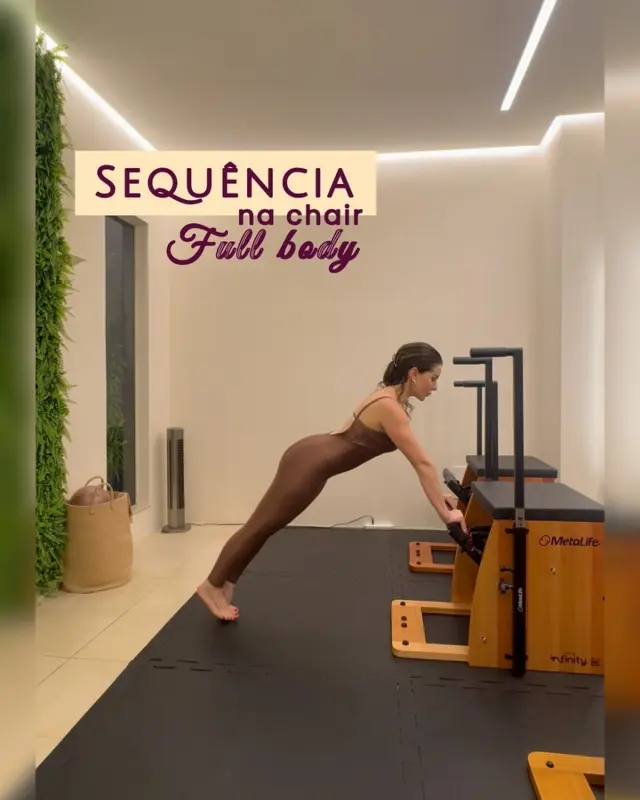
 Challenging pilates chair sequence for core and stability
#Pilates Chair
1 ideas
Challenging pilates chair sequence for core and stability
Get new #Pilates Chair ideas by email
Every Thursday: the week's best ideas, with the newest from #Pilates Chair.
Related tags
Pilates Chair Guide
Pilates chair work is a classic part of the Pilates method, using a compact piece of equipment with pedals and springs to add resistance and challenge balance. It is often called the Wunda chair or Pilates apparatus chair, and it can be used for seated, standing, kneeling, and supported exercises. Because the surface is small and the base of support is limited, the chair asks for steady control, good posture, and careful movement.
What the Pilates chair is used for
The chair is designed to train strength, stability, coordination, and mobility together. It is especially useful for the legs, hips, seat, core, and shoulders, but many exercises also ask the spine to stay long and the breath to stay calm. Unlike larger studio equipment, the chair often feels more direct and demanding, because there is less room for extra movement.
It can be used in several ways:
- to build lower-body strength through presses, lifts, and step-ups
- to challenge balance in standing work
- to support arm and shoulder strength with controlled pressing or holding
- to improve core control through slow, precise transitions
- to practice asymmetrical work, where one side stabilizes while the other moves
Read more
Main styles and approaches
Different Pilates teachers may use the chair in different ways, but the basic idea stays the same: move with control and resist the springs rather than forcing the pedals. Some sessions focus on classical Pilates sequences, while others blend in more contemporary movement patterns or rehabilitation-style support.
Common approaches include:
- seated exercises, which help you organize the trunk and use the legs with control
- standing exercises, which develop balance and whole-body coordination
- kneeling or supported positions, which reduce load while keeping the work precise
- one-sided exercises, which reveal differences in strength or stability from side to side
What beginners should know
The chair can look simple, but it is not always beginner-friendly. The small base and spring resistance can make exercises feel more intense than expected. If you are new to it, start with a teacher who can help you set up safely and choose suitable variations.
Keep these basics in mind:
- move slowly and avoid sudden pressure on the pedals
- keep your spine long rather than collapsing into the lower back or shoulders
- use the breath to help maintain rhythm and control
- choose a lighter starting level if the chair offers spring adjustments
- stop if you feel unstable, and return to a supported version
Practical tips for better chair work
Quality matters more than range. A smaller, well-controlled movement is usually more effective than pushing hard or trying to go deeper than you can manage. Pay attention to your standing foot, your pelvic alignment, and the way your ribs and shoulders are settling.
Helpful reminders:
- press through the whole foot when standing, not just the toes
- keep the knees tracking comfortably over the feet
- avoid locking the joints
- let the arms assist balance without gripping
- practice on both sides, even if one side feels easier
With regular practice, Pilates chair work can become a very effective way to develop strength and stability in a compact, focused format.
Videos come from YouTube and posts from Instagram; titles and summaries are our own. All rights belong to their creators.