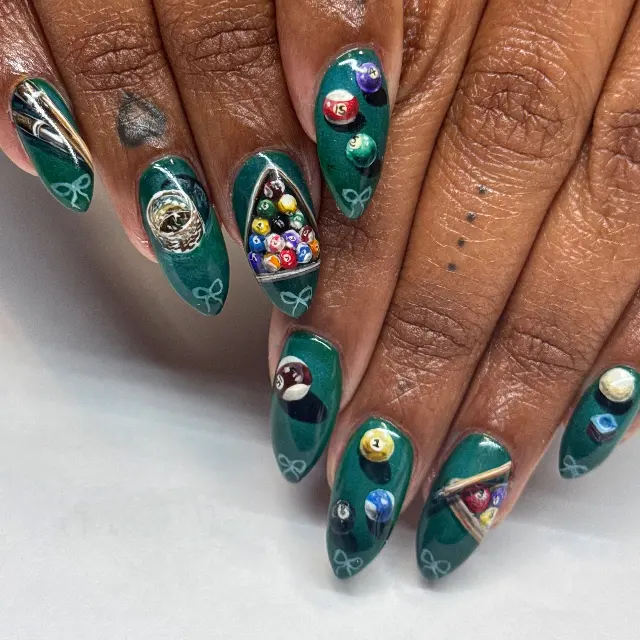
 Hand-painted billiards nail art with a pool table theme
#Pool Table Design
1 ideas
Hand-painted billiards nail art with a pool table theme
Get new #Pool Table Design ideas by email
Every Thursday: the week's best ideas, with the newest from #Pool Table Design.
Related tags
Pool Table Design: Styles, Materials and Room Ideas
A pool table is an unusual piece of furniture. It has to be perfectly flat and true so the balls roll honestly, and it also has to look right standing in a room for years. Good design holds those two demands together — the playing qualities come first, but the frame, the cloth and the proportions are what you actually live with.
What a table is made of
The heart of any serious table is the bed: a slab of slate, ground flat, that gives the balls an even surface and keeps the game consistent. Beneath it, a frame and cabinet carry the weight, which is considerable. Around the bed sit the cushions, usually rubber, which decide how the balls rebound; they are covered by rails fitted with small sights for aiming. The cloth is a woven wool or wool-blend fabric, and its weight and texture affect how fast the balls travel. Pockets are either simple drop pockets or feed a ball-return system inside the cabinet. Legs, aprons and finishes are where design expression lives — but everything above them depends on the bed being level.
Where the table comes from
Read more
Billiards began as an indoor version of outdoor lawn games in Europe, first played on wooden tables, and gradually acquired the slate bed, rubber cushions and standard dimensions that define the modern table. Today the same basic object serves several different games — pool, snooker, carom — each with its own table proportions, cloth and pocket shapes.
The main styles
- Traditional: carved or turned wood, deep stains, leather pockets, heavy silhouettes that suit period interiors.
- Modern minimalist: clean lines, matte finishes, slim rails, concealed ball return.
- Industrial: metal frames and exposed structure paired with reclaimed timber.
- Mid-century: tapered legs, warm woods, low profiles.
- Games-room and pub styles: compact, robust, built for frequent play rather than show.
Size, cloth and room
Tables commonly come in seven, eight and nine foot lengths; smaller tables suit most homes, larger ones give a more generous game. Whatever you choose, measure the room rather than the table — you need clearance for a cue and a full stroke on all four sides, which usually means leaving a good metre and a half free around the rails. Cloth colour is partly practical: darker shades hide chalk dust and marks, lighter ones show wear. A dedicated light above the table, shaded so it does not glare into players' eyes, makes an enormous difference to how the room feels.
Practical advice for a first table
- Check the floor is level and can carry the weight; slate is heavy.
- Buy from someone who will deliver, install and level the table properly.
- Expect to re-cloth and eventually replace cushions — it is normal upkeep.
- Brush the cloth, keep the table out of direct sun, and use a cover when it is idle.
- Think about the table when it is not being played: it is a large object, so let it earn its space with seating, storage or a second use such as a dining top.
The table's graphic shapes — the bright cloth, the pockets, the coloured balls — also travel well beyond the games room, appearing in illustration, textiles and nail art, which is part of why the look stays familiar even to people who never pick up a cue.
#Pool Table Design: frequently asked questions
What should I check in a room before choosing a pool table?
Measure the room rather than the table: you need enough clear space around all four sides for a cue and a full backswing, so shortlist the table only after the room passes that test. Also confirm the floor is level and strong enough to carry a slate bed, since a heavy table on an uneven surface will never play true. Leave a little thought for the light overhead, which should be shaded so it lights the cloth without glaring into players' eyes.
Why is the slate bed so important in pool table design?
The bed is the flat slab the balls roll on, and everything else in the design is arranged around keeping it true. A properly ground slate surface gives an even, consistent roll, while a table built on a weaker bed tends to develop dips and dead spots that no amount of levelling at the legs can fix. That is why the frame and cabinet are judged by how well they hold and support the bed rather than by looks alone.
Which pool table style fits which kind of interior?
Carved or turned wood with deep stains and leather pockets suits period rooms, while slim rails, matte finishes and clean lines sit easily in contemporary spaces. Metal frames with reclaimed timber give an industrial room its anchor, tapered legs and warm woods lean mid-century, and compact robust builds are the practical pick for a busy games room. Choose the look you want to live with, then insist the playing qualities are equal to it.
How do you care for a pool table day to day?
Brush the cloth regularly to lift chalk dust and grit, keep the table out of direct sunlight so the fabric does not fade, and cover it when it is not in use. Re-clothing the bed and eventually replacing the cushions are ordinary upkeep rather than signs of a fault, so plan for them. The cabinet and rails mostly need nothing more than a wipe with a soft cloth suited to their finish.
What mistakes do people make when buying a first pool table?
The commonest is measuring the table instead of the room, which leaves no room to actually play a shot. The second is skipping proper delivery, installation and levelling from someone who knows the job, since a table that arrives perfect can be ruined by a rushed setup. A third is ignoring how the table looks and works when nobody is playing, so give the large object a reason to stay in the room through seating, storage or a second use such as a dining top.
Videos come from YouTube and posts from Instagram; titles and summaries are our own. All rights belong to their creators.