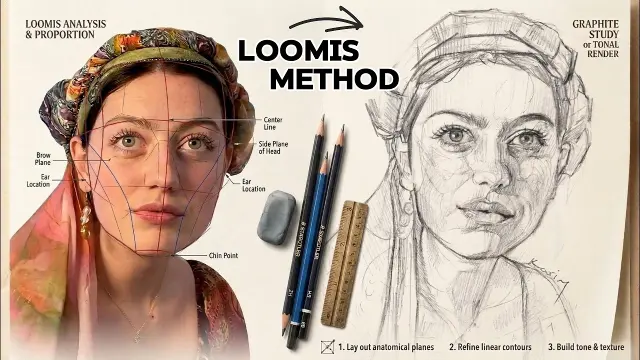
 Step-by-Step Face Drawing Guide Using the Loomis Method
#Portraiture
1 ideas
Step-by-Step Face Drawing Guide Using the Loomis Method
Get new #Portraiture ideas by email
Every Thursday: the week's best ideas, with the newest from #Portraiture.
Related tags
Portraiture: the Art of Depicting People
Portraiture is the art of representing a person’s appearance and character in an image. It can be found in painting, drawing, photography, sculpture, and digital art. At its heart, portraiture is not only about showing a face, but about suggesting presence: expression, personality, mood, and sometimes status or story.
What portraiture is for
People have made portraits for centuries to remember loved ones, record identity, celebrate important figures, or explore human expression. A portrait may be realistic and detailed, or simplified and symbolic. Some portraits aim to look exactly like the subject, while others focus more on emotion, style, or the artist’s interpretation.
Portraiture can show a single face, a half-length figure, or the whole body. It may be formal or casual, posed or candid. In every case, the main goal is to make the subject feel alive and recognizable in some way.
Read more
Main kinds of portraiture
There are many ways to approach portraiture, and each has its own strengths.
- Traditional portraiture often emphasizes likeness, proportion, and a clear view of the face.
- Psychological portraiture focuses on mood, expression, and inner life.
- Environmental portraiture places the subject in a meaningful setting that adds context.
- Formal portraiture tends to be carefully posed and composed.
- Casual or candid portraiture captures people in a more natural moment.
- Self-portraiture is when the artist depicts themselves, often as a study of identity and self-observation.
Each kind can be used in different media, from pencil sketches to oil painting, watercolor, charcoal, or photography.
What matters most
For beginners, the most important things to understand are proportion, structure, and light. The face may seem complex, but it is easier to draw or paint when you think of it as simple forms underneath the features. The head has volume, the eyes sit in the skull, and the nose, mouth, and ears have clear placement relative to each other.
Light is just as important as structure. It helps define the planes of the face and gives the portrait depth. A soft light creates gentle transitions, while stronger light can produce sharper contrast and a more dramatic effect.
Practical tips for beginners
- Start with basic shapes before adding details.
- Compare sizes and distances carefully, especially the spacing of the eyes, nose, and mouth.
- Look at the angle of the head and the direction of the gaze.
- Pay attention to the line of the shoulders, not just the face.
- Work from large shapes to small details.
- Keep the expression natural by avoiding overworking the features.
- Use references when possible, but also observe real people whenever you can.
A few things to remember
A successful portrait is not always the one that looks most polished. Often it is the one that feels most truthful. Small differences in pose, expression, or lighting can change the whole mood of the image. If you are making portraits yourself, be patient and observant. The more carefully you look, the more clearly you will see what makes one person distinct from another.
#Portraiture: frequently asked questions
How do I start making a portrait if I have never tried one before?
Begin with the simplest possible version of the head rather than the features, treating it as a rounded form with a clear up-down axis and a direction of gaze. Get the overall shape and the spacing between the features roughly right before you draw eyes, nose or mouth, and build from big shapes toward small details. Working this way means you are correcting structure instead of erasing finished detail.
Which kind of portraiture should I choose?
Let your purpose decide: if you want an accurate record of someone, a traditional approach with careful likeness and proportion suits best, while a psychological portrait is the better fit when mood and expression matter more than exactness. If the surroundings say something about the person, put them in a setting and work environmentally. Formal posing reads as deliberate, and casual or candid work captures people as they actually behave.
Do I need expensive materials or equipment to make portraits?
No — the medium matters far less than how carefully you observe, and a pencil and paper are enough to study proportion, structure and light. Different media simply give different strengths: dry media like charcoal and graphite are forgiving for blocking in shapes, while paint and photography each bring their own handling of tone and contrast. Start with whatever you already have and let the medium follow what you want to express.
How do I keep a portrait looking like the person instead of a generic face?
Look for the small, specific things — the angle of the head, the direction of the gaze, the line of the shoulders, the slight asymmetries — and protect them rather than tidying them away. Most likeness is lost when the artist keeps refining the features and smooths out the very quirks that made the face recognizable. Stop while the expression still feels natural.
What are the most common mistakes beginners make with portraits?
The usual ones are jumping into eyes and lips before the head's overall shape and proportions are settled, and treating the face in isolation while ignoring the neck and shoulders that carry it. Overworking the features is another frequent slip, since too much fussing makes an expression stiff and lifeless. Light is often forgotten entirely, yet soft and strong lighting produce very different levels of depth and drama.
How do I care for a finished portrait so it lasts?
Keep it out of direct sunlight and away from damp, since both fade and warp paper, canvas and photographic prints over time. Handle works on paper by the edges or with clean hands, store them flat between protective sheets, and frame behind glass or glazing where the piece will be displayed.
Videos come from YouTube and posts from Instagram; titles and summaries are our own. All rights belong to their creators.