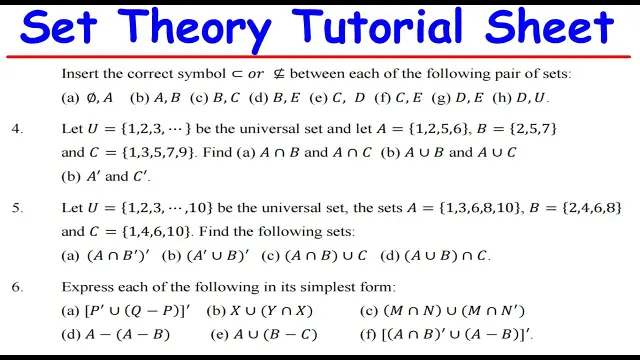
 Set Theory Practice Sheet: Worked Solutions Using Venn Diagrams
#Practice Problems
1 ideas
Set Theory Practice Sheet: Worked Solutions Using Venn Diagrams
Get new #Practice Problems ideas by email
Every Thursday: the week's best ideas, with the newest from #Practice Problems.
Related tags
Practice Problems: How Working Them Out Builds Real Skill
A practice problem is an exercise you solve yourself rather than read through. Where a worked example shows how a method goes, a practice problem asks you to supply the reasoning: to decide what is being asked, choose an approach, carry it out and check the result. The idea is older than any classroom — musicians repeat scales, carpenters build joints on scrap wood — but in academic subjects it takes the form of problem sets, exercise books and past papers.
The point is not to prove you already know something. It is the opposite: solving is how understanding is built. Reading an explanation creates a feeling of familiarity that is easy to mistake for knowledge. Trying to produce the answer without the explanation exposes the gaps — a definition half-remembered, a step skipped, a condition in the problem quietly ignored. That discomfort is the useful part.
Kinds of practice problems
Practice problems come in several flavours, and they do different jobs.
Read more
- Drills repeat one technique until it becomes automatic, so your attention is free for harder thinking later.
- Applied or word problems ask you to translate a situation into the formal language of the subject, which is a separate skill from calculating.
- Proof and derivation exercises, common in set theory, algebra and geometry, ask for justification rather than a number.
- Mixed sets shuffle topics so you must first recognise which method applies.
- Open-ended or extended problems combine several ideas and usually take far longer than a drill.
A good study sequence moves through these roughly in order. Drills first, while the mechanics are shaky; mixed sets once the basics hold, because recognising the right tool is what exams and real work actually demand.
Working through a problem
Begin by restating the problem in your own words, including what you are given and what you must find. Sketch, list or diagram it — a Venn diagram, a table of values, a labelled figure. For set theory problems in particular, drawing the regions and shading what is known turns a wall of symbols into something you can look at.
If you are stuck, write down what you do know and where the chain breaks. Consult a worked example of a *different* problem on the same topic, then return to yours. Give a problem real effort before looking at a solution, but do not grind for an hour out of pride; twenty focused minutes, then a hint, is a better use of time.
Reviewing matters more than solving
Check your answer against the conditions of the problem, not just against a solutions key. A number can be arithmetically correct and still impossible — a probability above one, a set element that was excluded by the premise.
Keep an error log. When you get something wrong, note in one line what you misunderstood, not just the right answer. Returning to those notes before a test is worth more than re-solving problems you already find easy.
Finally, space the practice out. A few problems spread across several days stick far better than the same number done in one long session, and revisiting a topic after a gap is itself a form of testing.
#Practice Problems: frequently asked questions
How do I actually begin a practice problem instead of just staring at it?
Write the question out in your own words first, naming what you have been given and what you are being asked to find. Then turn it into something visual — a diagram, a sketch, a small table of cases — so the relationships are in front of you rather than only in your head. Once the shape of the task is clear, the first step usually suggests itself.
What do I need in order to practise effectively?
A source of problems slightly beyond what you can already do comfortably, plus something to write on and a way to check your work afterwards. The checking part matters as much as the problems themselves: an answer key alone tells you whether you were right, but not why. Keep a short log of the errors you make so the review has something to work from.
Which type of practice problem should I choose first?
Start with repetition of a single technique if the mechanics still feel shaky, because fluency there frees your attention for reasoning later. Move on to problems that mix topics once the basics hold, since recognising which method a question wants is the skill that transfers to exams and real tasks. Save the long, multi-part problems for when you can already sustain a chain of steps without losing the thread.
What should I do when I get stuck partway through?
Write down precisely where the chain of reasoning breaks rather than starting over, and note what you do understand up to that point. Then look at a worked example of a different problem on the same topic — following someone else's solution to your own problem steals the part that teaches you. If it still will not move, take a hint and come back to it fresh rather than grinding away for a long stretch.
How should I go back over problems I have already solved?
Check your answer against the conditions of the original question, not only against the answer key, because a figure can be calculated correctly and still be impossible given the premise. Record in a line or two what misled you when something goes wrong, and reread those notes before a test instead of redoing problems you already find easy. Spreading the practice over several days, with gaps between, also makes the recall do more work.
What mistakes do people make most often when practising?
The commonest is mistaking familiarity for understanding — reading a solution and feeling convinced you could have produced it. The second is practising only what already feels comfortable, which builds confidence without building skill. A third is solving in one long block and never revisiting, so the work fades faster than it would have if it had been spaced out.
Videos come from YouTube and posts from Instagram; titles and summaries are our own. All rights belong to their creators.