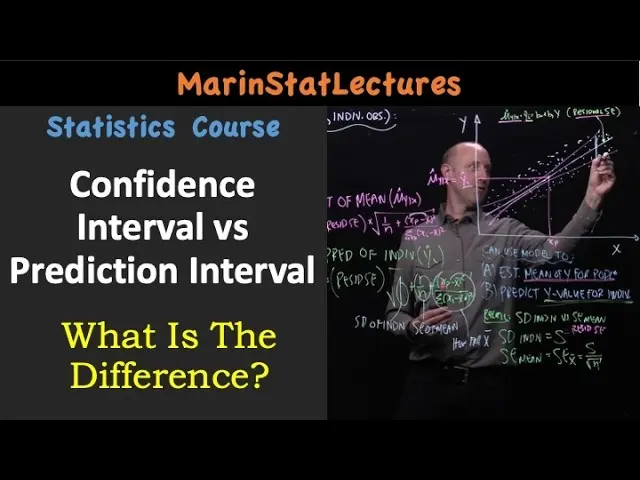
 Confidence Intervals vs Prediction Intervals in Regression
#Prediction Intervals
1 ideas
Confidence Intervals vs Prediction Intervals in Regression
Get new #Prediction Intervals ideas by email
Every Thursday: the week's best ideas, with the newest from #Prediction Intervals.
Related tags
Prediction Intervals: What They Are and How to Use Them
A prediction interval is a range of values within which a future observation is expected to fall, stated with a given probability. If you build a model that forecasts tomorrow's temperature, a delivery time or the price of a house, the prediction interval tells you not just the single number you should expect, but how far off that number is likely to be. It is the honest way to say "around here, give or take" when the world is noisy.
Where the idea comes from
Prediction intervals belong to interval estimation, the branch of statistics concerned with ranges rather than single point estimates. They appear wherever a model is used to forecast something not yet observed: regression, quality control, engineering tolerances, actuarial work and time series forecasting. The same logic has a Bayesian version, the posterior predictive interval, built from the distribution of future values given what has already been seen.
Prediction intervals and confidence intervals are not the same
Read more
This is the distinction that trips up most beginners. A confidence interval describes uncertainty about a population parameter, such as a mean or a slope. A prediction interval describes uncertainty about a single future observation. Because a new observation carries its own random noise on top of any uncertainty about the model, a prediction interval is always the wider of the two, often by a lot. A confidence interval can shrink towards zero as your sample grows; a prediction interval cannot, because the underlying variability of the data never disappears.
Main kinds
- Parametric intervals, which assume a distributional form for the noise, most often a normal distribution around the fitted model.
- Nonparametric and bootstrap intervals, which resample the data to estimate uncertainty without assuming a shape.
- Tolerance intervals, a close relative that covers a specified proportion of a population rather than a single future value.
- Forecast intervals in time series, which typically widen as you project further ahead.
What to watch for
Every prediction interval rests on assumptions. In regression, the usual formulas assume that the scatter of the data around the model is roughly constant and not strongly skewed; if it is not, the interval may be too narrow in some places and too wide in others. Intervals also tend to be less reliable far from the centre of your data, where the model has seen little. When in doubt, check the interval by simulating new data from your fitted model, or by holding data back and seeing how often the actual values land inside the range you predicted.
Practical tips
Always state the level alongside the interval; a range without a probability means little. Do not read a prediction interval as a guarantee for any single case, since by design a small share of future values will fall outside it. And keep the question clear in your head: if you are asked how well you know the average, you want a confidence interval; if you are asked what will happen next time, you want a prediction interval.
Videos come from YouTube and posts from Instagram; titles and summaries are our own. All rights belong to their creators.