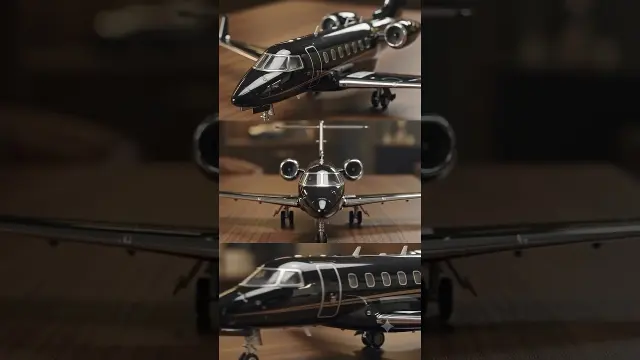
 Unboxing a Luxury Private Jet Diecast Scale Model
#Private Jet
1 ideas
Unboxing a Luxury Private Jet Diecast Scale Model
Get new #Private Jet ideas by email
Every Thursday: the week's best ideas, with the newest from #Private Jet.
Related tags
A Beginner's Guide to Private Jets
A private jet is an aircraft flown for a single group of travellers instead of selling seats one by one. You choose the departure point, the time and often the airport itself, and you share the cabin only with the people you invited. It is less a luxury object than a way of moving a small group point to point without the rituals of a big terminal — though the comfort that comes with it is real.
Where it comes from
Business aviation grew out of the years after the Second World War, when a great many capable light aircraft and, later, small turbine engines became available. What began as air-taxi work and short company hops gradually turned into a recognised way of flying, with its own airports, operators and rules. The idea has stayed remarkably constant since: a small aeroplane, a short runway, a schedule set by the passenger.
The main sizes
Read more
Private aircraft are usually grouped by cabin size and range.
- Turboprops: propeller-driven, economical on short hops, often able to use small airfields.
- Light and very light jets: compact cabins for a handful of passengers on regional trips.
- Midsize and super-midsize: stand-up headroom, more luggage space, comfortable for longer legs.
- Large and long-range jets: separate cabins, berths, full galleys, capable of intercontinental flights.
Ways to fly
Charter means hiring an aircraft and crew for one trip; it suits occasional travel and gives you the widest choice of aircraft. A jet card works like a prepaid account with a fixed hourly rate. Fractional ownership buys a share of one aircraft with a set number of hours a year. Whole ownership suits those who fly often enough to justify a crew, hangarage and management. Each step up trades flexibility for commitment.
On board and on the ground
Private flights usually leave from fixed-base operators rather than main terminal buildings, so you arrive shortly before departure and board quickly. Luggage limits are set by the aircraft's weight and hold size, not by a standard allowance, so ask early. Catering, pets and ground transport can all be arranged in advance. Cabins vary enormously: club seating, divans, folding tables, a galley, sometimes a bedroom. Connectivity is not guaranteed on every aircraft, so confirm it if you need to work.
What to weigh up
The honest answer is that private flying saves time and removes friction, and costs a great deal per flight; it makes most sense for groups travelling together on routes poorly served by airlines. It also carries a heavier climate cost per passenger than a full scheduled flight, which is why some operators offer offsetting and why flying empty legs or sharing a charter is worth considering. Turbulence, weather delays and diversion rules apply just as they do anywhere else.
Finally, plenty of people enjoy private aviation from the ground: scale models, cabin design, liveries and the sight of a sleek fuselage on a quiet apron. Collecting diecast aircraft is a gentle, affordable way into the subject — a good place to start before you ever step aboard.
#Private Jet: frequently asked questions
How do I start with private jet travel if I've never flown privately before?
Begin by being clear about the trip itself: how many people are travelling, which city pairs you need, and how much luggage you'll bring. From there, a charter is usually the simplest entry point, since you hire an aircraft and crew for a single trip without committing to anything longer. Ask the operator early about airports, luggage limits and catering so nothing is decided at the last minute.
What's the difference between charter, a jet card, fractional ownership and buying a whole aircraft?
Charter suits occasional travel and gives you the widest choice of aircraft for each trip, while a jet card works like a prepaid account at a fixed hourly rate. Fractional ownership buys a share of one aircraft with an agreed amount of flying time each year, and whole ownership only makes sense if you fly often enough to justify a crew, hangarage and management. Each step up trades flexibility for commitment, so match the option to how you actually travel rather than to how often you'd like to.
Which size of private aircraft should I choose?
The right choice comes down to range, cabin space and the airports you need to reach. Turboprops and light jets handle short regional hops and small airfields well, midsize cabins add headroom and luggage room for longer legs, and large or long-range jets give separate cabins and galleys for intercontinental trips. Pick the smallest aircraft that comfortably covers your route and group — that is usually the most sensible fit.
What should I know about airports, luggage and boarding on a private flight?
Private flights typically leave from fixed-base operators rather than main terminals, so you arrive shortly before departure and board quickly. Luggage is limited by the aircraft's weight and hold size rather than a standard allowance, so ask about it early. Catering, pets, ground transport and onboard connectivity can all be arranged, but none of it is automatic — confirm what you need in advance.
What are the common mistakes people make when flying privately?
The usual ones are booking an aircraft too small for the group's luggage, assuming every cabin has reliable connectivity, and leaving catering or ground transport to the last minute. Another is treating private aviation as cost-free convenience: it saves time and removes friction, but it carries a high cost per flight and a heavier climate impact per passenger than a full scheduled flight. Flying empty legs, sharing a charter or choosing the right aircraft size all help keep a trip sensible.
Can I enjoy private aviation without ever flying privately?
Yes — plenty of people follow the subject from the ground through cabin design, liveries, aviation photography and aircraft spotting. Collecting diecast scale models is an affordable and gentle way in, and unboxing a detailed model is a good introduction to how a cabin and fuselage are put together. It is a pleasant place to start before you ever step aboard a real one.
Videos come from YouTube and posts from Instagram; titles and summaries are our own. All rights belong to their creators.