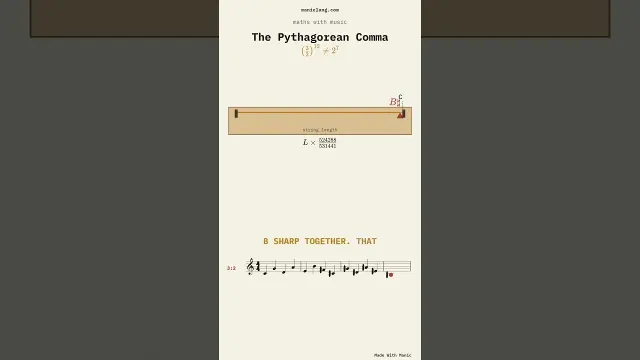
 The Pythagorean Comma Explained Through Twelve Perfect Fifths
#Pythagoras
2 ideas
The Pythagorean Comma Explained Through Twelve Perfect Fifths
 Visualizing the Pythagorean Comma With a Laser and Mirror
Get new #Pythagoras ideas by email
Every Thursday: the week's best ideas, with the newest from #Pythagoras.
Related tags
Pythagoras and His Mathematical Legacy
Who Pythagoras was
Pythagoras is one of the best-known figures from ancient Greek thought. He is remembered both as a philosopher and as the name behind a famous mathematical theorem. His ideas became linked with number, harmony, geometry, and the belief that patterns in the world can be understood through proportion and order.
What makes Pythagoras especially enduring is that his name stands for more than one idea. In mathematics, it is most often connected with the relationship between the sides of a right triangle. In music, it is associated with the study of simple numerical ratios and harmony. In philosophy, it suggests a way of looking at the world through structure and balance.
The Pythagorean theorem
Read more
The best-known idea linked to Pythagoras is the theorem about right triangles: the square of the longest side equals the sum of the squares of the other two sides. This principle is used whenever you need to find a missing side in a right triangle or check whether three lengths can form one.
You may meet it in geometry, construction, design, navigation, and many other practical settings. Even if you do not work with formulas every day, the theorem is useful because it gives a reliable way to understand space and distance.
For beginners, it helps to remember a few simple points:
- It applies only to right triangles.
- The longest side is opposite the right angle.
- The two shorter sides are often called the legs.
- It works with exact values, but also with approximations when needed.
Pythagoras and number relationships
Beyond geometry, Pythagoras is also connected with the idea that numbers reveal relationships in nature. One of the most interesting areas is music, where simple ratios between lengths or frequencies can create pleasing intervals. This is part of the wider Pythagorean tradition of linking mathematics and harmony.
That is why the name Pythagoras appears not only in geometry but also in discussions of musical tuning and numerical patterns. A famous example is the Pythagorean comma, a small mismatch that appears when tuning by stacking perfect fifths. It shows how mathematical ideals and real systems can differ slightly.
Why Pythagoras still matters
Pythagoras remains important because his name represents a bridge between abstract thought and practical use. The theorem named after him is one of the first major ideas many people learn in mathematics, and for good reason: it is both simple and powerful. It also opens the door to deeper ideas in geometry, ratio, and logical proof.
If you are just getting started, the best approach is to see Pythagoras as more than a single formula. Think of him as a symbol of ordered thinking: using clear relationships to make sense of shape, space, and sound. That is what has kept his name alive for so long.
Videos come from YouTube and posts from Instagram; titles and summaries are our own. All rights belong to their creators.