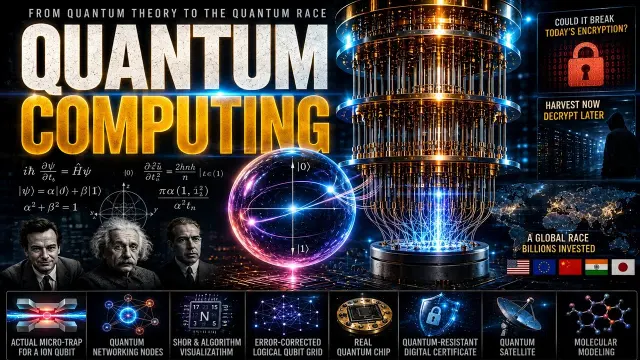
 Quantum Computing Explained from Theory to Hardware
#Quantum Algorithms
1 ideas
Quantum Computing Explained from Theory to Hardware
Get new #Quantum Algorithms ideas by email
Every Thursday: the week's best ideas, with the newest from #Quantum Algorithms.
Related tags
Quantum Algorithms Guide
Quantum algorithms are step-by-step methods designed to run on a quantum computer. They use the unusual behavior of quantum bits, or qubits, to process information in ways that are different from ordinary computers. While a classical computer works with bits that are either 0 or 1, a quantum computer can use superposition and entanglement to explore many possibilities at once. That does not mean it is always faster for every task, but for some problems it can offer a real advantage.
The idea comes from quantum mechanics, the branch of physics that describes how very small particles behave. In the early development of quantum computing, researchers realized that if information could be encoded in quantum states, then certain calculations might be done more efficiently. From there, quantum algorithms were developed to test what kinds of problems benefit from this model. Some are famous for showing clear speedups in specific cases, while others are designed to solve search, simulation, optimization, or machine learning-related tasks.
How quantum algorithms work
A quantum algorithm usually starts by preparing qubits in a known state. It then applies a sequence of quantum operations, often called gates, to shape the probabilities of the outcomes. Because quantum states can interfere with each other, the algorithm is built to increase the chance of the correct answer and reduce the chance of the wrong one.
Read more
Measurement is the final step. This is important to understand: you do not read all the hidden possibilities directly. Instead, the quantum state collapses to a single result when measured, so the algorithm must be carefully designed to make useful answers more likely.
Main kinds of quantum algorithms
Some quantum algorithms are built for broad mathematical tasks, while others target very specific problems.
- Search algorithms try to find an item in a large unsorted set more efficiently than a classical brute-force search.
- Factoring and number-related algorithms explore arithmetic problems that are hard for traditional computers.
- Simulation algorithms are used to model quantum systems, which is a natural fit because nature itself is quantum.
- Optimization algorithms aim to find good solutions among many possibilities, often when the best answer is hard to calculate directly.
- Quantum machine learning methods adapt ideas from data science to the quantum setting, though many are still experimental.
What beginners should know
If you are new to the topic, it helps to keep a few things in mind. Quantum algorithms are not magic shortcuts for every problem. They can be powerful, but only for certain kinds of tasks, and they often require carefully prepared input and error-free hardware. Real quantum devices are also sensitive to noise, which makes many algorithms difficult to run in practice.
It is useful to think of quantum algorithms as tools with a narrow but interesting range. When the structure of a problem matches the strengths of quantum computing, the algorithm can be elegant and effective. When it does not, a classical method may still be simpler and better.
Practical tips for learning the topic
- Start with the basic ideas of qubits, superposition, and measurement.
- Learn why interference matters, since it is central to most quantum algorithms.
- Focus on the problem the algorithm is solving, not just the math behind it.
- Compare each quantum method with a classical approach to understand its value.
- Be patient: many quantum algorithms are conceptually simple, but their behavior can take time to grasp.
Quantum algorithms are one of the most important parts of quantum computing because they show what this new kind of machine may eventually do best.
Videos come from YouTube and posts from Instagram; titles and summaries are our own. All rights belong to their creators.