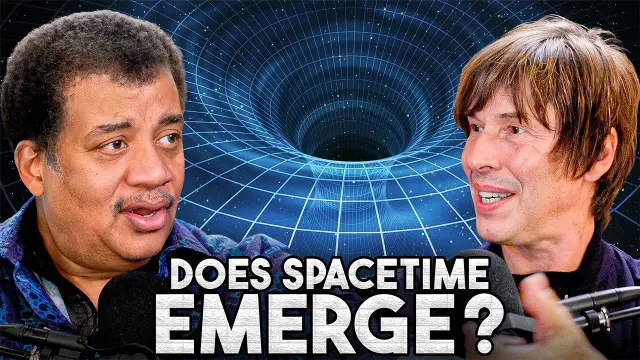
 Is Spacetime Fundamental, or is it Emergent? With Brian Cox
#Quantum Mechanics
2 ideas
Is Spacetime Fundamental, or is it Emergent? With Brian Cox
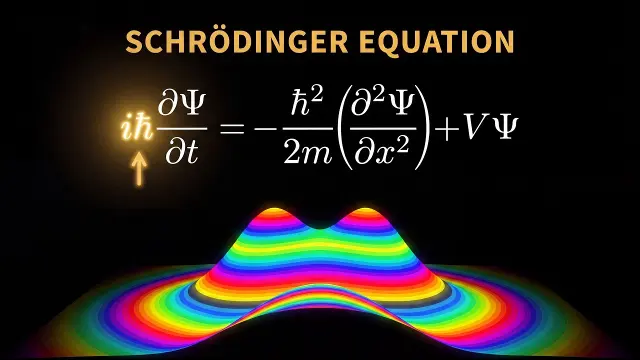 Understanding The Physics Of Schrödinger's Equation
Get new #Quantum Mechanics ideas by email
Every Thursday: the week's best ideas, with the newest from #Quantum Mechanics.
Related tags
Quantum Mechanics Explained
Quantum mechanics is the branch of physics that describes matter and energy at very small scales, such as atoms, electrons, and photons. It was developed to explain observations that classical physics could not fully account for, especially the behavior of particles in the microscopic world. At that scale, nature does not always act in the intuitive way we experience in everyday life.
What quantum mechanics studies
In classical physics, an object has a definite position, speed, and path. In quantum mechanics, the description is less direct. Instead of following a single exact route, a particle is described by a mathematical state that gives the probabilities of different outcomes. This does not mean everything is random without rules. It means the rules are different from the ones that govern large objects.
Quantum mechanics is used to understand the structure of atoms, the way light interacts with matter, and the behavior of many modern technologies. It is also a foundation for fields such as chemistry, materials science, and parts of electronics.
Read more
Where it comes from
The theory emerged in the early 20th century as scientists tried to explain results that did not fit older models. Questions about radiation, atomic structure, and the behavior of light led to a new framework. Over time, this framework grew into a broad and highly successful theory of nature at small scales.
Main ideas
Some of the best-known ideas in quantum mechanics are:
- Wave-particle duality: particles such as electrons and light can show both wave-like and particle-like behavior.
- Quantization: certain physical quantities can take only specific values, rather than any value at all.
- Superposition: a quantum system can be described as a combination of possible states until it is measured.
- Uncertainty: there are limits to how precisely some pairs of properties can be known at the same time.
- Measurement: observing a system plays a special role in determining the outcome we see.
These ideas can feel unfamiliar because they do not match everyday intuition. Still, they form a consistent framework that has been tested in many ways.
Common kinds of quantum ideas
Quantum mechanics includes several major approaches and related topics. You may hear about:
- Wave functions, which describe the state of a system
- Schrödinger’s equation, which shows how that state changes over time
- Quantum states and observables, which connect the math to measurable results
- Quantum fields, in more advanced physics, where particles are treated as excitations of fields
For beginners, it helps to think of quantum mechanics as a language for describing possibilities, not just certainties.
What beginners should know
If you are new to the subject, do not worry if the concepts feel abstract at first. A solid starting point is to focus on the meaning of probability, waves, and measurement. Mathematical details can come later. The important thing is to accept that quantum theory is not simply a smaller version of classical physics. It is a different framework with its own rules.
Practical way to approach it
When learning quantum mechanics, start with simple systems such as a particle in a box or the hydrogen atom. These examples show how the theory works without becoming overwhelming. It also helps to keep separate the physical idea and the mathematical model: the equations are tools for predicting outcomes, while the interpretation can take more time to understand.
Quantum mechanics is one of the most important scientific theories ever developed, because it explains how the microscopic world behaves and helps us understand much of the matter and technology around us.
Videos come from YouTube and posts from Instagram; titles and summaries are our own. All rights belong to their creators.