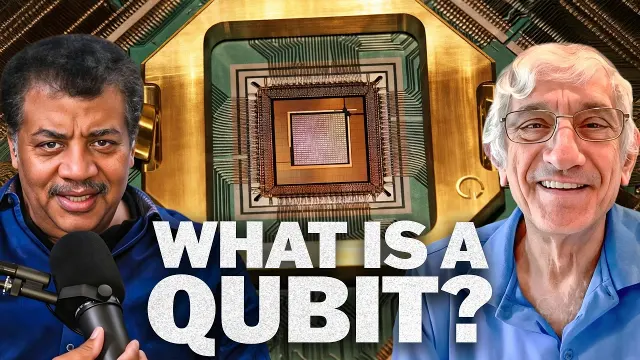
 Nobel Laureate John Martinis on Quantum Tunneling and Computing
#Quantum Tunneling
1 ideas
Nobel Laureate John Martinis on Quantum Tunneling and Computing
Get new #Quantum Tunneling ideas by email
Every Thursday: the week's best ideas, with the newest from #Quantum Tunneling.
Related tags
Quantum Tunneling: How Particles Pass Through Walls
Imagine throwing a ball at a wall. If the ball is not thrown hard enough, it bounces back — every time, no exceptions. Now shrink that ball down to the size of an electron and something remarkable happens: every so often, it turns up on the other side. Not by breaking through, not by going over, but by simply appearing where it should not have been able to reach. That is quantum tunneling.
What it actually means
In quantum physics, a particle is not a tiny billiard ball but a wave of probability spread through space. When that wave meets an energy barrier — a region it classically has too little energy to cross — the wave does not stop abruptly at the edge. It dies away inside the barrier, and if the barrier is thin enough, a small part of it emerges on the far side. A smaller surviving wave means a lower chance of finding the particle there, but the chance is never quite zero. The thinner and lower the barrier, the more likely the crossing. This is why tunneling is common on the scale of atoms and almost invisible on the scale of everyday objects: for a thrown ball the probability is so absurdly small that it can be treated as impossible.
Why it matters
Read more
Tunneling is not a curiosity. It is written into the way the world works. The sun and other stars shine because protons overcome their mutual electrical repulsion and fuse — a process that only proceeds at a useful rate thanks to tunneling. Radioactive decay of certain nuclei happens the same way, with particles escaping a barrier that should hold them. Chemistry is full of it too: many reactions, including some catalysed by enzymes, proceed faster than classical physics would allow because atoms and protons tunnel through the energy hill instead of climbing it.
Where you meet it
Several familiar technologies depend on tunneling directly.
- Tunnel diodes exploit the effect to switch very quickly in electronic circuits.
- Scanning tunnelling microscopes pass a tiny current between an ultra-fine tip and a surface; because that current is exquisitely sensitive to distance, it can map individual atoms.
- Flash memory stores data by trapping electrons behind an insulating barrier and later letting them tunnel out — the erase step in the devices you carry around every day.
If you are just starting out
Do not try to picture tunneling as a particle digging a hole; the mental image leads you astray. Think instead in terms of probability amplitudes and thin barriers. A little mathematics — the idea of a wavefunction and exponential decay inside a barrier — goes a long way, and the standard textbook example of a particle hitting a rectangular barrier is worth working through by hand at least once. Accept that some questions, such as exactly when a tunneling event will occur, have no precise answer; only probabilities do. That discomfort is not a gap in your understanding. It is the physics.
#Quantum Tunneling: frequently asked questions
What do I need to understand before quantum tunneling starts to make sense?
You need two ideas first: that a particle is described by a wavefunction rather than a solid little object, and that this wave dies away gradually inside a barrier instead of stopping dead at its edge. Working through the standard textbook case of a particle meeting a rectangular barrier by hand is the fastest way to see how those two ideas fit together. A little mathematics goes a long way here, and it is worth more than reading many explanations without doing the calculation.
Which mental picture of tunneling should I choose?
Think of a probability wave spreading through space and leaking a small surviving part onto the far side of a barrier. The tempting image of a particle digging a tunnel or squeezing through a gap is misleading, because nothing is actually travelling through the barrier in that way. The wave picture also explains why the effect depends on how thin and how low the barrier is.
Why does tunneling never seem to happen to things I can see and touch?
The chance of a particle appearing beyond a barrier drops extremely fast as the object gets heavier and the barrier gets wider or taller. For something like a thrown ball the probability is so unimaginably small that treating it as impossible costs you nothing in practice. On the scale of electrons and atoms, the same barrier is thin enough that the crossing becomes routine.
Where does tunneling actually show up in everyday technology?
It sits behind tunnel diodes that switch rapidly in circuits, and behind scanning tunnelling microscopes, whose tiny current is so sensitive to distance that it can map a surface atom by atom. It also drives flash memory, where electrons are held behind an insulating barrier and later released by tunneling when data is erased. So several things you carry around rely on it directly.
What are the most common mistakes beginners make with tunneling?
The usual ones are imagining a particle boring a hole, and expecting to be told exactly when a tunneling event will happen. Physics gives you probabilities here, not schedules, so wanting a precise moment is a misunderstanding rather than a gap in the theory. Another frequent slip is forgetting that the barrier's thickness and height, not the particle's speed alone, set how likely the crossing is.
Videos come from YouTube and posts from Instagram; titles and summaries are our own. All rights belong to their creators.