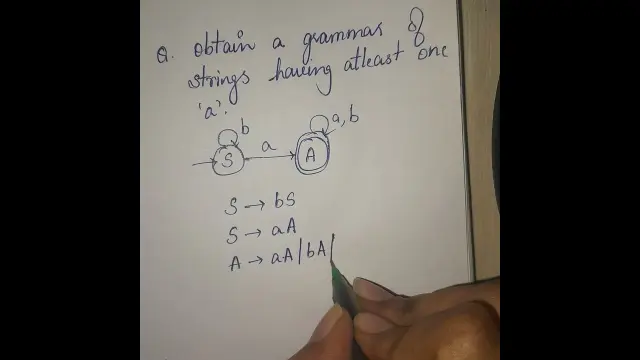
 Grammar for Strings Having At Least One Character A
#Regular Grammar
1 ideas
Grammar for Strings Having At Least One Character A
Get new #Regular Grammar ideas by email
Every Thursday: the week's best ideas, with the newest from #Regular Grammar.
Related tags
Regular Grammar Explained Simply
Regular grammar is a formal way of writing rules for building strings in a language. It belongs to the study of formal grammars in mathematics and computer science, where languages are described with precise symbols rather than everyday words. You may meet it when learning about automata, compilers, or the theory of languages.
What regular grammar is
A regular grammar uses production rules that follow a very restricted pattern. These rules are simple enough that the set of strings they generate can also be recognized by a finite automaton. That close connection is what makes regular grammar important: it gives a compact, structured way to describe regular languages.
In a regular grammar, each rule typically has one nonterminal symbol on the left side, and on the right side it may have a terminal symbol, possibly followed or preceded by one nonterminal. The exact form depends on whether the grammar is right-linear or left-linear.
Read more
Main kinds
The two common forms are:
- Right-linear grammar: rules usually look like A → aB or A → a or A → ε
- Left-linear grammar: rules usually look like A → Ba or A → a or A → ε
Here:
- A and B are nonterminal symbols
- a is a terminal symbol
- ε represents the empty string
A grammar is called regular if all of its production rules follow one of these linear forms. In many basic settings, mixing left-linear and right-linear rules in the same grammar is avoided, since that can make the structure less straightforward.
What regular grammar is used for
Regular grammars are used to describe simple patterns in strings. They are especially useful when the order of symbols matters, but the language does not need nested structure or memory beyond a finite amount.
They are closely related to:
- regular expressions
- finite automata
- regular languages
Because of this, regular grammar often appears in introductory theory courses and in the early stages of language design and parsing.
What to know as a beginner
If you are new to regular grammar, it helps to remember three ideas:
- It is more limited than general grammar systems.
- It can describe only languages that do not require matching long-range dependencies, such as balanced nesting.
- It is equivalent in power to finite automata and regular expressions.
That means regular grammar is good for simple repetition, optional elements, and fixed sequences, but not for patterns that need counting or recursive matching beyond its limited form.
Practical tips for working with it
When you write or check a regular grammar, ask yourself:
- Does every rule follow the required linear form?
- Are terminals and nonterminals placed correctly?
- Can the empty string be produced only when intended?
- Does the grammar stay in one direction, right-linear or left-linear, for clarity?
If you are converting between a regular grammar and a finite automaton, it often helps to trace one symbol at a time. Each nonterminal can be thought of as a state, and each terminal as a transition leading to another state or to acceptance.
Regular grammar is simple by design. That simplicity is exactly what makes it useful: it gives you a clean, exact way to describe many small language patterns without unnecessary complexity.
Videos come from YouTube and posts from Instagram; titles and summaries are our own. All rights belong to their creators.