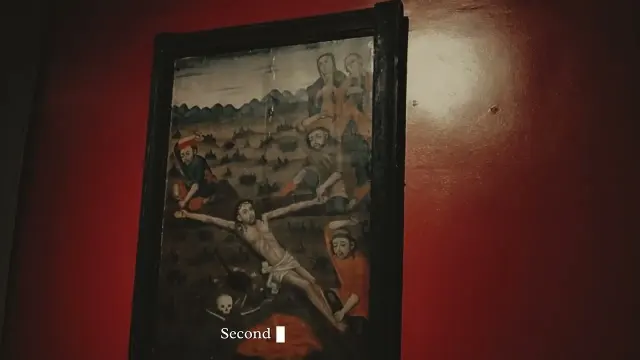
 Via Crucis Art and the Chocolate Hills of Bohol
#Religious Art
1 ideas
Via Crucis Art and the Chocolate Hills of Bohol
Get new #Religious Art ideas by email
Every Thursday: the week's best ideas, with the newest from #Religious Art.
Related tags
Religious Art: A Beginner's Guide to Symbol, Craft and Devotion
Religious art is art made to serve faith: to teach, to inspire devotion, to mark sacred time, or simply to give shape to something people believe but cannot see. It appears across nearly every culture and belief system, and it is one of the oldest kinds of creative work we know of, appearing long before art was made purely to be admired.
A universal impulse, many traditions
Different religions answer the question of images in very different ways. Some traditions fill their worship spaces with figures, stories and ornament. Others, such as many schools of Islamic and Jewish practice, hold to aniconism and turn toward geometry, calligraphy and pattern instead of representational figures. Buddhism and Hinduism have vast, deeply codified iconography, where posture, gesture, colour and the objects held by a figure each carry meaning. Christian art spans icons, manuscript illumination, stained glass, sculpture, panel painting, vestments and metalwork.
Where it comes from
Read more
Religious art rarely begins as decoration. It begins as function. Early images were made for ritual, for burial, for teaching a story to people who could not read, or for marking a space as sacred. Over centuries this work absorbed everything around it: local craft traditions, the materials available, the ambitions of patrons, and the skills of the people who made the objects. That is why a single religious theme can look wildly different in one country and another, and why the same subject has been reinterpreted in styles as varied as mosaic, folk carving and modern abstraction.
The main kinds and techniques
You will encounter several broad groups. Devotional images made for prayer or meditation; narrative works that tell the stories of a faith; liturgical objects and vestments used in worship; and architectural art, from windows and carved doors to the painted ceilings of temples and churches. The techniques follow the setting: fresco and mosaic for walls, tempera and oil for panels, carving in wood and stone, embroidery for textiles, and printmaking for affordable images meant to circulate and be hung at home. Folk and vernacular traditions matter enormously here too, often producing some of the most distinctive and personal work.
What beginners should know
The first thing to learn is that these images are usually legible. Figures carry attributes, objects and colours that signal who they are and what they stand for. Halos, garments, animals, plants, hand gestures and the arrangement of figures in a composition all do specific work. If you learn a handful of these conventions, the picture opens up.
Second, look for the purpose behind the object. A private devotional image is made for close, slow looking; a window is made to be read in changing light; a processional object is made to be carried and seen from a distance.
Third, approach with care. Much of this art is still in active use, and many objects were made for hands and bodies rather than for display cases. When you visit a place of worship, dress and behave accordingly, ask before photographing, and treat what you see as belonging to someone's practice rather than as a curiosity.
If you want to study it properly, choose one theme and follow it across cultures. You will learn more from watching a single motif change than from trying to hold the whole subject at once.
#Religious Art: frequently asked questions
How do I start learning about religious art if I know nothing about it?
Start by picking one theme — a figure, a story, or a symbol — and follow it across several traditions rather than trying to absorb the whole field at once. Learn the basic visual conventions first: halos, gestures, colours and the objects a figure holds usually tell you who it is and what it stands for. Once those read clearly, the images stop feeling closed off.
What do I actually need to begin collecting or displaying religious art at home?
You mainly need a little context and a place that suits the object — a small print or carving made for private devotion reads very differently up close than a large piece meant for a public hall. Ask about the object's origin and whether it was made for use in worship, since some pieces carry expectations about handling. Keep it simple at first and let your understanding grow with the collection.
Which kind of religious art should I choose?
Choose by what the object was made to do, not by style alone: a quiet image for prayer, a narrative scene that tells a story, a liturgical object, or architectural work such as windows and carved doors. Private devotional pieces reward slow, close looking, while processional and architectural works are designed to be seen from a distance and in motion. Matching the purpose to how you will actually live with the piece usually gives the best answer.
How should I care for religious art, especially older or handmade pieces?
Treat it as something that belongs to a living practice rather than as a curiosity, and handle it as little as possible. Textiles, wood, pigment and gilding are all sensitive to light, damp and touch, so keep pieces out of direct sun and steady humidity. If a work is still in ritual use or is unusually old, ask the community or a conservator before you intervene.
Where can I find ideas for a religious art piece for a particular occasion or space?
Look at how the tradition you have in mind marks that occasion — the colours, symbols and scenes it favours will suggest a subject quickly. Then look at how the same subject has been handled in different crafts, from carving and embroidery to printmaking and modern abstraction, since folk and vernacular traditions often produce the most personal versions. A single well-chosen motif usually carries more weight than a crowded composition.
What are the common mistakes people make when looking at or buying religious art?
The most frequent mistake is reading the image literally and missing its coded language, which makes the work seem decorative when it is actually saying something specific. Another is treating an object made for worship as pure décor, without asking how it was meant to be used or seen. Finally, many people try to learn the entire subject at once instead of following one theme deeply — the second approach teaches far more.
Videos come from YouTube and posts from Instagram; titles and summaries are our own. All rights belong to their creators.