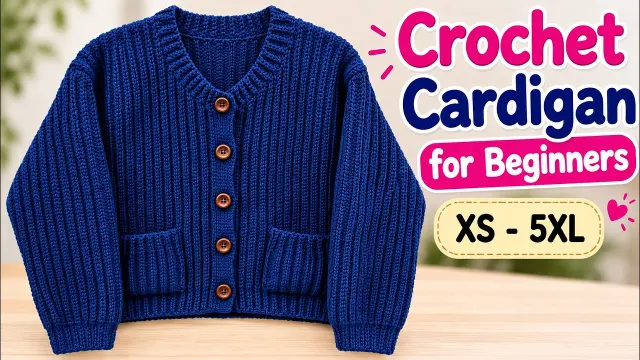
 Beginner-Friendly Ribbed Crochet Cardigan with Pockets
#Ribbed Cardigan
1 ideas
Beginner-Friendly Ribbed Crochet Cardigan with Pockets
Get new #Ribbed Cardigan ideas by email
Every Thursday: the week's best ideas, with the newest from #Ribbed Cardigan.
Related tags
Ribbed Cardigan: A Complete Guide to Styles and Stitches
A ribbed cardigan is a knitted or crocheted garment whose fabric is built from raised vertical ridges running from hem to shoulder. Those ridges are not decoration added at the end: they are the structure of the fabric itself, and they change how the cardigan stretches, hangs and fits. It is one of the most forgiving garments a beginner can make, and one of the most worn pieces in a handmade wardrobe.
Where the rib comes from
Ribbing is made by alternating columns of stitches that pull in with columns that push out. In knitting, that means alternating knit and purl stitches across the row — a single knit followed by a single purl gives a fine, dense rib, while two-by-two or three-by-three groupings give broader, softer ridges. In crochet, the same look comes from working only into the back loop, from front and back post stitches, or from slip stitches worked in vertical lines. All of these methods produce the same effect: a fabric that contracts sideways and springs back.
That elasticity is why ribbing traditionally appears at cuffs, hems and neckbands. Using it across an entire cardigan turns the whole piece into a stretchy, body-hugging layer.
Read more
Main styles
Ribbed cardigans fall into a few recognisable shapes. The open-front cardigan has no closure and relies on the rib's natural drape. The button-through version adds a placket, often worked in a tighter rib so the bands stay flat. Cropped versions end at the waist and pair well with high-waisted trousers and skirts, while longline and oversized versions read as outerwear. Details that change the character of a piece include patch pockets, a shawl collar, dropped shoulders and contrast buttons. Direction matters too: ribs worked vertically elongate the body, while horizontal ribbing across a yoke or sleeve creates a different, more structured look.
What beginners should know
- Gauge is everything. Ribbing pulls in dramatically, so a swatch measured flat will mislead you. Measure your swatch gently stretched, the way you want the garment to sit.
- Rib fabric grows. Wool and alpaca ribs relax with wear and after washing, so many makers build in a little negative ease rather than knitting to exact body measurements.
- Choose a yarn with memory. Springy wool and wool blends hold rib structure; heavy cottons and silky fibres tend to sag and lose the ridges over time.
- Keep your tension even at the transitions. The ridge lines show every inconsistency, so it is worth practising the stitch pattern on a small square first.
- Plan the button bands and pockets before you start, and note how much yarn they will take.
Care and finishing
Block ribbed pieces gently and avoid hanging them, which stretches the ridges out of shape. Fold them instead. A light steaming rather than a heavy press keeps the texture crisp. With simple care, a well-made ribbed cardigan holds its shape for years and becomes the layer you reach for without thinking.
#Ribbed Cardigan: frequently asked questions
How do I start making a ribbed cardigan if I'm a beginner?
Start with a simple shape, such as an open-front or a relaxed button-through cardigan, because ribbing is forgiving and easy to fit. Make a small swatch first so you can see how the fabric stretches and how the finished piece will sit on the body.
What materials do I need for a ribbed cardigan project?
You need yarn with good stretch and recovery, plus the tools that match your chosen method, whether knitting needles or a crochet hook. A pattern or outline, stitch markers, and buttons if you want a closure will also help you keep the shape consistent.
Which style of ribbed cardigan should I choose?
Choose an open-front style if you want something easy to layer, or a button-through version if you want a more polished finish. Cropped, longline, and oversized shapes each create a different look, so think about how you plan to wear it and what silhouettes you like best.
How should I care for a ribbed cardigan so it keeps its shape?
Handle it gently and avoid hanging it, because the weight can stretch the ribs out. Fold it instead, and use light steaming or careful blocking to keep the texture crisp without flattening the ridges.
What are common mistakes to avoid when making a ribbed cardigan?
One common mistake is measuring ribbing too flat, which can make the finished cardigan fit more tightly than expected. Another is choosing a yarn that sags easily, or not keeping tension even, since rib stitches show irregularities very clearly.
Videos come from YouTube and posts from Instagram; titles and summaries are our own. All rights belong to their creators.