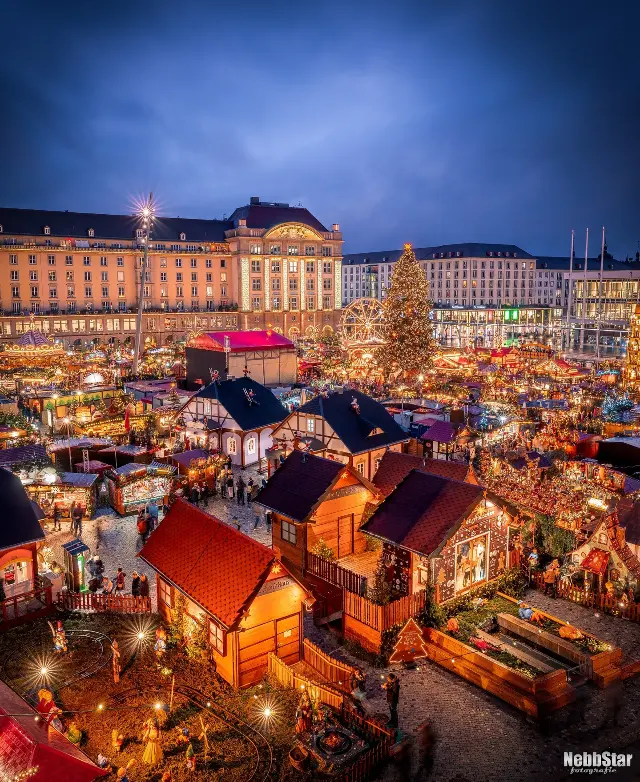
 Dresden Striezelmarkt opens for the Christmas season
#Saxony
1 ideas
Dresden Striezelmarkt opens for the Christmas season
Get new #Saxony ideas by email
Every Thursday: the week's best ideas, with the newest from #Saxony.
Related tags
Saxony: Germany's Eastern Cultural Heartland
Saxony is one of Germany's federal states, sitting in the east of the country where the land rises from river plains into low mountain ranges. It shares borders with Poland to the east and Czechia to the south, and it is a place where grand Baroque architecture, dense forests and a long craft tradition sit close together. If you have heard of Saxony at all, it is probably through Dresden or Leipzig — but the state between and around them is where much of its character lives.
Cities and rivers
The Free State of Saxony, as it is officially known, has Dresden as its capital and Leipzig as its largest city. Dresden grew around the Elbe and is famous for its rebuilt old town, its riverside terraces and the palaces and galleries that made it a royal residence for centuries. Leipzig has a different temperament altogether: a trade-fair city, a publishing city, a city of courtyards and arcades, and one with a strong musical heritage that runs through its churches and concert halls. Smaller towns such as Chemnitz, Görlitz, Bautzen and Freiberg each carry their own slice of the story — industrial, medieval, or both at once.
Landscapes to walk through
Read more
The Elbe cuts a valley through the state and gives Saxony much of its shape. South of Dresden the sandstone hills of Saxon Switzerland form a national park of strange rock towers, quiet forests and marked trails; it is walkable for ordinary visitors, though the climbs are real and good shoes matter. To the south-west the Erzgebirge, the Ore Mountains, rise toward the Czech border — a region shaped by centuries of mining, now better known for winter walking and for the crafts that grew out of it. East of Dresden lies Lusatia, a flat land of lakes and villages where the Sorbian minority lives and where you will see bilingual signs in a Slavic language that predates German settlement.
Wood, wax and Christmas
The Ore Mountains are the heart of a craft culture that is genuinely alive rather than staged: woodcarvers and turners make nutcrackers, smoking figures, candle pyramids and the arched candle-holders that sit in windows through Advent. The region's Christmas markets, and Dresden's own, follow patterns that have barely changed in generations. Year-round you can watch workshops at their benches, and buying a piece directly from a maker is one of the more satisfying souvenirs in Germany.
At the table
Saxon cooking is hearty and regional. Expect fruit bread studded with raisins and candied peel, a baked curd-cheese cake called Eierschecke, potato dishes of every kind, and a vegetable dish from Leipzig that mixes spring vegetables with dumplings. Coffee is taken seriously, and the afternoon ritual of cake and coffee is not a tourist invention.
Practical advice for a first visit
- Regional trains connect the main cities well, and tickets are cheaper bought before boarding.
- Many small shops close on Sundays, so plan food and supplies ahead.
- Bring clothing for rain and uneven ground if you intend to hike.
- Some places still prefer cash, particularly in villages and at market stalls.
- Learn a few German phrases; outside the cities, English thins out quickly.
Saxony rewards slow travel: a few days in each of two cities, one long walk in the hills, and time set aside for the craftsmen's workshops will tell you more than a rushed tour ever could.
#Saxony: frequently asked questions
How should I plan a first trip to Saxony?
Give it time rather than trying to cover the whole state: a few days split between two cities, one long walk in the hills, and an afternoon in a craft workshop works far better than a rushed circuit. Regional trains link the main cities comfortably and are cheapest when you buy the ticket before boarding. Since many small shops shut on Sundays, sort out food and supplies in advance.
Which part of Saxony should I choose — the cities or the countryside?
They answer different needs, so pick by temperament: Dresden and Leipzig for architecture, galleries, music and café culture, or the surrounding regions for sandstone rock trails and forested mountain paths. The Ore Mountains south-west of Dresden suit anyone curious about living craft traditions, while the flat lake country to the east offers gentler wandering and a bilingual Sorbian culture you won't find elsewhere in Germany.
What do I need for hiking in Saxon Switzerland?
The trails are genuinely walkable for ordinary visitors, but the climbs and descents are real, so sturdy shoes with grip matter more than anything else. Bring rain layers and something warm, since weather shifts quickly on the plateau and the rock paths stay damp. Carry water and snacks, because facilities thin out once you leave the trailheads.
How do I choose which Saxon craft piece to bring home?
Look for the woodcarvers and turners of the mountain villages, whose nutcrackers, smoking figures and candle pyramids are made at the bench rather than in a factory, and buy directly from the workshop where you can. Seeing a piece being made tells you far more about quality than the label does, and it makes a souvenir with a story attached. Many workshops welcome visitors year-round, not only during the Advent markets.
What should I eat and drink in Saxony?
Expect hearty regional cooking rather than refined menus: raisin-studded fruit bread, potato dishes in many forms, a baked curd-cheese cake, and a Leipzig vegetable dish served with dumplings. Coffee matters here, and the afternoon cake-and-coffee habit is a genuine local ritual rather than something staged for visitors. Vegetarians manage fine, but it pays to ask what's in a dish rather than assume.
What mistakes do first-time visitors make in Saxony?
The common ones are cramming too much in, assuming cards are accepted everywhere, and expecting English to work in villages and at market stalls. Bring some cash and learn a handful of German phrases, and treat Sunday as a day to plan around rather than to improvise. Above all, don't skip the small towns between the big cities — much of the region's character sits exactly there.
Videos come from YouTube and posts from Instagram; titles and summaries are our own. All rights belong to their creators.