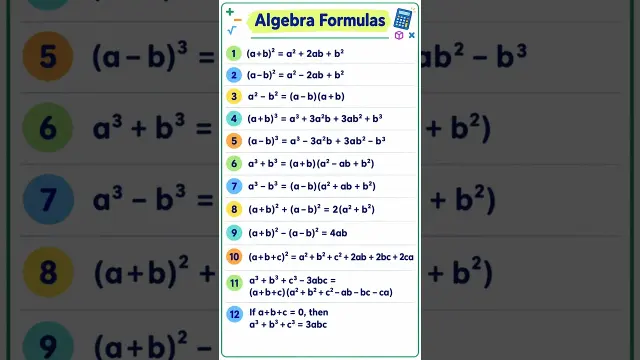
 Twelve important algebra identities for school exams
#School Exams
1 ideas
Twelve important algebra identities for school exams
Get new #School Exams ideas by email
Every Thursday: the week's best ideas, with the newest from #School Exams.
Related tags
School Exams: A Calm Guide to Preparing Well
School exams are the tests schools use to check what you have actually learned after a term or a year of teaching. They exist on a simple logic: teaching happens over months, and at some point the school needs to know what stuck. Marks matter, but the deeper purpose is feedback — for you, to see which ideas you have really absorbed, and for your teachers, to see what needs revisiting.
Exams come in several kinds. Written papers ask you to answer questions or write at length under time pressure. Oral exams test how well you can explain something out loud. Practical assessments in subjects like science, art, music or design ask you to show a skill rather than describe it. Some tests are short and frequent, meant to keep you on track; others are the big end-of-year papers that weigh most. Knowing which kind you are facing changes how you revise — recall and speed for a written paper, fluency and calm for an oral one.
Building a revision plan
The most common mistake is leaving everything to the last week and reading it all passively. Reading feels productive because it is comfortable, but recognition is not the same as recall.
Read more
- Start from the syllabus or a list of topics, and mark honestly what you know, half-know, and avoid.
- Spread the work over several weeks rather than concentrating it. Coming back to a topic after a gap is what makes it stay.
- Give each session a specific target: not "revise biology" but "explain the stages of cell division without notes".
- Write down what you covered, so you can see progress when motivation dips.
Studying actively
The techniques that work are the ones that make you retrieve information rather than look at it. Close the book and write what you remember, then check and correct. Turn headings into questions and answer them aloud. Explain a topic to someone at home, or to an empty chair — the gaps in your explanation show you where to go back. Practice questions and past papers, if your school provides them, are especially useful: they teach you the shape of the exam, how marks are given, and how long you have for each part.
Do a little of this often. Short, focused sessions with real breaks beat long evenings of half-attention.
Looking after yourself
Sleep is not a luxury you can trade for extra hours of revision; it is when your memory settles. Eat properly, move around between sessions, and keep some contact with people who are not revising. If exam stress feels overwhelming, talk to a parent, a teacher or a school counsellor — that is what they are there for, and it is a normal thing to need.
On the day
Pack what you need the night before. Read the whole paper first, start with questions you can answer, and watch the clock. If your mind goes blank, breathe slowly and begin with something small. Afterwards, let it go — you cannot revise a paper you have already sat, and the next one deserves your full attention.
#School Exams: frequently asked questions
How do I start revising for school exams without feeling overwhelmed?
Begin with the syllabus or your list of topics and sort them honestly into what you know well, what you half-know and what you have been avoiding. That gives you a realistic map rather than a vague sense of panic. Then spread the work across the weeks you have left instead of saving it all for the final stretch.
What do I actually need to revise effectively?
You need your syllabus or topic list, your notes and textbook, and something to write with so you can test yourself rather than just read. Past papers or practice questions from your school are especially valuable if they are available, because they show you the shape of the exam. A quiet place and short focused sessions matter more than elaborate setups.
Does the kind of exam change how I should prepare?
Yes, quite a lot. Written papers reward fast recall and practice under time pressure, while oral exams reward being able to explain something fluently out loud, so rehearse speaking your answers. Practical assessments ask you to demonstrate a skill, so hands-on repetition beats reading about it.
What is the most common mistake students make when revising?
Reading notes passively and mistaking the comfortable feeling of recognition for real knowledge. If you can follow a page while looking at it, that does not mean you could reproduce it with the book closed. Testing yourself, correcting what you got wrong and returning to topics after a gap is what makes them stick.
How should I handle the day of the exam itself?
Pack everything you need the night before, then read the whole paper before writing anything so you know what is coming. Start with questions you can answer confidently and keep an eye on the clock. If your mind goes blank, breathe slowly and begin with something small to get moving again.
How do I keep my motivation up over a long revision period?
Give each session a specific target, like being able to explain a topic without notes, rather than a vague subject name. Write down what you covered so you can see progress when enthusiasm dips. Short focused sessions with real breaks hold up better than long evenings of half-attention.
Videos come from YouTube and posts from Instagram; titles and summaries are our own. All rights belong to their creators.