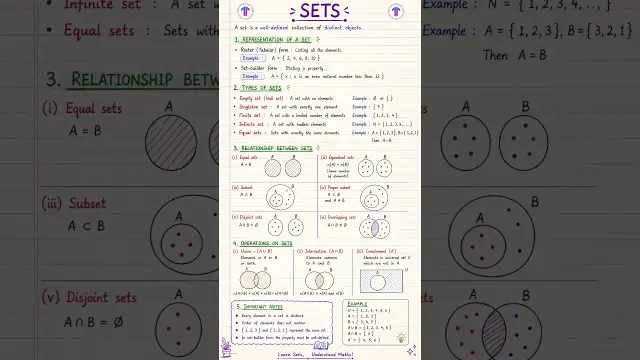
 Sets Revision: Types of Sets, Venn Diagrams and Set Operations
#Set Operations
1 ideas
Sets Revision: Types of Sets, Venn Diagrams and Set Operations
Get new #Set Operations ideas by email
Every Thursday: the week's best ideas, with the newest from #Set Operations.
Related tags
Set Operations: Union, Intersection and Difference
A set is simply a collection of distinct things — numbers, letters, people, anything you like — and set operations are the ways of combining or comparing two or more of these collections to make new ones. The idea grew out of nineteenth-century mathematics, but you meet it constantly in everyday reasoning: sorting a guest list, comparing two playlists, working out who is in one club but not the other.
The basic operations
Union takes everything from both sets, with duplicates counted once. If one set holds the red fruits and another the round ones, their union is every fruit that is red, round, or both.
Intersection keeps only what the sets have in common. The intersection of red fruits and round fruits is the cherries and the tomatoes.
Read more
Difference removes one set from another. The difference of red fruits minus round fruits leaves the red things that are not round — strawberries, say. Note that this operation is not reversible: swapping the two sets gives a different result.
Complement works against a background set, often called the universal set. The complement of a set is everything in that background that the set leaves out. It only means something once you have agreed what the background is.
Symmetric difference collects what belongs to exactly one of the two sets — the union with the intersection taken away. Cartesian product, the odd one out, pairs every element of one set with every element of the other, producing not a list of items but a list of combinations.
Seeing it with Venn diagrams
Two overlapping circles make these operations visible. The union is both circles together, the intersection is the lens where they overlap, and each difference is one circle's crescent-shaped remainder. Drawing the picture first is often the fastest way to see whether a problem is asking for "and", "or", or "but not".
Rules worth knowing
Union and intersection are commutative — order does not matter — and associative, so you can group three sets however you like. Intersection distributes over union and union over intersection. De Morgan's laws connect the two: the complement of a union is the intersection of the complements, and the reverse also holds. These rules let you rewrite an expression into something simpler before you calculate.
If you are just starting
Name your sets clearly and write their elements out. Decide early what the universal set is, especially when complements appear. Sketch a Venn diagram even when the question seems easy. And check small cases by hand: with two or three elements you can list every combination, which quickly shows whether a general rule you have written down actually behaves.
#Set Operations: frequently asked questions
What is a set operation, in plain terms?
It is any rule for combining or comparing collections of distinct things so that a new collection comes out. Union, intersection, difference and complement are the everyday ones; the Cartesian product is the exception, since it pairs items up instead of gathering them. The idea is really just careful bookkeeping applied to groups.
How do I decide whether a problem wants union, intersection or difference?
Listen to the little connecting words: "or" and "everything that is either" point to union, "and" or "shared" points to intersection, and "but not" or "excluding" points to difference. Sketching overlapping circles first is usually faster than reasoning it out in your head, because the picture shows at a glance which region is being asked for. Remember that difference depends on order, so swapping the sets gives you something else entirely.
Do I need a universal set before I can use complements?
Yes — a complement is only meaningful against an agreed background, since it means everything in that background the set leaves out. Decide what the universal set is early, especially in problems where a complement appears partway through. Without that agreement the answer is not wrong so much as undefined.
What mistakes do people most often make with set operations?
Treating difference as if it worked both ways is the classic slip, along with forgetting that union counts a repeated item only once. Another common one is reaching for a complement without having settled on a background set. Checking a small example by hand — listing the items and working through them — catches most of these before they spread.
Which set operation produces combinations rather than a list of items?
The Cartesian product: it matches every element of one set with every element of the other, so the result is a collection of pairings. That makes it the odd one out among the basic operations, and it is the one people are most likely to misread as an ordinary union. If your answer looks like pairs instead of single items, that is the operation at work.
How can I simplify a complicated set expression before calculating?
Use the rules: order does not matter for union and intersection, grouping does not matter either, and each distributes over the other. De Morgan's laws let you push a complement inside a bracket by swapping union for intersection, or the reverse, which often turns a tangle into something you can read off a diagram. Rewriting first is almost always less work than grinding through the original form.
Videos come from YouTube and posts from Instagram; titles and summaries are our own. All rights belong to their creators.