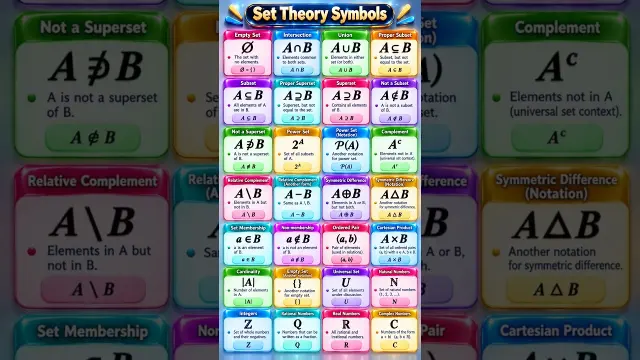
 Set Theory Symbols Explained: Union, Intersection, Subset and More
#Set Symbols
1 ideas
Set Theory Symbols Explained: Union, Intersection, Subset and More
Get new #Set Symbols ideas by email
Every Thursday: the week's best ideas, with the newest from #Set Symbols.
Related tags
Set Symbols: A Beginner's Guide to Set Notation
A set is a collection of distinct things treated as a single object: the vowels of the alphabet, the even numbers, the people in a room. Set symbols are the shorthand mathematicians use to say precisely which things belong to a collection and how collections relate to one another. They look cryptic at first, but there are only a few dozen in common use, and most of them behave exactly as their shapes suggest.
Where the notation comes from
Set notation grew out of nineteenth-century work on the foundations of mathematics, when writers needed a compact way to reason about collections in general rather than about particular numbers. The symbols were refined over the following decades and gradually settled into the forms you meet in textbooks today. Several were chosen for their pictures: the union sign looks like a cup holding things together, the intersection sign like an arch, and the membership sign a stylised letter e for "element".
Membership and comparison
Read more
The most basic pair is "is an element of" and "is not an element of". If you write that a number belongs to a set, you are making a single true-or-false claim about one object.
- Membership: an element on the left, a set on the right.
- Subset: every element of the first set is also in the second.
- Proper subset: a subset that is genuinely smaller than the set containing it.
- Empty set: the set with no elements at all, written as a circle with a slash.
A common stumbling block is mixing up membership and subsethood. A single object belongs to a set; a set is contained in another set. Likewise, the empty set is a subset of every set, but it is not an element of most of them. Authors also disagree about whether the subset sign implies "smaller", so check how each book uses it.
Combining sets
Union gathers everything from both sets into one, removing duplicates. Intersection keeps only what the two have in common. Difference removes the elements of one set from another, and complement collects everything in the surrounding universe that is missing from a given set. Two useful laws, named after De Morgan, relate these operations: the complement of a union is the intersection of the complements, and the reverse also holds.
Standard number sets
Fixed letters name the familiar families: natural numbers, integers, rationals, reals and complex numbers. You will see these used constantly as the starting point in definitions.
Writing sets out
Sets can be listed between braces, with an ellipsis when the pattern is obvious, or described by a rule: a set-builder expression states which elements are drawn from a larger set and which condition they must satisfy. Order and repetition carry no meaning in a set, so two listings with the same members describe the same object.
Practical tips
Read every formula aloud, turning each symbol into words. Build a one-page symbol sheet in your own handwriting. Practise translating in both directions, from symbols to sentences and back. Note the conventions of whichever text you are using, and when a symbol is unfamiliar, look at the surrounding sentence: the meaning is almost always implied by what is being claimed.
#Set Symbols: frequently asked questions
How should a beginner start learning set symbols?
Start with the two claims you will make most often: whether something belongs to a set, and whether one set sits inside another. Get comfortable saying those aloud in words before worrying about the rest of the notation, because almost everything else is built on top of them. Once those feel natural, add the operations that combine sets and the fixed letters used for number families.
Do I need any special materials or prior maths to read set symbols?
No special tools are required — paper, a pencil and a text that explains its own conventions are enough. The ideas themselves are about collections and belonging, so no advanced arithmetic is assumed. What helps most is patience with the shapes, since many symbols were drawn to resemble the idea they stand for.
Which symbols should I learn first, and which can wait?
Membership, subsethood, union, intersection and difference cover the great majority of what you will meet, so treat them as the core. The empty set sign and the fixed letters for number families come next because they appear constantly in definitions. Complements and the laws relating the operations are easier once the basic five are automatic.
Why do I keep confusing membership with subsethood?
Because both feel like 'is in', yet one applies to a single object and the other to a whole collection. The reliable check is to look at what sits on the left: a lone element takes the membership sign, while a set takes the subset sign. Reading the line aloud as a full sentence catches the mix-up almost every time.
What are the most common mistakes when writing sets out?
People often assume that order or repetition changes a set, when neither does — the same members always describe the same object. Another frequent slip is forgetting that the empty set is contained in every set while rarely being a member of one. Finally, authors differ on whether the subset sign allows equality, so it is worth confirming which convention your source uses.
How can I get fluent at reading set notation rather than just decoding it?
Turn every formula into spoken words, then try going the other way and writing a sentence back into symbols. Keeping a single handwritten sheet of the symbols you have met, in your own phrasing, makes revision quick and personal. When a sign is unfamiliar, read the claim around it — the surrounding sentence usually tells you what it must mean.
Videos come from YouTube and posts from Instagram; titles and summaries are our own. All rights belong to their creators.