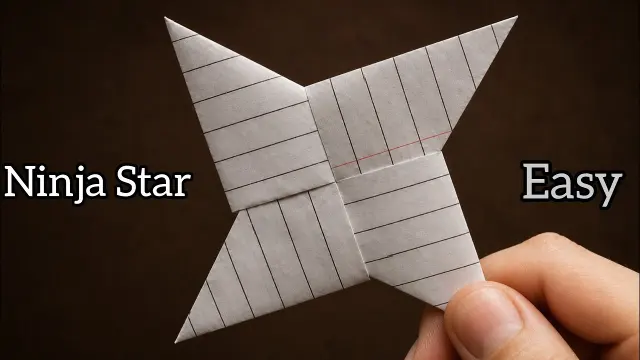
 Step-by-Step Paper Ninja Star Origami Tutorial for Beginners
#Shuriken
2 ideas
Step-by-Step Paper Ninja Star Origami Tutorial for Beginners
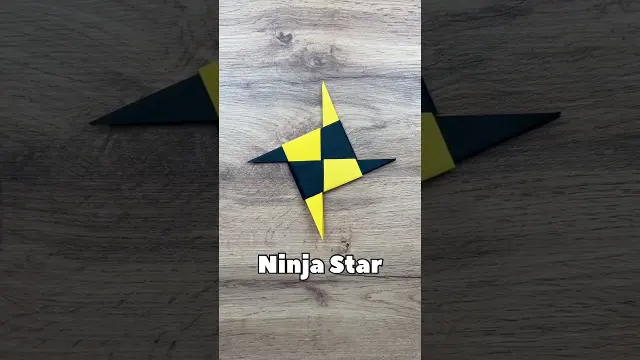 Easy Origami Ninja Star Shuriken: Step-by-Step Paper Craft
Get new #Shuriken ideas by email
Every Thursday: the week's best ideas, with the newest from #Shuriken.
Related tags
Shuriken: Paper Ninja Stars and the Art Behind Them
Shuriken is the Japanese word for a hand-thrown blade, and it covers a wide family of small, concealed weapons rather than one single shape. Written in Japanese, the word uses three characters: "shu" for hand, "ri" for behind or inside, and "ken" for blade — a blade kept hidden in the hand. Today the word travels far beyond Japan, and it most often brings to mind two quite different things — the historical iron throwing star and the folded paper version that sits on a table in front of a child with a square sheet and a great deal of concentration. Both belong to the same story.
The Historical Blade
Traditionally, shuriken were carried as secondary tools by warriors who needed a distraction, a way to slow a pursuer, or a means of buying a moment to draw a sword. They were never the main weapon of a fight. Two broad families are usually described: straight, dart-like spikes known as bo-shuriken, thrown from the hand along a flat trajectory, and the multi-pointed, flat stars called hira-shuriken or shaken, which spin as they fly.
The star shape is not decoration. Several points mean that whatever angle the blade meets its target at, an edge is likely to be presented. Those points also made the object usable at close range as a small hand tool. Surviving examples show an astonishing range of shapes — four points, six, eight, some with holes at the centre, some with wrapped grips.
Read more
Folded Paper Stars
The paper version is a separate pleasure entirely, and it is where most people meet the word now. Two identical squares, folded into triangular modules and locked together, produce the familiar four-pointed star that spins neatly when thrown flat. A second style starts from a single square and collapses into a similar form by a different route, holding its shape through tension alone.
What beginners should know:
- Sharp creases matter more than speed. Run a fingernail along every fold and the finished star will sit tight instead of flapping open.
- Use paper that is thin but not flimsy. Copier paper works; glossy magazine pages look striking but slide apart.
- Fold in good light on a flat surface, and make your first star from two squares of different colours so you can see how the modules interlock.
- Do not throw a paper star at faces, pets or anything breakable. It is a folding exercise, not a toy weapon.
Why It Endures
The appeal is partly the silhouette — that clean, urgent star shape that reads instantly, even at a small size — and partly the fact that the folding is genuinely satisfying to learn. It rewards precision, it takes minutes rather than hours, and it can be made from nothing but scrap paper. Whether you come to shuriken through history, through craft, or through a child asking you to make one, the subject has an unusual quality: an object designed to be hidden and thrown has become something people give away, folded from paper, one after another.
#Shuriken: frequently asked questions
How do I start making a paper shuriken if I have never folded one before?
Start with two squares of paper the same size, in two different colours so you can see exactly how the halves lock into each other. Fold on a flat, well-lit surface and work slowly through one module at a time before trying to join them. Learning the collapse from a single sheet is a good follow-up once the interlocking version feels familiar.
What kind of paper works best for a folded shuriken?
Choose paper that is thin but still holds a crease, since anything too stiff is hard to lock together and anything too flimsy will not stay. Everyday copy paper is a reliable choice, while glossy magazine pages look striking but tend to slide apart as you work. If the star keeps springing open, the paper is usually the culprit rather than your folding.
Should I be looking at the historical throwing blade or the paper version?
They are almost separate hobbies that share a name: the iron blade is a subject for history books and museum collections, while folded paper is something you can make at a kitchen table in a few minutes. Most people today arrive through the paper craft and discover the historical side afterwards. Pick whichever matches what you actually want to spend an afternoon doing.
How do I stop my finished star from flapping open?
Crease quality matters far more than folding speed, so press each fold firmly with a fingernail before moving on. Make sure every edge is tucked fully into its pocket rather than resting loosely on top. Store finished stars flat and out of damp air, since moisture softens the paper and lets the tension escape.
What can I do with paper shuriken once I have made a few?
They work well as party favours, gift toppers, garlands or small decorations for a themed celebration, and they are a good craft-table activity for children. Folding them in mixed colours or from patterned paper makes them display-friendly. Keep them as decoration rather than throwing toys and the whole project stays safe.
What are the most common beginner mistakes?
Rushing the creases and using shiny or overly thick paper are the two things that most often cause a star to fall apart. Another frequent slip is throwing the finished star at people or pets, which it is not designed for. Fold in good light, on a flat surface, and let precision matter more than speed.
Videos come from YouTube and posts from Instagram; titles and summaries are our own. All rights belong to their creators.