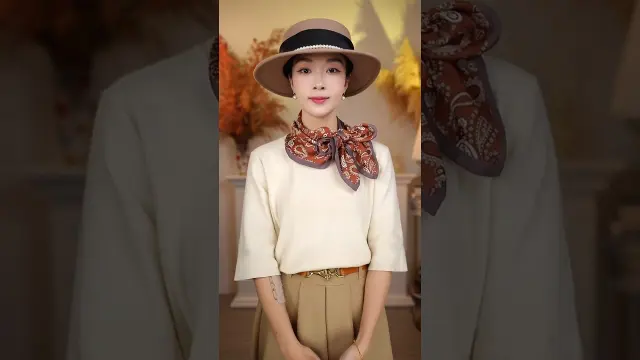
 Classy Scarf Styling Inspiration for Elegant Women
#Silk Scarf
1 ideas
Classy Scarf Styling Inspiration for Elegant Women
Get new #Silk Scarf ideas by email
Every Thursday: the week's best ideas, with the newest from #Silk Scarf.
Related tags
Silk Scarf Styling: Fabric, Folds and Care
A silk scarf is one of the quietest pieces in a wardrobe and one of the most versatile. Folded small at the throat, it reads as polish; knotted loosely over a coat, it becomes the only colour an outfit needs; tied around a bag handle or through the hair, it turns an ordinary day into something considered. Part of its charm is that it asks very little of you: no fitting, no sizing, no season.
Where silk comes from
Silk is a natural protein fibre, spun by silkworms as they build their cocoons. The practice of reeling and weaving it began in ancient China and travelled slowly outward along the trade routes that later carried its name. For centuries it was a luxury guarded closely, and even now, when it is produced far more widely, silk keeps a reputation for being a little ceremonial. That history is part of why a scarf feels like an heirloom rather than an accessory.
The main kinds you will meet
Read more
Silk scarves differ mostly in weave and finish. Smooth, glossy satin has a fluid drape and a strong sheen; twill is denser and slightly matte, which makes it hold a knot firmly; crepe de chine has a soft, gently pebbled surface and hangs closely; lightweight chiffon and gauze are airy and best in summer. Square scarves, traditionally around ninety centimetres, are the classic format, while long oblongs and narrow twillies suit belts, hair and bag handles. Many scarves are finished with a hand-rolled hem, where the edge is rolled and stitched by hand — a small detail that keeps the drape clean and is worth looking for.
How to start
Beginners usually do best with a mid-sized square in a colour that already exists in their wardrobe, since it will work with more of what they own. Learn two or three folds well rather than twenty badly: the bias fold, where the square is folded diagonally into a long band; the triangle, worn at the front or back; and the simple loop, folded into a narrow strip and knotted once. Practise in front of a mirror with a scarf you don't mind creasing. If you want the scarf to stay put, a small knot tied close to the neck holds better than a loose bow.
Looking after it
Silk is stronger than it feels but dislikes rough treatment. Wash by hand in cool water with a mild soap, never wring it, and press the water out in a towel before drying flat in the shade — direct sun dulls colour. Iron on a low setting, on the reverse, with a thin cloth between. Store scarves rolled or folded flat, away from damp and light, and give them air now and then. Treated this way, a good silk scarf outlasts most of what you own.
#Silk Scarf: frequently asked questions
How do I start wearing a silk scarf without looking overdressed?
Start with a mid-sized square in a colour that already appears somewhere in your wardrobe, so it echoes what you are wearing instead of competing with it. Wear it one way for a while — loose over a coat or knotted at the throat — until tying it feels automatic. Choosing a matte-ish finish rather than the glossiest one also keeps the look daytime and easy.
Which kind of silk scarf should I choose for my first one?
It depends on how you want it to behave: dense, slightly matte weaves hold a knot firmly and suit structured styling, while soft, gently textured weaves drape closely and feel more forgiving. Very light, airy weaves are lovely for warm weather but are harder to knot neatly. A square format is the most versatile starting point, while long narrow shapes are better for belts, hair and bag handles.
How do I tie a silk scarf so it actually stays in place?
Learn two or three folds properly rather than many badly — a diagonal band, a triangle, and a simple narrow loop will cover most outfits. A small knot tied snugly close to the neck holds far better than a loose bow, which slips as you move. Practise on a scarf you don't mind creasing so you aren't afraid to adjust it.
Can I wash a silk scarf at home, or does it need a specialist?
You can usually hand-wash it in cool water with a mild soap, but the handling matters more than the soap: never wring it out, press the water away in a towel instead, and dry it flat in the shade because strong sun will dull the colour. Iron it on a low setting, on the reverse, with a thin cloth in between. Store it rolled or flat away from damp and light, and air it out occasionally.
What are common mistakes people make with silk scarves?
The usual ones are buying a bold colour that goes with nothing they own, attempting complicated knots before the simple ones sit well, and treating the scarf roughly when washing or storing it. Another is ignoring the finish — a neat hand-rolled hem keeps the drape clean, so it is worth seeking out rather than settling for a flatter stitched edge.
What occasions does a silk scarf suit best?
Its strength is that it does little and does it well: knotted at the throat it reads as polish for work or formal settings, loose over a coat it adds the only colour an outfit needs, and tied through the hair or a bag handle it lifts an ordinary day. Because it needs no fitting or sizing, it travels well and works across seasons. One scarf can therefore cover both dressed-up and everyday moments.
Videos come from YouTube and posts from Instagram; titles and summaries are our own. All rights belong to their creators.