 Exploring Emergent Complexity in Simple Systems
#Simulation
2 ideas
Exploring Emergent Complexity in Simple Systems
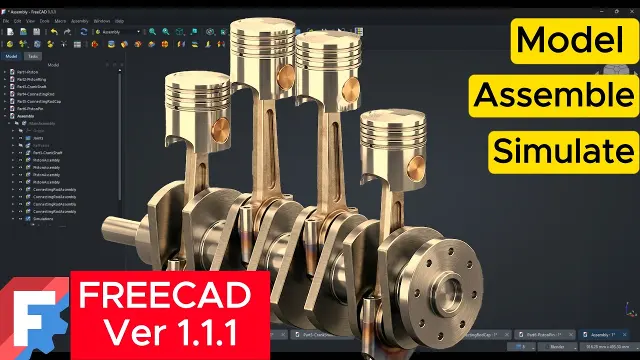 Designing and Simulating a Four-Cylinder Engine in FreeCAD
Get new #Simulation ideas by email
Every Thursday: the week's best ideas, with the newest from #Simulation.
Related tags
Simulation: Understanding Real-World Systems Through Models
Simulation is the use of a model to imitate how a real system behaves over time. It can describe something physical, like the flow of air around a shape, or something abstract, like traffic, weather, business processes, or the spread of ideas. At its core, simulation helps you study a system without needing to build it, break it, or wait for it to unfold in real life.
People have used simulation in some form for a long time, from mechanical models and scaled replicas to mathematical and computer-based methods. Today, simulation is common in engineering, science, design, education, and planning. It is useful whenever a situation is too complex, expensive, risky, or slow to explore directly.
What simulation is used for
Simulation can help you:
- test how a design might perform
- compare different choices before making one
- understand cause and effect in complex systems
- practice a process in a safe setting
- spot problems early
- learn how small changes can lead to large differences
Read more
It is not the same as prediction in a perfect sense. A simulation is only as good as the assumptions, data, and rules behind it. That is why it is best seen as a tool for exploring possibilities rather than a guarantee of what will happen.
Main kinds of simulation
There are many forms of simulation, but a few broad types are especially common:
- Physical simulation uses a model or prototype to mimic real behavior, such as a scale model or a test setup.
- Mathematical simulation uses equations to represent how a system changes.
- Computer simulation runs those equations or rules through software, often over many steps.
- Discrete-event simulation focuses on events that happen at specific moments, such as arrivals, queues, or machine breakdowns.
- Continuous simulation follows systems that change smoothly over time, such as motion, heat, or fluid flow.
- Agent-based simulation models many individual actors, each following simple rules, to see what emerges from their interactions.
What beginners should know
If you are new to simulation, start with a simple question. What do you want to learn? A good simulation begins with a clear purpose. Then decide what details matter and what can be left out. Too much detail can make a model hard to use; too little can make it unrealistic.
It also helps to remember that every simulation is a simplified version of reality. A useful model is not one that includes everything, but one that captures the important parts clearly.
Practical tips
- Begin with a small, manageable model.
- Check whether the output makes sense in obvious situations.
- Compare the model with real observations when you can.
- Change one variable at a time to understand its effect.
- Keep track of assumptions so you know what the simulation can and cannot tell you.
- Use clear labels and simple visuals to interpret results.
Simulation is valuable because it lets you explore ideas before committing to them. Whether you are studying a natural process, testing a design, or trying to understand a system with many moving parts, simulation gives you a structured way to learn from models and refine your thinking.
Videos come from YouTube and posts from Instagram; titles and summaries are our own. All rights belong to their creators.