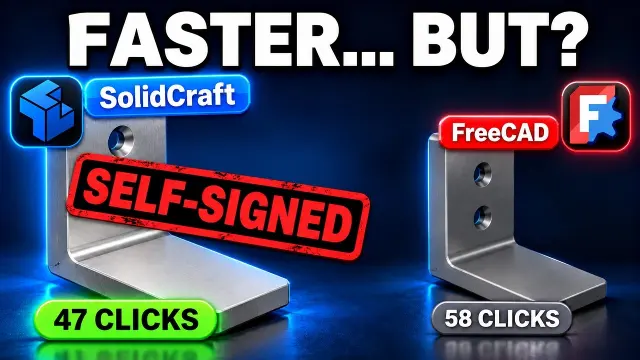
 Testing SolidCraft Against FreeCAD for 3D Printing Brackets
#SolidCraft
1 ideas
Testing SolidCraft Against FreeCAD for 3D Printing Brackets
Get new #SolidCraft ideas by email
Every Thursday: the week's best ideas, with the newest from #SolidCraft.
Related tags
SolidCraft and Solid Modeling Basics
What SolidCraft means
SolidCraft is a broad way of working with solid forms: planning, shaping, and building objects so they are structurally sound, practical, and well proportioned. The idea sits at the meeting point of design and making. It can describe handcrafts made from wood, clay, metal, or other materials, and it also fits digital modeling for things that will be cut, printed, machined, or assembled later.
At its heart, the approach is about thinking in three dimensions. Instead of decorating a flat surface first, you begin with the overall volume, then refine edges, joins, openings, and details. That makes it especially useful for functional items such as holders, containers, fixtures, brackets, furniture parts, decorative objects, and prototypes.
Where it comes from
Read more
The practice draws from traditional craft, industrial design, and engineering. Makers have always needed to turn an idea into a solid object that holds together and does its job. In the digital world, that same principle appears in solid modeling, where shapes are built from accurate forms and measurements rather than drawn only as outlines. In hands-on craft, the same logic appears when you carve, cast, join, or build up material to create a stable form.
Main methods and styles
There are several common ways to work in this style:
- Additive making, where you build up material layer by layer, with clay, resin, laminate, or digital fabrication
- Subtractive making, where you remove material by carving, cutting, sanding, or machining
- Assembly-based making, where separate parts are joined into one finished object
- Hybrid making, where you combine several methods for strength, detail, or ease of production
The style you choose depends on the material and the purpose of the object. Smooth curves, crisp geometric forms, and practical joinery are all common. Clean proportions matter, because even a simple shape can look refined when the structure is balanced.
What beginners should know
If you are new to SolidCraft, start with simple forms. A block, cylinder, or bracket teaches far more than a complex shape at first. Focus on accurate dimensions, clear edges, and a few reliable joints or connections. Learn how your material behaves: some materials bend, some split, some shrink, and some need support while being shaped.
It also helps to plan for use, not just appearance. Ask yourself how the object will be held, opened, cleaned, mounted, or moved. Practical design usually leads to better results than purely decorative choices.
Helpful tips
- Keep early designs simple and test the proportions before adding detail.
- Leave enough material around stress points, holes, and joins.
- Check fit carefully if parts need to connect.
- Finish edges cleanly, since small imperfections are easier to see on simple solid forms.
- When working digitally, build from clear dimensions and revise often.
SolidCraft rewards patience and clarity. Whether you work by hand or on a screen, the goal is the same: create an object that feels purposeful, sturdy, and complete.
Videos come from YouTube and posts from Instagram; titles and summaries are our own. All rights belong to their creators.