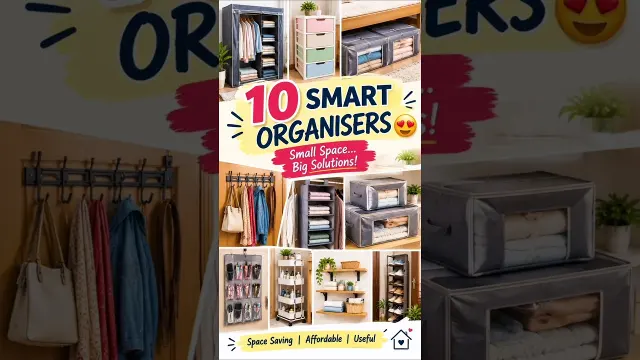
 Smart storage organisers and space-saving ideas for small homes
#Space Saving Ideas
1 ideas
Smart storage organisers and space-saving ideas for small homes
Get new #Space Saving Ideas ideas by email
Every Thursday: the week's best ideas, with the newest from #Space Saving Ideas.
Related tags
Space Saving Ideas for Small Homes
A small home asks a different kind of thinking. Instead of adding more room, you work with what you have — using height, hidden corners and furniture that serves more than one purpose. Space saving is less about buying clever gadgets than about noticing where volume is being wasted, and then deciding what deserves to occupy it.
Start with what you own
Before rearranging anything, it helps to sort. Most homes hold a surprising amount of things that are kept out of habit rather than use: duplicate kitchen tools, clothes that no longer fit, cables for devices long gone. Clearing first means the storage you do add has less to hold.
A simple rule is to keep what you use regularly within easy reach, what you use occasionally higher up or further away, and to let go of the rest. Seasonal items — winter bedding, holiday decorations — belong in the least accessible places, because you only need them a few times a year.
Read more
Use the vertical space
Walls are the most underused storage in most homes. Shelves above doorways, tall bookcases that reach near the ceiling, hooks in hallways and racks behind doors all turn empty air into usable room. In kitchens, a rail with hooks holds utensils and pans that would otherwise take up drawers.
Height also applies to furniture: a bed with built-in drawers, a sofa with storage underneath, a coffee table with a shelf. Choosing pieces that hold something is often more effective than adding another cupboard.
Make surfaces work harder
Flat surfaces collect clutter quickly, so give them a job. A bench by the door with baskets beneath holds shoes and bags. A desk with a shelf above it keeps papers off the top. Baskets and boxes are useful because they group many small things into one object, but they work best when labelled or at least partly see-through, so nothing disappears into a mystery.
Fold, roll and stack
How you store things matters as much as where. Rolling clothes in drawers takes less room than folding flat. Stacking plates vertically in a cupboard, storing lids on a rack, hanging bags inside one another — these small habits add up to real space over a whole home.
Keep it liveable
The goal is a home that feels calm, not a puzzle where everything must be returned to exactly the right place. Leave some emptiness on shelves, keep the most-used things where your hand naturally reaches, and choose storage you actually find easy to use. A system you abandon after a week saves nothing.
Beginners often make the mistake of buying containers before sorting, or filling every gap until the room feels tight. Start with one area — a wardrobe, a kitchen drawer, a hallway — finish it, and notice what changed. Small homes rarely have one big solution; they are made comfortable by many modest ones, each quietly doing its part.
#Space Saving Ideas: frequently asked questions
How do I start making a small home feel more spacious?
Begin by sorting what you already own rather than buying storage first. Set aside things kept out of habit rather than use, then give the remaining items a place based on how often you reach for them. Once the clutter is reduced, you can see where volume is actually being wasted.
Do I need to buy special furniture or gadgets to save space?
Not necessarily — noticing wasted room matters more than shopping. Many homes gain the most from using walls, door backs and the space above eye level that already exist. When you do buy, choose pieces that hold something, like a bed with drawers or a bench with baskets underneath.
Which storage approach suits a very small room best?
Think vertically and pick pieces that do more than one job. Shelves near the ceiling, hooks on walls and furniture with built-in compartments usually free up more room than another cupboard. Whatever you choose should be something you find genuinely easy to use, or it will be abandoned.
How can I keep a space-saving system from falling apart?
Leave some empty space on shelves and keep everyday items within easy reach. A home that feels calm gets maintained; one that behaves like a puzzle where everything must sit exactly right does not. If a system is awkward, simplify it rather than forcing yourself to keep up.
What are common mistakes people make when trying to save space?
Buying containers before sorting is the usual first misstep, since you end up organising things you did not need to keep. Filling every last gap until the room feels tight is another, as it trades comfort for capacity. Starting with one small area, finishing it, and seeing what changed works better than attempting the whole home at once.
Are there simple everyday habits that free up room over time?
Yes — how you store things matters as much as where. Rolling clothes instead of folding them flat, standing plates on edge, and nesting bags inside one another all reclaim small amounts of space. Across a whole home, those habits add up.
Videos come from YouTube and posts from Instagram; titles and summaries are our own. All rights belong to their creators.