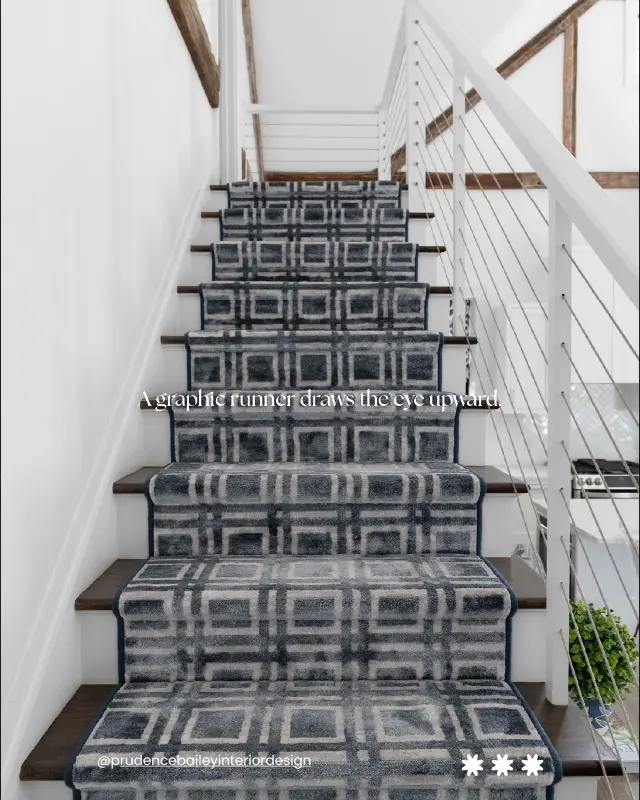
 A Home United by Detail: Stair Runner, Blue Patterns and Warm Wood
#Stair Runner
1 ideas
A Home United by Detail: Stair Runner, Blue Patterns and Warm Wood
Get new #Stair Runner ideas by email
Every Thursday: the week's best ideas, with the newest from #Stair Runner.
Related tags
Stair Runner Guide: Choosing and Caring for a Carpeted Staircase
A stair runner is a narrow length of carpet or rug laid down the centre of a staircase, usually leaving a band of bare wood visible on each side. It is one of those details that seems purely decorative until you live with one — then you notice how much softer and quieter a staircase feels, and how much safer it is underfoot.
Where the idea comes from
Covering the middle of a stair is an old practical habit rather than a modern styling choice. In houses with hard, polished treads, a strip of textile down the centre cut down noise, gave grip underfoot and protected the wood where feet actually land, while the exposed edges kept the look of the staircase. That logic still holds: the runner absorbs wear, the wood frames it.
The two ways of fitting
Read more
The classic method fixes the runner to each tread with a slim wooden or metal rod, called a stair rod, sitting in the angle where the tread meets the riser. This makes the runner easy to lift for cleaning or replacing, and it suits period houses. The alternative is to lay the runner continuously from top to bottom, moulded over the nose of each step and fixed out of sight, which gives an unbroken line and a calmer, more contemporary look. Both usually sit on an underlay, and both need the runner to be fixed firmly — a loose runner is a trip hazard, so this is a job worth doing properly or having done properly.
Materials and patterns
Wool is the traditional choice: dense, hard-wearing and warm underfoot, and it holds colour well. Sisal, jute and coir have a drier, more textured look and suit simpler interiors, though they can feel rougher and mark more easily. Synthetic fibres are durable and easy to clean. Patterns matter for practical reasons as much as visual ones: a busy stripe, a small geometric repeat or a traditional medallion design disguises the small marks that stairs inevitably collect, while a plain light carpet shows every speck. A pattern also helps the eye read the edge of each step.
What to know before you start
- Measure the full run: the width of each tread, the height of each riser, and the total length over every step, plus a little extra for the turns.
- Check how the edges will be finished; a bound edge or a folded, stitched edge both stop fraying.
- Make sure the pattern repeat lines up over the nosings — a stripe that drifts sideways over twenty steps is very hard to unsee.
- Ask about the pile direction and how the carpet behaves on a curve if your staircase turns.
Living with it
Vacuum regularly, following the pile direction, and treat spills quickly by blotting rather than rubbing. Have the runner checked now and then for looseness at the rods or fixings, and tighten or have it refitted as soon as anything shifts, since the steps near the bottom take the heaviest traffic and a slack section there is where trouble starts. Deal with fraying edges and worn nosings early, while a repair is still small; a fitted runner is made to the length of your staircase, so it cannot be turned or moved around the way a loose rug can, and looking after the section that takes the most footfall is what keeps it going. Deep-clean it from time to time according to the fibre, and let a professional handle anything that needs taking up. Looked after, a good runner lasts for decades.
#Stair Runner: frequently asked questions
How do I start planning a stair runner?
Start by measuring the full run: the width of every tread, the height of every riser and the total length over all the steps, with a little extra allowed for turns. Then decide how it will be fixed, because rods on each tread and a continuous fitted installation look quite different and change how easy the runner is to lift later.
Which material is best for a staircase runner?
Wool is the traditional choice because it is dense, warm underfoot, hard-wearing and holds colour well. Sisal, jute and coir give a drier, more textured look for simpler interiors but feel rougher and mark more easily, while synthetic fibres are durable and simple to clean. Match the material to how much traffic the stairs get and how much upkeep you are happy to do.
Should I choose a plain or patterned runner?
A pattern earns its place for practical reasons as much as visual ones: a busy stripe, a small geometric repeat or a traditional medallion design hides the little marks stairs inevitably collect, and it helps the eye read the edge of each step. A plain light carpet, by contrast, shows every speck.
How do I look after a stair runner day to day?
Vacuum regularly, working in the direction of the pile, and deal with spills by blotting rather than rubbing. Check the rods or fixings now and then and have anything slack tightened or refitted quickly, since the steps nearest the bottom take the heaviest traffic and that is where problems usually begin.
What mistakes do people make with stair runners?
The biggest one is a poorly fixed runner, which becomes a trip hazard rather than a safety improvement, so it is worth doing properly or having done professionally. Other common slips are leaving edges unbound so they fray, and ignoring whether a pattern repeat will line up over the nosings. It also pays to ask how the pile direction behaves and how the carpet handles a curve if the staircase turns.
Can a stair runner be turned or moved like a loose rug?
No — a fitted runner is made to the length of your particular staircase, so it cannot be rotated or shifted to spread the wear. That makes early attention to fraying edges and worn nosings worthwhile while the repair is still small, and deep cleaning should follow whatever suits the fibre.
Videos come from YouTube and posts from Instagram; titles and summaries are our own. All rights belong to their creators.