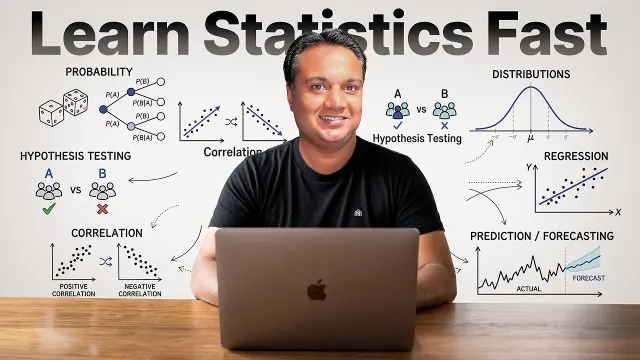
 Statistics for AI Engineering: A Four-Hour Course Walkthrough
#Statistics Course
1 ideas
Statistics for AI Engineering: A Four-Hour Course Walkthrough
Get new #Statistics Course ideas by email
Every Thursday: the week's best ideas, with the newest from #Statistics Course.
Related tags
Statistics Courses: A Beginner's Guide to Learning Stats
Statistics is the discipline of collecting, organising, summarising and interpreting data so that uncertainty can be handled in a disciplined way. A statistics course teaches that discipline: not just formulas, but the habits of thought that let you look at numbers and ask sensible questions about where they came from and what they can honestly support.
What a course usually covers
Most introductory courses follow a similar arc. They begin with descriptive statistics: how to summarise a set of observations using measures of centre such as the mean and median, and measures of spread such as variance and standard deviation. You learn to read and produce graphs and tables, and to notice how easily a chart can mislead.
From there comes probability, the language the rest of the subject is written in. Random variables, distributions, expectation and the idea of a sampling distribution follow. These topics feel abstract at first, but they are what makes the later material coherent rather than a list of recipes.
Read more
Inferential statistics is the destination. Confidence intervals and hypothesis testing let you reason from a sample to a wider population, while acknowledging that the conclusion is never certain. Courses typically add correlation and simple regression, and often touch on study design, so you can tell the difference between an experiment and an observational study and understand why that distinction matters.
Kinds of courses
Courses differ in emphasis. Applied courses focus on interpreting results from real datasets and on choosing the right method for a question. Theoretical courses build the mathematics underneath, which suits readers heading toward research or further study. Some are organised around a single tool, teaching the software alongside the concepts; others stay tool-agnostic and expect you to pick up the computing separately.
Practical advice for beginners
- Learn the vocabulary early. Terms like population, sample, parameter, estimator and significance are used constantly and casually, and confusion about them causes most of the difficulty later.
- Work the exercises by hand at least once, then let software do the repetition. Understanding what a calculation does is different from being able to run it.
- Always ask what the data represent. A method applied to unsuitable data produces confident nonsense.
- Interpret results in sentences. If you can only state a conclusion as a p-value, you have not finished understanding it.
- Revisit probability. Most students who struggle with inference are really struggling with the sampling ideas underneath.
Statistics rewards patience rather than speed. Nothing in the subject is genuinely beyond a careful reader, but the pieces build on each other, so gaps early on become expensive later. Work steadily, keep asking what each number means in the context of the data, and the course will change how you read claims you meet everywhere else.
#Statistics Course: frequently asked questions
How should a complete beginner start a statistics course?
Begin with the vocabulary, because terms like population, sample, parameter, estimator and significance appear constantly and confusion about them causes most of the trouble later. Get comfortable summarising data — centre, spread, tables and graphs — before moving on to probability. Starting slowly on those foundations makes the inference material far less mysterious.
What do I need to know before enrolling?
Comfort with basic algebra is the main prerequisite, plus the willingness to sit with a symbol-heavy explanation until it makes sense. Some courses assume a little calculus or prior probability, so check the description before committing. If you plan to use a software tool alongside the course, pick up the basics of it separately, since many courses teach concepts rather than software.
Should I choose an applied course or a theoretical one?
Take the applied route if your goal is to interpret real datasets and choose sensible methods for a question; take the theoretical route if you are heading toward research or further study. Courses also differ in whether they are built around one software tool or stay tool-agnostic. Applied and theoretical paths are not in conflict — the applied one is usually the easier entry point, and the mathematics can follow later.
How can I keep up when the material starts to feel abstract?
Probability and sampling distributions are where most students lose their footing, so revisit those ideas rather than pushing forward through inference on shaky ground. Work exercises by hand at least once so you can see what a calculation does, then let software handle the repetition. Steady practice suits this subject better than bursts of speed, because the topics build on one another.
What are the most common mistakes learners make?
The usual ones are applying a method without asking what the data actually represent, and treating a result as a finished conclusion instead of something to be interpreted. Another is learning the mechanics of a test while skipping the reasoning behind it, which leaves you unable to judge whether the test was appropriate. Reading results back as plain sentences is a good check that you have understood them.
How do I know I have actually understood a topic rather than just followed the steps?
Try stating the conclusion in ordinary language, in the context of the data it came from; if you can only express it as a test statistic or a p-value, the understanding is not there yet. You should also be able to explain what would change if the sample or the study design were different. Being able to spot a misleading chart or a claim the data cannot support is a strong sign the course has done its job.
Videos come from YouTube and posts from Instagram; titles and summaries are our own. All rights belong to their creators.