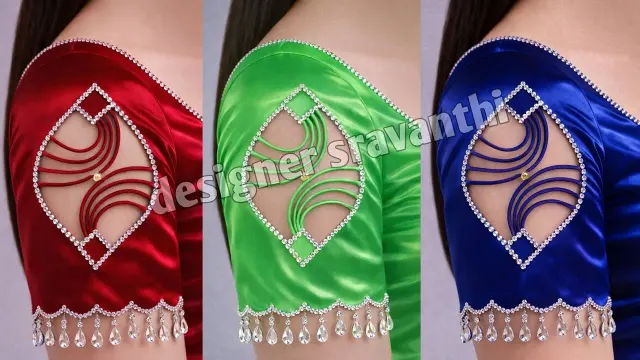
 Ten Blouse Sleeve Designs to Try for Daily, Party and Bridal Wear
#Stitching Ideas
1 ideas
Ten Blouse Sleeve Designs to Try for Daily, Party and Bridal Wear
Get new #Stitching Ideas ideas by email
Every Thursday: the week's best ideas, with the newest from #Stitching Ideas.
Related tags
Stitching Ideas: A Beginner's Guide to Hand Sewing
Stitching is one of the oldest skills people still practise by choice. Long before sewing machines, clothes, bedding and sails were joined by hand with a needle and thread, and many of those same stitches are still the ones used today. What makes stitching appealing now is not necessity but possibility: a needle, some thread and a scrap of fabric are enough to repair something, decorate something, or make something entirely new.
The basic stitches worth learning first
Almost every hand-sewing idea rests on a handful of stitches. Running stitch is the simplest, a straight line of small, even dashes worked in and out of the fabric. Backstitch looks similar but is far stronger, because each new stitch loops back into the end of the previous one, making it a good choice for seams that will take strain. Blanket stitch works along an edge, catching the raw fabric so it does not fray, and whip stitch does a similar job more quickly. Slip stitch joins two folded edges so invisibly that the thread disappears inside the fold.
You do not need to master all of them at once. Learn running stitch and backstitch comfortably, and the rest will follow more easily than they look.
Read more
Mending as a creative practice
One of the most rewarding directions for stitching is repair. Visible mending treats a patch or a darn as decoration rather than something to hide: a hole in a jumper can be darned with contrasting wool, a tear in a shirt covered with a patch held down by bold blanket stitch. Sashiko, a Japanese tradition of running-stitch patterns on indigo cloth, grew out of exactly this kind of practical repairing, and its geometric motifs are now used for embellishment as much as for strength.
Embroidery and embellishment
For those drawn to decoration, embroidery offers endless scope. Simple stitches already in your hand can do most of the work: running stitch for outlines, backstitch for firm lines, and satin stitch, worked closely side by side, to fill small shapes. Begin with a plain, firmly woven cotton and a design built from straight lines and simple curves, and you will avoid the frustration that comes from starting with something too intricate.
Practical things to know before you start
Thread your needle with a length no longer than your forearm; longer thread tangles and frays before it is used up. Choose a needle suited to the fabric, finer for lightweight cloth and sturdier for denim or canvas. Knot the thread end and finish with a couple of small backstitches rather than a bulky knot, which sits lumpily under a seam. Press your work as you go, since seams and edges lie far flatter after a touch of iron.
Above all, let the first projects be small and forgiving. A patched knee, a stitched border on a tea towel, a simple appliquéd shape — each one teaches your hands something the next project will use.
Videos come from YouTube and posts from Instagram; titles and summaries are our own. All rights belong to their creators.