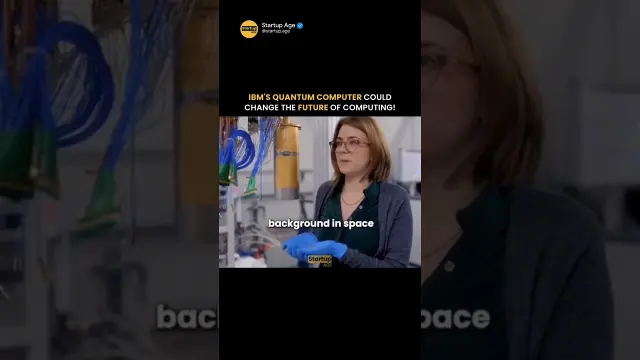
 Inside IBM's Modular Quantum System Two Computer
#Superconducting Qubits
1 ideas
Inside IBM's Modular Quantum System Two Computer
Get new #Superconducting Qubits ideas by email
Every Thursday: the week's best ideas, with the newest from #Superconducting Qubits.
Related tags
Superconducting Qubits: A Beginner's Guide
A superconducting qubit is an artificial atom built from an electrical circuit. Instead of trapping a single particle, it uses a microscopic loop of superconducting metal patterned on a chip, cooled until it carries current with no resistance at all. The quantum information lives in the collective motion of the circuit — the oscillating current or voltage across it — and can be placed in a superposition of two states, much as an electron in an atom can occupy two energy levels at once. This is why superconducting qubits sit at the meeting point of quantum physics, microwave engineering and semiconductor fabrication.
Why the circuit needs a Josephson junction
A plain resonant circuit has evenly spaced energy levels, which makes it useless as a qubit: you cannot address just two of them without disturbing the rest. The trick is to break the circuit with a Josephson junction, a thin insulating barrier between two superconductors. Current can tunnel through it without resistance, and the relationship between current and phase is strongly non-linear. That non-linearity spreads the energy levels apart unevenly, so a microwave pulse at exactly one frequency drives only the lowest pair. The junction is the heart of every superconducting qubit.
The main kinds
Read more
Designs differ in which circuit variable carries the quantum state. Charge qubits encode information in the number of Cooper pairs on a small island; flux qubits use the circulating current in a loop; phase qubits use the phase across a junction. The transmon — a charge qubit made deliberately insensitive to charge noise by adding a large shunt capacitor — became a common workhorse because it is easier to fabricate and control. Fluxonium and other variants trade simplicity for longer coherence. All of them are built with the same tools used for ordinary integrated circuits.
Cold, quiet, and microwave-driven
Qubits operate at temperatures of a few thousandths of a kelvin, inside a dilution refrigerator that cools by mixing two isotopes of helium. At that temperature thermal noise is small enough not to swamp the quantum states. Signals travel down carefully filtered coaxial lines, and control pulses are shaped microwave tones generated at room temperature. Reading out a qubit usually means coupling it to a resonator and measuring how the resonator's response shifts depending on the qubit's state.
Where the errors come from
Coherence is the central struggle. Energy leaks away through dielectric loss in the materials, through stray two-level systems in oxides at surfaces, through quasiparticles breaking Cooper pairs, and through unwanted coupling to neighbouring qubits and control lines. Fabrication cleanliness matters as much as clever design; a qubit is only as good as the surfaces it is made from.
Error correction and scale
Because individual qubits are noisy, useful machines are expected to rely on error correction: spreading one logical qubit across many physical ones and repeatedly checking for errors without measuring the encoded information directly. Surface codes are a common framework for this. Wiring thousands of qubits also pushes designs toward modular architectures with chips connected by microwave or optical links.
If you are starting out
Learn the basics of quantum information first — superposition, measurement, decoherence, the Bloch sphere — then add the circuit side: transmission lines, resonators, and the quantum harmonic oscillator. Familiarity with cryogenics and microwave measurement helps enormously. Expect slow progress at first, and read the device physics alongside the algorithms; the two only make sense together.
Videos come from YouTube and posts from Instagram; titles and summaries are our own. All rights belong to their creators.