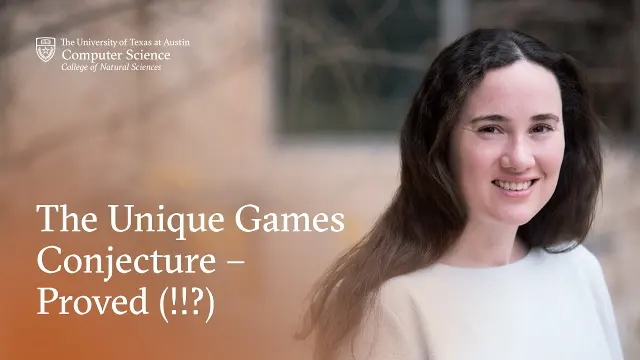
 Dana Moshkovitz Explains the Proposed Proof of the Unique Games Conjecture
#Theoretical Computer Science
1 ideas
Dana Moshkovitz Explains the Proposed Proof of the Unique Games Conjecture
Get new #Theoretical Computer Science ideas by email
Every Thursday: the week's best ideas, with the newest from #Theoretical Computer Science.
Related tags
Theoretical Computer Science: The Math Behind Computing
Theoretical computer science is the part of computing that asks questions about computation itself rather than about any particular program. What can be computed at all? How much time and memory does a problem genuinely require? What are the absolute limits that no clever engineering can get around? Instead of writing software, it studies the mathematical objects underneath software: abstract machines, formal languages, proofs, graphs, probability and information.
A field defined by its questions
Most of the subject rests on a simple idea: strip a computer down to its essentials and describe it as a mathematical object. Once computation becomes an object of study, you can prove things about it. You can show that a problem is solvable by giving an algorithm, or that a whole class of problems cannot be solved efficiently by any algorithm unless something surprising turns out to be true. That habit of asking for proof rather than demonstration is what separates the field from programming.
The main branches
Read more
- Complexity theory sorts problems by the resources they need and studies the relationships between those classes, including the famous open question of whether efficient verification implies efficient solution.
- Algorithms and data structures design and analyse methods for solving problems, with attention to worst cases, average cases and lower bounds.
- Computability and logic examine what is decidable in principle, using formal models of machines and of reasoning.
- Automata and formal language theory describe the machinery behind parsing, pattern matching and the design of programming languages.
- Cryptography builds on hardness assumptions, turning problems that seem difficult into tools for secrecy and verification.
- Information and coding theory measure uncertainty and study how messages survive noise.
- Graph theory, combinatorics and discrete probability supply much of the everyday language and toolset.
- Learning theory, quantum models of computation and the theory of distributed systems extend the same questions to new settings.
Why limits matter
Negative results are as valuable as positive ones. Knowing that a problem is hard tells you to stop searching for an exact, fast solution and instead approximate, restrict the input, or change the question. Much of the field's practical influence comes from this kind of guidance, quietly shaping what software designers consider realistic.
How the work is done
The standard tools are definitions, theorems and proofs. A typical argument reduces one problem to another: if you could solve this, you could also solve that, which we believe is difficult. Other techniques include counting arguments, diagonalisation, probabilistic methods and careful case analysis. Papers in the area are dense with notation, and reading them is a skill built slowly.
Where to begin
Start with discrete mathematics, especially proofs, sets, relations and induction. Add a first course in algorithms and one in formal languages or computability, then follow whichever thread holds your attention. Work exercises rather than only reading, and get comfortable being stuck; the field rewards patience more than speed. A study group helps, because explaining an argument out loud exposes the gaps in it. You do not need to know how to build large systems, but you do need to enjoy precision.
#Theoretical Computer Science: frequently asked questions
What is theoretical computer science, in plain terms?
It is the branch of computing that studies computation itself instead of any single program: what can be computed, how much time and memory a problem truly demands, and which limits no engineering effort can remove. Rather than shipping software, it treats machines, languages, proofs and graphs as mathematical objects and asks for proof rather than demonstration.
How do I get started if I have no background in it?
Begin with discrete mathematics, focusing on proofs, sets, relations and induction, since nearly everything later is built on that fluency. Then add a first course in algorithms and one in formal languages or computability, and follow whichever thread interests you most. Work the exercises instead of only reading, and expect to be stuck often, because patience matters here far more than speed.
Which area within the field should I choose?
Let your curiosity pick it: complexity theory if you are drawn to what makes problems hard, algorithms if you like designing and analysing methods, automata and formal languages if parsing and language design appeal to you, and cryptography or information theory if secrecy and noise do. You do not have to commit early, since the branches share a common toolkit of combinatorics, probability and proof technique.
What background or mindset do I actually need?
You need comfort with precision and abstraction, not experience building large systems. A study group helps a great deal, because explaining an argument aloud quickly exposes the gaps in it. Reading dense, notation-heavy papers is a separate skill, and it is built slowly by working through them rather than skimming.
What mistakes do beginners commonly make?
The usual one is reading without attempting proofs, which creates the feeling of understanding without the ability. Another is chasing the most advanced topic first, skipping the discrete mathematics that everything else assumes. A third is treating hardness results as discouraging: knowing a problem is hard is useful guidance to approximate it, restrict the input, or reframe the question instead of hunting for an exact fast solution.
Videos come from YouTube and posts from Instagram; titles and summaries are our own. All rights belong to their creators.