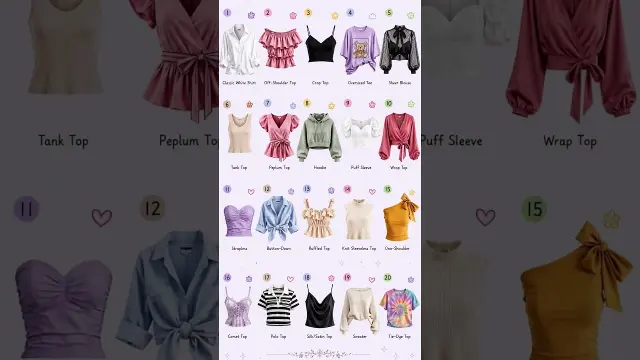
 Top styles guide featuring twenty cute everyday tops
#Top Style Guide
1 ideas
Top styles guide featuring twenty cute everyday tops
Get new #Top Style Guide ideas by email
Every Thursday: the week's best ideas, with the newest from #Top Style Guide.
Related tags
Top Style Guide: Everyday Tops, Cuts and Fabrics
A top is the piece of clothing worn on the upper body, and it is the hardest-working item in most wardrobes. It sits closest to the face, so it shapes how an outfit reads before anything else does. It also has to survive the most wear and the most washing, which is why the difference between a top you reach for constantly and one that stays folded in a drawer usually comes down to a few practical details rather than how it looked on a hanger.
The main styles
The plainest forms are the ones worth knowing first. A T-shirt is a simple knit with short sleeves and a round neck, originally an undergarment and now the most common casual top. A blouse is a woven shirt, usually lighter and more fluid than a men's shirt, often with darts or soft shaping. A shirt, by contrast, is structured: a collar, a button placket, cuffs. A tank top has no sleeves; a camisole is a lighter version, often worn as a layer. Then come the variations that sit in between: the long-sleeve tee, the polo with its soft collar, the tunic that falls past the hip, the cropped top that ends near the waist, and the knit sweater or jumper for cold weather.
Necklines and how they sit
Read more
Neckline matters more than most people expect, because it frames the face. A crew neck sits high and close; a V-neck draws the eye downward and lengthens the neck; a scoop or square neck opens the collarbone; a boat neck runs wide and nearly straight from shoulder to shoulder. Higher necks tend to look tidier and more formal, lower ones more relaxed. There is no universally flattering shape, only the one that suits how you want to look and how much you want to fuss with the garment during the day.
Fit, fabric and the small details
Fit is about ease, not size. A top should let you raise your arms, sit and breathe without pulling across the chest or riding up at the hem. Shoulder seams should land roughly at the edge of the shoulder. Fabric decides how a top behaves: cotton knits are breathable and easy to wash, linen is cool but creases, viscose drapes softly, and a little elastane adds stretch and recovery. Natural fibres usually breathe better; blends often hold their shape longer. Woven fabrics look crisper, knits feel more forgiving.
Look at the construction before you buy. Check whether the seams lie flat, whether the hem is even, whether buttons sit securely, and whether the fabric is thin enough to show what is underneath. A slightly thicker knit or a woven top rarely needs a layer beneath it.
Practical tips
Choose a small number of neutral tops that work with most of your bottoms, then add colour and pattern. Learn which neckline and sleeve length you actually wear, and buy more of those rather than experimenting each time. Wash knits inside out in cooler water, dry them flat where the shape allows, and fold rather than hang heavy sweaters so the shoulders do not stretch. A top that fits well and feels comfortable will be worn far more than one that merely looks good on the rail, and that is the real measure of a good buy.
#Top Style Guide: frequently asked questions
How do I start building a collection of tops I'll actually wear?
Begin with what you already reach for: notice which neckline, sleeve length and fabric you keep choosing, and treat that as your template. Build a small core of neutral tops that work with most of your bottoms, then add colour and pattern once the basics are covered. Buying more of what you genuinely wear beats experimenting with something new every time.
Which neckline should I choose?
There is no shape that flatters everyone, so choose by the effect you want and how much you want to adjust the garment during the day. A high crew neck reads tidier and more formal, a V-neck draws the eye down and lengthens the neck, and a scoop, square or boat neck opens the collarbone for a more relaxed look. Think about how the top frames your face first, since that is what people see.
What should I check before buying a top?
Look at construction rather than the hanger: seams should lie flat, the hem should be even, and buttons should be sewn on securely. Hold the fabric up to the light to see whether it is thin enough to show what is underneath, because a slightly thicker knit or a woven top rarely needs an extra layer. Then move in it, since a top that pulls across the chest or rides up will stay in the drawer.
How do I know if a top really fits?
Fit is about ease, not the size on the label: you should be able to raise your arms, sit and breathe without strain. Shoulder seams should land roughly at the edge of your shoulder, and the hem should stay put when you move. If it looks good on the rail but you keep tugging at it, it is the wrong fit.
How should I care for knits and delicate tops?
Wash knits inside out in cooler water and dry them flat where the shape allows, so they keep their proportions instead of stretching on a line. Fold heavy sweaters rather than hanging them, because a hanger can pull the shoulders out of shape. Storing and washing this way keeps the garment looking closer to how it did when you bought it.
What mistakes should I avoid when shopping for tops?
The most common one is buying for how the top looks on a hanger rather than how it feels and behaves on you. Another is choosing a fabric or neckline that needs constant adjusting, which usually means it will go unworn. A top that fits well and feels comfortable will get far more wear than one that only looks good on the rail.
Videos come from YouTube and posts from Instagram; titles and summaries are our own. All rights belong to their creators.