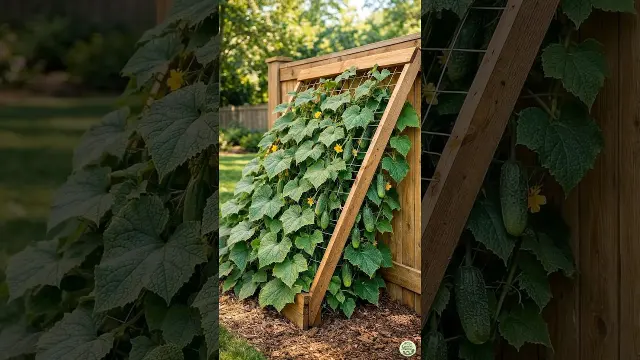
 A Lean-To Cucumber Trellis Hack For Small Backyards
#Trellis Ideas
1 ideas
A Lean-To Cucumber Trellis Hack For Small Backyards
Get new #Trellis Ideas ideas by email
Every Thursday: the week's best ideas, with the newest from #Trellis Ideas.
Related tags
Trellis Ideas for Gardens and Climbing Plants
A trellis is a support structure that helps climbing plants grow upward instead of spreading across the ground. You can use one in a garden, on a fence, against a wall, or in a container. Trellises are useful for vegetables, flowering vines, and many ornamental climbers because they keep plants tidier, improve air flow, and make fruit and flowers easier to see and harvest.
What a trellis is for
At its simplest, a trellis gives a plant something to hold onto. Some plants climb by twining their stems around a support, while others use tendrils or need their stems tied in gently. A trellis can also help save space, which makes it a good choice for small gardens, patios, and narrow beds.
People use trellises for both practical and decorative reasons. A plain support can disappear behind leaves, or it can become part of the garden design. It may be used to screen a view, divide a space, add height, or frame a doorway or path.
Read more
Common trellis styles
There are many basic forms, and the best choice depends on the plant and the space.
- Flat panel trellis: a simple grid or lattice that stands against a wall or fence
- A-frame trellis: two panels joined at the top, useful for heavier vines or temporary beds
- Arch or arbor: a curved structure that creates a passageway or garden feature
- Obelisk or tower: a tall freestanding shape that works well in beds and large pots
- String or wire support: a light, minimal system often used for vegetables
- Fan-shaped trellis: spreads outward and can suit trained ornamental climbers
Wood, metal, bamboo, and strong twine are all commonly used. The best material is one that suits the weight of the plant and the look you want in the garden.
Choosing the right support
When you pick a trellis, think about the mature size of the plant, not just its young growth. A small vine can quickly become heavy, so a support that seems large at first may soon feel too small. Taller climbers need a structure that is firmly anchored and stable in wind.
It also helps to match the trellis to how the plant climbs. Some plants cling on their own, while others need training and soft ties. A smooth wall alone may not be enough unless you add wires or a frame with space for the stems to attach.
Tips for beginners
Start with a simple design and one plant type at a time. Give the trellis a little room from walls so air can move behind the foliage. Check ties regularly so they do not cut into stems as the plant grows.
- Place the support before the plant becomes large
- Use soft ties rather than anything that might damage stems
- Guide new growth early, while stems are still flexible
- Water and feed as needed, because climbing plants often grow quickly
- Prune lightly if the plant becomes too dense or tangled
A useful garden habit
Trellises are one of the easiest ways to make a garden feel more organized and more vertical. They can turn a blank fence into a green feature, support edible plants, or give flowering climbers a place to shine. Once you understand how a plant grows, choosing a trellis becomes much simpler, and even a small space can feel fuller and more alive.
Videos come from YouTube and posts from Instagram; titles and summaries are our own. All rights belong to their creators.