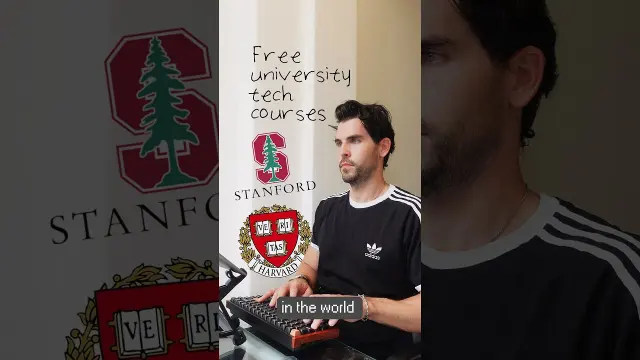
 Free University Tech Courses from Harvard, Stanford and MIT
#University Courses
1 ideas
Free University Tech Courses from Harvard, Stanford and MIT
Get new #University Courses ideas by email
Every Thursday: the week's best ideas, with the newest from #University Courses.
Related tags
University Courses: A Guide to Learning at Any Stage
A university course is a single unit of study: one subject, taught over a set period, usually a term or a semester, and measured in credits. Stack enough of them and you have a degree; take one on its own and you have a focused piece of learning. That flexibility is why courses appeal far beyond full-time students — people take them to change careers, to fill a gap in their skills, to prepare for further study, or simply out of curiosity.
Where the format comes from
The lecture-and-discussion arrangement most courses still use grew out of medieval European universities, where a teacher read a set text aloud and students argued about it afterwards. The reading aloud disappeared; the argument, in the form of seminars, tutorials and problem classes, did not. Alongside it came the examination, and with it the credit system that lets study be counted, compared and transferred between institutions.
The main kinds of course
Read more
Lectures dominate in large introductory subjects, with one teacher addressing many students. Seminars and tutorials are smaller and depend on your participation. Laboratory and studio courses teach through doing, with practical work assessed alongside written work. Some courses run entirely online, either as part of a degree or as open material that anyone can work through. Short courses and continuing education sit outside degree programmes and often focus on a single practical skill.
What to look at before you commit
The syllabus is the real description of a course, not the title. Read it for the topics covered, the assumed prior knowledge, the assessment breakdown and the reading list. Check how much time the course expects outside class — a common rule of thumb is two to three hours of independent work for every hour taught, though this varies widely. If you are choosing between options, compare assessment styles as carefully as subject matter: a course graded mostly on one long project suits different habits than one graded on frequent small tests.
Getting the most from it
Go to the first lecture and the first tutorial. Courses build, and the early weeks set the vocabulary everything else uses. Take notes in your own words rather than transcribing, and review them within a day or two, while the gaps are still obvious. Do the problem sets and readings when they are set, not before the deadline, because the point is to find out what you do not understand while there is still time to ask.
Ask. Office hours and tutorials exist for exactly this, and the students who use them are rarely the ones struggling most. Working through material with others helps too — explaining something out loud exposes what you only half know. If you are studying independently, treat the syllabus as your guide and keep a steady rhythm rather than bingeing before an exam.
And keep the syllabus somewhere you can see it. Most of the anxiety around a course comes from losing track of what is due and when, not from the difficulty of the subject itself.
#University Courses: frequently asked questions
How do I start taking a university course if I'm not enrolled in a full degree?
Begin by deciding what you want the course to do for you — build a skill, prepare for further study, or simply satisfy curiosity — then look for the course that matches that aim rather than a title that sounds appealing. Many institutions offer open or continuing-education routes that let you take a single unit without committing to a programme. Read the syllabus before you register so you know what prior knowledge is assumed and how the work is assessed.
What should I check before choosing between two similar courses?
Look past the title and read the syllabus, which is the real description of what gets covered, what background it expects, and how you will be graded. Compare assessment styles as carefully as subject matter, since a course built around one large project rewards different working habits than one built around frequent small tests. Also weigh how much independent work is expected outside class and whether that fits your available time.
What is the difference between lectures, seminars and lab or studio courses?
Lectures are the large-format sessions where one teacher addresses many students and sets out the core material. Seminars and tutorials are smaller and depend on your participation, while laboratory and studio courses teach through practical work assessed alongside written assignments. Some courses run entirely online, either as part of a degree or as open material you can work through on your own.
How can I keep up with a course once it has started?
Attend the first lecture and the first tutorial — courses build, and the early weeks establish the vocabulary everything later depends on. Take notes in your own words and review them within a day or two while the gaps are still fresh, and do the readings and problem sets when they are set so you discover misunderstandings while there is still time to ask. Use office hours and study with others, because explaining something aloud shows you what you only half know.
What are the most common mistakes people make with a course?
The biggest one is treating the title as the description and skipping the syllabus, then discovering the assessment or assumed background does not suit them. Another is transcribing rather than summarising, and leaving the reading until the deadline instead of using it to test understanding. Much of the stress around a course comes from losing track of what is due, so keep the syllabus where you can see it.
Videos come from YouTube and posts from Instagram; titles and summaries are our own. All rights belong to their creators.