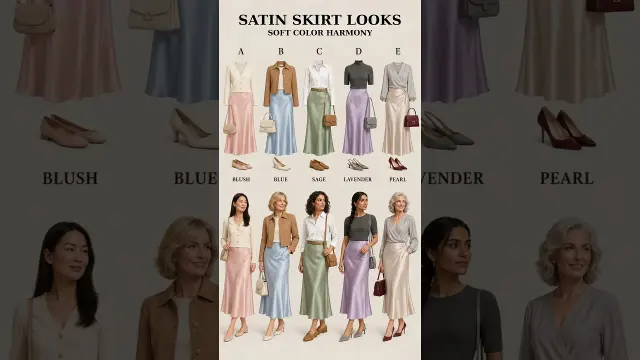
 Classy and Versatile Satin Skirt Outfit Ideas
#Versatile Style
1 ideas
Classy and Versatile Satin Skirt Outfit Ideas
Get new #Versatile Style ideas by email
Every Thursday: the week's best ideas, with the newest from #Versatile Style.
Related tags
Versatile Style: A Wardrobe That Works Harder
Versatile style is not a look you can copy from a single outfit. It is a way of choosing and combining clothes so that most of what hangs in your wardrobe can serve more than one purpose. A plain knit becomes a layer under a blazer, a companion to a skirt, a warm top on a cold morning. A pair of straight-leg trousers goes to work with a shirt and to dinner with a soft sweater. The point is not to own less for its own sake, but to own things that keep earning their place.
The idea grew out of a simple observation that most of us wear a small fraction of what we keep, while the rest waits for an occasion that rarely comes. Wardrobe planners and stylists responded by turning attention from quantity to connection: how many outfits a piece can create with what you already own. That is the whole test. Everything else follows from it.
The principles behind it
- Cohesion over variety. Colours that echo each other, and a shared level of formality, let almost anything pair with almost anything.
- Fit first. A well-fitting simple garment looks better than an elaborate one that pulls or droops, and it is far easier to combine.
- Layering as a tool. Thin layers let one set of clothes cover warm and cool days, casual and formal moments.
- Neutral foundations, personal accents. Start from calm basics, then add the colours, textures and shapes that feel like you.
Read more
Pieces that tend to work
A versatile wardrobe usually rests on a few shapes that repeat in different fabrics: a shirt with a clean collar, a good knit, straight or gently wide trousers, a skirt that moves easily, a jacket that finishes an outfit, and shoes you can walk in. None of these are rules. They are simply shapes that carry many roles without looking out of place.
What makes them work is restraint in detail. Prints and trims are harder to combine; quiet surfaces are forgiven more easily. If you love a strong pattern, use it as the one statement piece and keep the rest calm around it.
Getting started
Begin with what you already have. Pull out the items you reach for again and again and look at what they share — cut, colour, fabric weight. That pattern is your real style, and it is the most reliable guide you have. Then note the gaps: the top that would make two skirts wearable, the layer that would carry a dress into cooler weather.
When you do add something, try it on with at least three things you own before it comes home. If it only works with one outfit, it is not versatile, however lovely it looks on the hanger.
Care matters as much as selection. Clothes that are washed gently, stored folded where folding suits them, and repaired early last longer and keep their shape, which is what makes them easy to wear. Versatility is quiet: it shows up as a wardrobe that never leaves you standing in front of it, wondering what to put on.
#Versatile Style: frequently asked questions
How do I start building a versatile wardrobe?
Start with what you already own rather than with a shopping list. Pull out the pieces you reach for constantly and look for what they share — the same cut, colour family or fabric weight — because that repeated pattern is your real style. From there, note the gaps: the top that would make two skirts wearable, or the layer that would take a dress into cooler weather.
What do I actually need for a versatile style?
You need a small set of shapes that can play several roles, such as a clean-collared shirt, a good knit, straight or gently wide trousers, a skirt that moves easily, a finishing jacket and shoes you can walk in. What matters more than the list is that the pieces share a level of formality and echo each other in colour, so almost anything pairs with anything. Quiet surfaces and restrained detail combine far more easily than prints and trims.
Should I choose neutral basics or pieces with personality?
Both, but in that order. Build the calm foundation first — the plain layers and simple shapes that work with everything — then add the colours, textures and shapes that feel like you. If you love a strong pattern, let it be the single statement in the outfit and keep everything around it quiet.
How do I know if something is truly versatile before buying it?
Try it on with at least three things you already own. If it only works with one outfit, it isn't versatile, however lovely it looks on the hanger. The same test applies at home: an item that rarely leaves the wardrobe is telling you something.
How should I care for versatile pieces so they last?
Wash gently, fold the things that hold their shape better folded, and repair small damage early rather than waiting. Clothes treated this way keep their fit and finish, which is exactly what makes them easy to reach for. Care is part of versatility, not a separate chore.
What mistakes should I avoid when dressing for an occasion?
The common slip is buying something that suits only that one event, then having nothing to wear it with again. Instead, take a piece you already trust and change its role with a layer, a shoe or a softer top. Also beware of an elaborate garment that doesn't fit well — a simple piece that sits properly will always look better and combine more easily.
Videos come from YouTube and posts from Instagram; titles and summaries are our own. All rights belong to their creators.