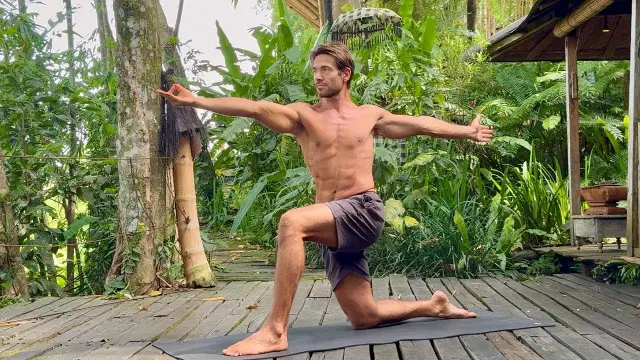
 20 Minute Full Body Yoga Flow for Strength and Mobility
#Vinyasa Flow
1 ideas
20 Minute Full Body Yoga Flow for Strength and Mobility
Get new #Vinyasa Flow ideas by email
Every Thursday: the week's best ideas, with the newest from #Vinyasa Flow.
Related tags
Vinyasa Flow Yoga: A Guide to Moving With Your Breath
Vinyasa is a style of yoga in which movement and breath are linked: you inhale as you lengthen into a pose, exhale as you settle or transition out of it. The word itself is Sanskrit and can be loosely translated as "to place in a special way," which captures the spirit of the practice — each posture arranged deliberately, one after another, rather than held for a long time in stillness.
The sequence of postures known as Sun Salutations is the backbone of most vinyasa classes. These flowing rounds of forward folds, planks, upward-facing poses and downward-facing dogs are repeated, varied and layered with standing poses, balances and seated work. Because the order changes from class to class, vinyasa is sometimes called flow yoga: no two sessions are identical, and the emphasis sits on continuous movement guided by the rhythm of your own breathing.
Where it comes from
Vinyasa grew out of the hatha yoga tradition and was shaped in the twentieth century by teachers who wanted to bring movement into what had become a largely static practice. It spread widely through studio classes and, later, through online teaching, and today it sits alongside styles such as ashtanga — which uses a fixed sequence — and slower, more restorative approaches.
Read more
What a class feels like
Most classes open with a settling-in period, then build heat through repeated flows, explore standing and balancing poses, and close with slower stretches and a rest at the end. Some sessions are vigorous and strength-focused; others are gentle, with more time in each posture. Teachers vary widely in pace, music, language and how much instruction they offer, so trying a few different classes is the best way to find what suits you.
Starting out
- Tell the teacher you are new if you can. They can offer modifications and simpler alternatives.
- Expect to feel lost. Following along imperfectly is normal, and no one is watching you closely.
- Breathe first. If your breath turns shallow or ragged, slow down or take a pause; the breath is the guide, not the pose.
- Use props. Blocks and straps are not a beginner's crutch — they help you find the shape safely.
- Bend your knees generously in forward folds and keep them soft in downward dog. Straight legs are not the goal.
- Rest whenever you need to. Child's pose is a legitimate part of the class, not an interruption.
- Protect your wrists and lower back by spreading weight through your hands and engaging your core in plank transitions.
Over time, the practice tends to build strength, flexibility, balance and a little more steadiness in the mind. Progress is rarely dramatic, and it does not need to be — the point is showing up, breathing, and moving at a pace you can sustain. If you have an injury or a health concern, check with a qualified professional before starting, and let your teacher know so they can adapt the practice to you.
#Vinyasa Flow: frequently asked questions
How do I begin a Vinyasa Flow practice if I've never done yoga before?
Start with a beginner-friendly class and arrive a little early so you can mention that you're new — teachers can then point you toward simpler versions of each posture. Follow the breath rather than chasing the shape, and let yourself pause or rest whenever the pace outruns you. Trying a couple of different classes, in person or online, will quickly show you which pace suits you.
What do I actually need before my first Vinyasa class?
Comfortable clothing you can move and breathe in, plus a mat, is really all it takes. Blocks, straps and a cushion are worth having on hand, since they make many shapes more accessible rather than being a beginner's crutch. Practise somewhere with enough room to stretch your arms out and lie down without hitting anything.
How do I choose between a vigorous Vinyasa class and a gentler one?
Vinyasa covers a wide range: some sessions move fast and build heat, while others linger in each posture and move slowly. Think about what you want from the session — energy and strength, or something calmer and more stretch-focused — and pick accordingly. Because teachers differ so much in pace, music and instruction style, sampling a few is the only real way to know.
What are the most common mistakes people make when flowing through a Vinyasa sequence?
The classic one is letting the breath fall behind the movement, so it turns shallow or ragged while the body races on. Others are locking the knees in forward folds, collapsing into the lower back during plank transitions instead of engaging the core, and treating a rest as a failure rather than part of the practice. Spreading the weight evenly through the hands also protects the wrists.
Can a short Vinyasa session be worthwhile, or does it need to be long?
A short flow still links breath and movement, so it can build warmth, mobility and focus in the time you have. Twenty minutes of continuous rounds, opening with a little settling and closing with slower stretches, works as a complete practice. Consistency matters far more than length.
How does Vinyasa Flow differ from other styles of yoga?
Vinyasa is defined by continuous movement tied to the breath, with sequences that change from class to class rather than being fixed. That sets it apart from styles built on a set order of postures, and from slower approaches that hold shapes for longer with more stillness. It grew out of the older hatha tradition, which is why many of the same postures appear across all of them.
Videos come from YouTube and posts from Instagram; titles and summaries are our own. All rights belong to their creators.