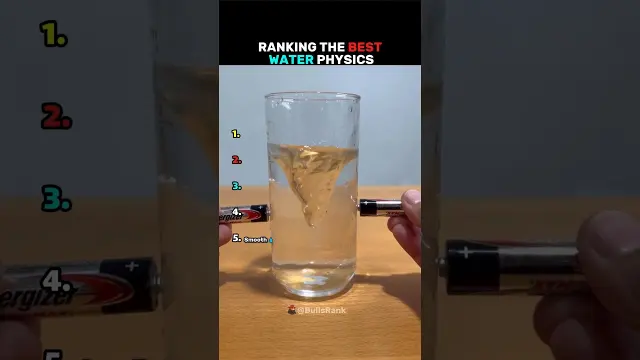
 Water Physics Moments That Look Almost Unreal on Camera
#Water Physics
1 ideas
Water Physics Moments That Look Almost Unreal on Camera
Get new #Water Physics ideas by email
Every Thursday: the week's best ideas, with the newest from #Water Physics.
Related tags
Water Physics: Why Water Moves the Way It Does
Water is so familiar that it is easy to stop noticing it. Then a single drop lands in a bowl and for a fraction of a second it rises into a perfect crown, throws off a ring of tiny satellites, and collapses back into a mirror. Nothing has been added to the water. The strange shapes were always there, just too fast or too small for us to follow with the naked eye.
Surface tension: the skin it does not have
Water behaves as though it is wrapped in a thin elastic film. In reality, molecules at the surface are pulled inward by their neighbours more than outward, so the surface tries to shrink to the smallest area it can manage. That is why small droplets are close to spheres, why insects can stand on a pond, and why a needle can float on a full glass if you place it gently rather than dropping it. Warm water and soap both weaken this effect, which is why soapy water wets and spreads where clean water beads up.
Droplets, splashes and the shapes in between
Read more
When a drop hits a surface, the outcome depends on speed, drop size and how much the surface resists being wetted. A slow drop spreads and settles. A faster one flings out a thin sheet that curls into a crown, tips break off as smaller droplets, and a narrow jet may bounce back up in the middle. Water hitting water is stranger still: a falling drop can trap a cushion of air beneath it, ring out a splash, and leave a vortex ring that drifts downward, invisible except for the specks it carries with it.
Why it looks unreal on camera
Much of the magic is simply time. Fast shutters freeze a splash that your eye reads as a blur; slow motion stretches a few thousandths of a second into something you can study. Light does the rest. Water bends light as it passes from air into liquid, so a straw appears broken, a pool looks shallower than it is, and a droplet can act as a tiny lens, flipping the world upside down inside it. Reflections, meanwhile, are strongest at shallow viewing angles, which is why a wet pavement turns into a sky at a glance.
What to try yourself
- Fill a glass to the brim and add coins one at a time; watch the surface rise above the rim before it breaks.
- Put a few drops of water on a waxy or oily surface and nudge them together with a pin; they will merge into one.
- Float a paperclip or a light leaf on still water to see surface tension hold something denser than itself.
- Film a dripping tap against a dark background with a bright light behind it, then watch the footage slowed down.
- Photograph puddles at a low angle rather than from above; reflections appear where none seemed to exist.
You do not need special equipment to enjoy any of this. A tap, a bowl, a phone and a little patience are enough to watch physics do something that looks like a trick.
#Water Physics: frequently asked questions
How can I start exploring water physics at home?
Start with what you already have: a tap, a bowl, a glass and your phone. Simple setups like overfilling a glass, watching a dripping tap, or floating a light object on still water reveal the same effects you see in polished slow-motion footage. The main ingredient is patience rather than equipment.
Why does water seem to have a skin on its surface?
Molecules at the surface are pulled sideways and downward by their neighbours but not upward, so the surface contracts toward the smallest area it can hold. That tension is what lets small droplets round up, lets insects stand on a pond, and lets a light object rest on a full glass. Adding soap or warming the water weakens the effect and changes how the liquid spreads.
What decides whether a drop splashes or just spreads?
The result depends on how fast the drop is travelling, how large it is, and how strongly the surface resists being wetted. A gentle drop simply spreads and settles, while a faster one throws out a thin sheet that curls into a crown and breaks into smaller droplets. Changing any one of those conditions gives you a different shape.
How do I photograph splashes and droplets well?
Lighting matters more than the camera: place a bright source behind the splash and shoot against a dark background so the water stands out. A fast shutter freezes the moment, and filming at a high frame rate lets you slow the action down afterwards. Puddles and wet pavement are worth shooting from a low angle, where reflections appear that are invisible from above.
Why does water look so strange through a droplet or in a pool?
Water bends light as it passes from air into liquid, so straight objects appear broken and depth looks shallower than it is. A rounded droplet or curved surface can act as a small lens and invert what sits behind it. That same bending is what makes a wet street mirror the sky at a glance.
What mistakes should I avoid when trying these experiments?
The most common one is rushing: these events last a fraction of a second, so set up the shot and the light before you disturb the water. Another is a dirty or soapy container, which changes how the surface behaves and spoils the effect you were trying to see. Keep the setup still and give the water time to settle between attempts.
Videos come from YouTube and posts from Instagram; titles and summaries are our own. All rights belong to their creators.