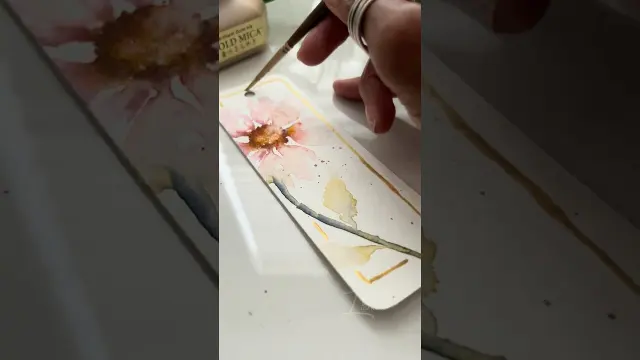
 Easy Watercolour Bookmarks With Loose Florals and Ribbon
#Watercolor Flowers
1 ideas
Easy Watercolour Bookmarks With Loose Florals and Ribbon
Get new #Watercolor Flowers ideas by email
Every Thursday: the week's best ideas, with the newest from #Watercolor Flowers.
Related tags
Watercolor Flowers: A Guide to Painting Loose Florals
Watercolor flowers are exactly what the name suggests: blooms painted with pigment thinned by water, so that colour arrives in transparent layers instead of solid strokes. What draws people to the subject is the way the medium behaves — a wet wash spreads on its own, edges soften or sharpen depending on how dry the paper is, and the white of the sheet becomes the brightest highlight in the petal. It is a forgiving way to paint and an honest one, because watercolor keeps a record of every decision you make.
Where the tradition comes from
Watercolor paint is pigment held together with a binder that reactivates with water. Because thin layers let you suggest delicate shifts of colour, the medium has long been used to describe plants and flowers, both as careful study and as decoration. A separate and equally old tradition exists in East Asian ink and wash painting, where plum blossom, peony, lotus and chrysanthemum are painted with a few loaded brushstrokes and a great deal of empty paper. Contemporary flower painting borrows freely from both: accuracy from one, suggestion from the other.
Two ways to approach a flower
- Loose and expressive: you work quickly from a wet shape, letting colours bleed into each other, and the finished painting reads as a gesture rather than a record.
- Botanical and illustrative: you draw first, then build colour in thin, patient layers, aiming for a recognisable likeness.
Neither is more advanced than the other. Most painters move between the two depending on mood and subject, and a loose study is often the best preparation for a precise one.
Read more
Techniques worth learning early
- Wet-on-wet: paint or clean water goes onto damp paper, so the pigment blooms outward on its own.
- Wet-on-dry: paint onto dry paper, giving crisp edges and defined shapes.
- Dry brush: a nearly empty brush dragged across textured paper, useful for stems and seed heads.
- Lifting: blotting or brushing damp pigment away to recover a light area.
- Glazing: letting one transparent layer dry completely before adding the next, which builds depth without muddiness.
What beginners should know
Water control matters more than drawing skill. A brush that is too wet floods the paper; too dry and the colour stalls. Keep a scrap sheet beside you to test the strength of a mix before it touches the painting. Work from light to dark, since pale colours cannot be recovered once darkened, and let layers dry properly — impatience is the usual reason a flower turns grey. Draw lightly, so the pencil never fights the paint.
Practical tips
- Paint the same flower several times in one sitting; the second and third are always freer than the first.
- Limit your palette. Two reds, two yellows and a blue will mix almost any petal you need.
- Vary your greens for leaves and stems, mixing warm and cool versions rather than using one flat green.
- Leave gaps of untouched paper inside the flower; they read as light.
- Group blooms in odd numbers and vary their size to keep a composition natural.
Finished watercolor is sensitive to strong light, so keep paintings framed behind glass and away from direct sun if you want the colour to stay fresh.
#Watercolor Flowers: frequently asked questions
How do I get started painting watercolor flowers if I've never used the medium before?
Start with a single bloom rather than a full bouquet, and paint it several times in one sitting — the later attempts are almost always freer and more confident than the first. Spend your early practice on water control rather than drawing accuracy, testing each mix on a scrap sheet before it touches the painting. Drawing lightly underneath helps, since a heavy pencil line will fight the paint instead of disappearing beneath it.
What supplies do I actually need for watercolor flowers?
You need watercolor paint, a brush or two, watercolor paper and water — everything else is optional. A limited palette is genuinely enough: a couple of reds, a couple of yellows and a blue will mix nearly any petal you come across, and varying your greens between warm and cool keeps foliage from looking flat. Keep a spare sheet nearby for testing colour strength, and have something on hand for blotting so you can lift paint back off.
Should I paint flowers loose and expressive, or detailed and botanical?
Neither approach is more advanced than the other, and most painters move between them depending on mood and subject. Loose work starts from a wet shape and lets colours bleed into one another so the painting reads as a gesture, while botanical work builds thin layers over a drawing toward a recognisable likeness. A quick loose study is often the best possible preparation before you attempt a precise one.
Why do my watercolor flowers keep turning muddy or grey?
Impatience is usually the culprit — adding the next layer before the previous one has fully dried turns a fresh flower grey. Let each transparent layer dry completely before glazing the next over it, and work from light to dark, because pale colour cannot be recovered once it has been darkened. A brush that is too wet will also flood the paper and blur your edges, so keep testing the load before you commit it.
How do I care for a finished watercolor flower painting so the colour stays fresh?
Watercolor is sensitive to strong light, so frame the piece behind glass and hang it away from direct sun. Keeping it out of bright exposure is the main thing that preserves the brightness of the colour over time. Handle the paper itself by the edges where you can, since oils and moisture from hands mark the surface.
What are the most common beginner mistakes with watercolor flowers?
Overloading the brush with water, rushing the drying time between layers, and drawing too heavily underneath are the usual ones. Another is filling the whole flower with pigment: leaving gaps of untouched paper inside the bloom is what reads as light, and they cannot be added back later. Using one flat green for every leaf is a quieter mistake worth fixing early by mixing warm and cool versions instead.
Videos come from YouTube and posts from Instagram; titles and summaries are our own. All rights belong to their creators.