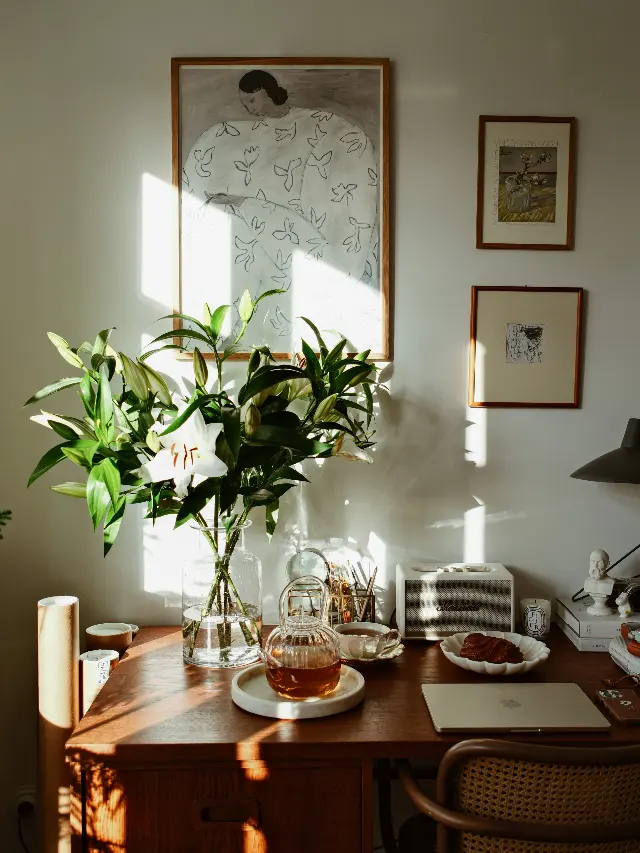
 A quiet Sunday coffee moment in a cosy, styled workspace corner
#Workspace Inspiration
1 ideas
A quiet Sunday coffee moment in a cosy, styled workspace corner
Get new #Workspace Inspiration ideas by email
Every Thursday: the week's best ideas, with the newest from #Workspace Inspiration.
Related tags
Workspace Inspiration: Ideas for a Desk You Love
A workspace is more than a surface you sit at. It is the corner where thought, craft and daily routine meet, and the way it is arranged quietly shapes how easy it feels to begin. Workspace inspiration is the practice of looking at other people's desks, studios and kitchen tables not to copy them piece by piece, but to notice what makes them work and carry those ideas home.
The idea has deep roots. For centuries, craftspeople arranged their benches around the order of their tasks: tools within reach, materials stored according to how often they were used, light falling on the work rather than behind it. Writers and artists have long been documented at their desks, and the interest in those rooms is less about furniture than about habit. Social sharing turned a private practice into a collective one, but the underlying principle is old: a good workspace is designed around a person, not around a picture.
The main approaches
- Practical first. The desk is organised around the work: storage where the hand naturally falls, cables managed, the most-used items closest.
- Quiet and minimal. Few objects, soft colour, plenty of empty space, so the eye has somewhere to rest.
- Warm and layered. Wood, textiles, plants, books and collected objects, arranged so the corner feels lived in rather than staged.
- Shared and flexible. A table that serves as desk, dining spot and workbench, with storage that can be cleared away quickly.
Read more
Most real spaces blend several of these. The useful question is never "does it look right?" but "does it suit how I work?"
What beginners should know
Start with light. Natural daylight, ideally from the side, is the single most valuable feature of any desk, and it is worth rearranging a room to get it. Add a task lamp for darker hours and avoid placing a screen directly in front of a bright window.
Then think about the chair and the height of the surface before anything decorative. Comfort decides whether you will actually use the space. Keep the desk at a height that lets your forearms rest level, and support your feet.
Clear the surface you work on, and give everything else a home. Clutter tends to gather where objects have no fixed place; a drawer, a box or a shelf resolves more than repeated tidying does.
Practical tips
- Design for the first five minutes of the day: whatever you need to begin should be reachable without moving.
- Let one thing be personal, whether a photograph, a plant or a stone from a walk. A single meaningful object does more than many.
- Choose storage you can open with one hand and see into.
- Leave a patch of empty desk. Space is a material.
- Change things slowly. A workspace evolves with the work you do in it, and the best corners are the ones that have been adjusted for years.
Workspace inspiration, in the end, is permission to take your own daily life seriously enough to arrange it well.
#Workspace Inspiration: frequently asked questions
How do I start creating a workspace when I don't really know what I'm doing?
Begin with the conditions you can't fake: daylight from the side, a chair you can sit in comfortably, and a surface at a height that lets your forearms rest level with your feet supported. Clear the top of the desk before you think about anything decorative, and give the things that pile up a fixed place to live. Only after that is settled does it make sense to think about how the corner looks.
What do I actually need versus what is just nice to have?
The essentials are light, comfortable seating, a well-proportioned surface, and somewhere to put things so the work area stays clear. A task lamp for darker hours and simple storage you can open with one hand and see into cover most of the rest. Everything beyond that is personal preference, which is why copying a beautiful photo piece by piece rarely produces a space that works for you.
How do I choose which style of workspace suits me?
Rather than picking a look, watch how you actually use the space: if you need tools and materials constantly, an organised, task-led arrangement will serve you better than an empty minimal desk. If the corner has to double as a dining table or workbench, choose flexible storage that clears away quickly. Most real workspaces mix several approaches, and the test is whether it suits your habits, not whether it photographs well.
How do I stop my desk from turning into a pile of clutter again?
Clutter collects wherever objects have no assigned home, so a drawer, box or shelf does more lasting good than tidying the surface over and over. Choose containers that are easy to open and let you see what's inside, and deliberately leave part of the desk empty so there's room to work. Bringing in fewer things, each of which you actually use, keeps the space from filling back up.
What mistakes do people make when setting up a workspace?
The most common one is shopping for decor before sorting out light, seating and surface height, which are what decide whether you'll want to sit there. Another is placing a screen directly in front of a bright window, or styling the corner to match an image instead of to match the way you work. Changing everything at once is also a trap, since a workspace tends to improve through slow, small adjustments over time.
Videos come from YouTube and posts from Instagram; titles and summaries are our own. All rights belong to their creators.