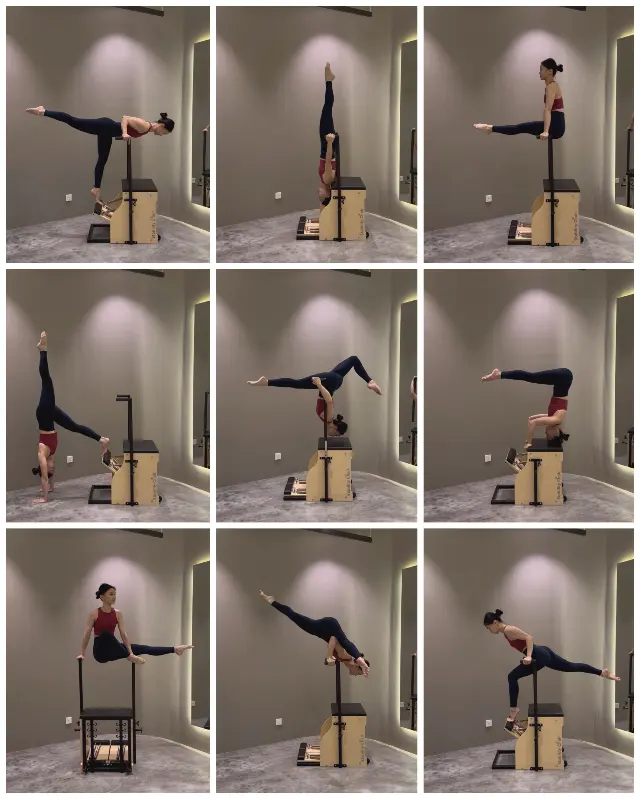
 Wunda chair movement challenges and shapes
#Wunda Chair
1 ideas
Wunda chair movement challenges and shapes
Get new #Wunda Chair ideas by email
Every Thursday: the week's best ideas, with the newest from #Wunda Chair.
Related tags
Wunda Chair Guide
What the Wunda Chair is
The Wunda Chair is a compact Pilates apparatus used for strength, balance, control, and mobility. It has a padded seat and a pedal system with springs that create resistance. The chair is small enough to fit in a studio corner, yet it can offer a wide range of exercises for the whole body.
It belongs to the classical Pilates equipment family, developed to support the method’s focus on precise movement, breath, and core control. Because the base is smaller than a reformer or Cadillac, it often asks for more stability and concentration. That is part of what makes it both challenging and useful.
How it is used
Read more
The Wunda Chair can be used seated, standing, kneeling, or lying beside the apparatus, depending on the exercise. The spring resistance helps train controlled pushing and pulling actions, while the unstable platform encourages alignment and balance.
It is commonly used to work:
- legs and glutes
- abdominal control
- back and shoulder strength
- foot and ankle stability
- coordination and posture
Many exercises involve pressing the pedal down and slowly returning it with control. Others use the top of the chair for supported standing work or side-body exercises. The exact repertoire varies by Pilates style and teacher.
Main styles and exercise families
Wunda Chair work can be grouped into a few broad types:
- Basic pedal presses: often used to build familiarity with spring resistance and alignment
- Standing exercises: help challenge balance, leg strength, and posture
- Seated exercises: focus on core control and spinal organization
- Side-lying or kneeling exercises: develop lateral strength and shoulder stability
- Advanced control work: may include full-body sequences, jumps, or more demanding balance positions
Some Pilates traditions use the chair in a very classical way, with a set sequence and strict form. Others adapt it more freely for rehabilitation, athletic training, or general fitness. Whatever the style, the principles stay the same: control, precision, and smooth movement.
What beginners should know
If you are new to the Wunda Chair, start slowly. The apparatus can feel less forgiving than mat work because the surface is smaller and the springs can change the difficulty quickly. A good teacher will help you learn how to mount, dismount, and move safely.
A few practical tips:
- Keep your movements small and controlled at first
- Focus on steady breathing
- Avoid locking your knees or shoulders
- Use your center for support instead of pushing with momentum
- Ask for spring settings that match your level
It is normal to need time to build confidence. Many beginners find the chair especially helpful for noticing habits in posture, weight placement, and pelvic control.
Why people like it
The Wunda Chair is valued because it is compact, versatile, and direct. It can make simple exercises feel deeply challenging, and it rewards careful technique. For many people, it is one of the clearest ways to experience the Pilates idea that strength and control go hand in hand.
If you approach it patiently, the Wunda Chair can become a powerful tool for improving balance, body awareness, and functional strength.
Videos come from YouTube and posts from Instagram; titles and summaries are our own. All rights belong to their creators.