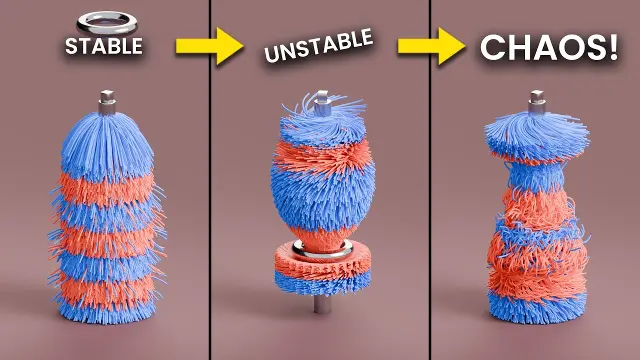
 Satisfying 3D Physics Simulations Created in Blender
#3D Art
3 ideas
Satisfying 3D Physics Simulations Created in Blender
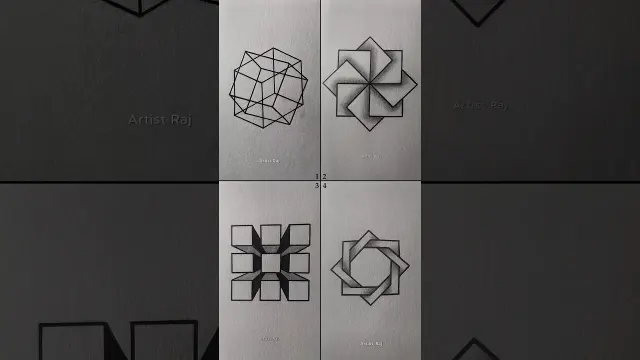 Simple Tutorial on How to Draw 3D Things
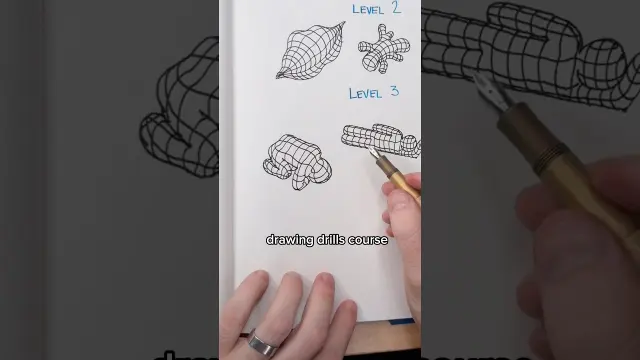 Drawing drills to train your eye in three dimensions
Get new #3D Art ideas by email
Every Thursday: the week's best ideas, with the newest from #3D Art.
Related tags
3D Art: A Beginner's Guide to Depth and Dimension
Three-dimensional art is any work that gives the impression of depth, volume and physical presence. A drawing on a flat sheet can feel solid, a sculpture can be walked around, a digital model can be rotated and lit from any angle. What they share is the same underlying idea: an object has height, width and depth, and the artist's job is to translate that fullness into something a viewer can believe in.
Where it comes from
Sculpture and relief carving are as old as human making, but the illusion of depth on a flat surface is a more specific achievement. Long before perspective was written down, artists were already shrinking distant figures, overlapping forms and darkening receding spaces. When drawing systems were formalised during the Renaissance, the rules of perspective became teachable rather than intuitive, and artists have been refining and deliberately breaking them ever since.
The main kinds
Read more
Sculpture and installation work occupy real space, so depth is simply there. Relief carving sits between sculpture and drawing, projecting from a background surface. Then there is the large family of illusion: pencil and charcoal shading, architectural perspective drawings, trompe-l'oeil work designed to trick the eye, anamorphic images that only resolve from one viewpoint, and chalk or tape drawings on pavement that stretch a scene across the ground. Digital and computer-generated work adds a newer branch, where light, material and camera can be set and reset endlessly.
What beginners should know
Almost all of the effect rests on a handful of habits. Light comes from a direction, so decide where yours is before you shade anything, and keep it consistent. Anything closer appears larger; parallel lines that recede converge. Overlap tells the eye which shape is in front. Edges soften with distance, and contrast weakens with it too. Cast shadows anchor an object so it does not appear to float.
Beginners often rush the drawing underneath and start shading too early. Measure and check proportions first, then build value slowly from light to dark, using a range of tones rather than one heavy press of the pencil. Sight along your pencil to compare angles, and turn your paper or stand back regularly; errors hide when you stay close.
Practical tips
- Draw from life when you can. Real objects show you how light actually behaves, which photographs flatten.
- Set a single lamp on one side of a simple still life and draw what the light does, not what you assume.
- Keep a sketchbook for quick studies of boxes, cylinders and spheres in different lighting; they underpin nearly everything else.
- Photograph your own work and flip it. Inversions make crooked lines obvious.
- Practise patience with the boring parts. Repeated simple forms teach more than ambitious subjects attempted once.
Whether you work with pencil, clay or software, the goal is the same: to make a flat or static thing feel like it occupies space you could reach into. That is a skill built by looking closely, not by talent.
#3D Art: frequently asked questions
How do I start learning 3D art as a beginner?
Start with simple forms like boxes, cylinders, and spheres, because they teach you how light, shadow, and volume work together. Focus on observing real objects, sketching from life when possible, and checking your proportions before adding detail.
What do I need to make 3D art?
You can begin with very basic tools such as paper and a pencil, or you can work with clay, mixed materials, or digital software depending on the kind of art you want to make. A good eye for light, shadow, and perspective matters more than fancy equipment, especially at the start.
Which type of 3D art should I choose?
Choose based on the effect you want and the space you have. Sculpture, relief carving, and installations are best when you want a real object to occupy space, while drawing, chalk illusions, and digital work are better if you want to create the feeling of depth on a flat surface.
What are the most common mistakes when making 3D art?
A common mistake is shading too early before the structure is clear, which can make the form feel flat or uneven. Another is using inconsistent light, ignoring overlap and perspective, or pressing too hard too soon instead of building tone gradually.
How can I make my 3D drawing or model look more realistic?
Keep the direction of light consistent and use cast shadows to anchor the object in space. Also pay attention to how edges soften in the distance and how contrast becomes weaker farther away, because those small changes help the eye believe the form is real.
How should I care for finished 3D art?
Keep physical pieces clean, dry, and protected from rough handling so their surfaces and shapes stay intact. For digital work, save copies in more than one place and revisit the lighting, camera angle, or materials later if you want to refine the result.
Videos come from YouTube and posts from Instagram; titles and summaries are our own. All rights belong to their creators.