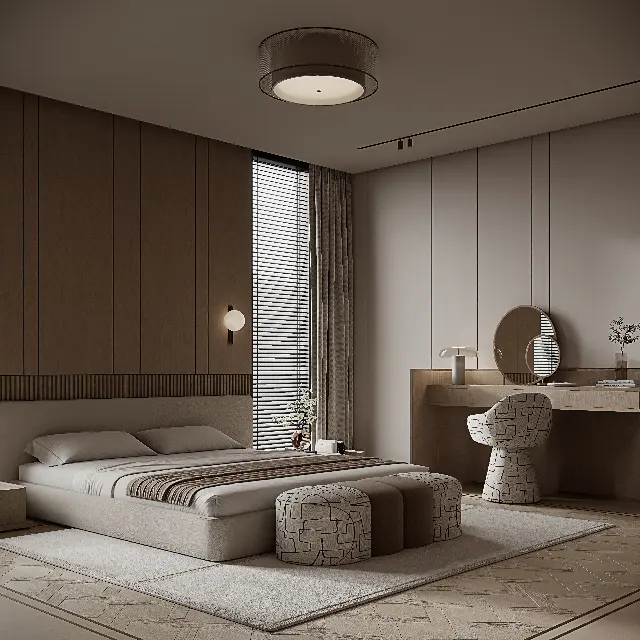
 Minimal bedroom design rendered by nada.saad_1
#3D Visualization
1 ideas
Minimal bedroom design rendered by nada.saad_1
Get new #3D Visualization ideas by email
Every Thursday: the week's best ideas, with the newest from #3D Visualization.
Related tags
3D Visualization: A Beginner's Guide to Rendering Ideas
3D visualization is the craft of building a scene inside a computer and producing images, or short animations, that look like photographs of something that does not exist yet. A designer constructs objects in three dimensions, gives them surfaces and materials, places lights, and lets the software calculate how light would travel through that space. The result can describe a room before it is built, a product before it is manufactured, or a mood that would be expensive to stage in real life.
Where it comes from
The idea is older than most people assume. Engineers and mathematicians were computing shaded images of three-dimensional shapes long before home computers existed, and the vocabulary of the field still carries that heritage: geometry, perspective, projection. What changed over the decades was speed. Work that once required a room full of machines and hours of waiting now happens on an ordinary laptop in minutes, which is why 3D imagery has moved from technical drafting into interior design, advertising, architecture and pure visual pleasure.
What it is used for
Interior and architectural visualization is the most familiar use: showing a client a finished bedroom, a kitchen or a facade before any material is ordered. Product visualization presents objects with controlled lighting and no studio logistics. Concept and set design use the same tools to explore ideas for film, theatre and events. Alongside these professional uses sits a large creative community that renders imagined spaces simply because the act of composing light and form is satisfying.
The main approaches
Roughly, work splits into modelling, texturing, lighting and rendering, though in practice these overlap. Some artists model everything from scratch; others assemble scenes from ready-made elements and concentrate on composition. Two broad rendering styles dominate the look of most images: photorealistic, which aims for the appearance of a camera photograph, complete with soft shadows and slight imperfection; and stylized or illustrative, which flattens, simplifies or exaggerates colour and light for atmosphere. Neither is more advanced than the other. Style should follow the purpose of the image.
Read more
What beginners should know
Start with one small scene rather than a whole apartment. A single corner with a chair, a window and a lamp teaches more than a sprawling project you never finish. Learn how light behaves before you collect materials: the direction, softness and quantity of light do more for realism than any surface texture. Study real interiors and real photographs and ask yourself where the light comes from and what it bounces off.
Practical tips
- Keep your geometry simple where the camera will never look closely.
- Build a small library of materials you have tested and trust.
- Render at low resolution while composing, then raise quality only at the end.
- Leave a little imperfection — a crease, a slightly uneven surface — because perfect surfaces read as artificial.
- Save versions as you go; experiments are easier to judge when you can compare.
Patience matters more than equipment. Every convincing image is the product of many small, unremarkable decisions about light, scale and material, made one at a time.
#3D Visualization: frequently asked questions
How do I get started with 3D visualization if I've never built a scene before?
Begin with one small scene instead of trying to model an entire home — a single corner with a chair, a window and a lamp will teach you more than a sprawling project you never finish. Focus your early effort on light rather than on collecting materials, because the direction, softness and amount of light shape realism far more than any surface texture. Study real interiors and photographs as you go and ask yourself where the light is coming from and what it bounces off.
What do I actually need to make 3D images — expensive equipment?
Patience matters more than gear. The work that once required a room full of machines now happens on ordinary hardware, so a modest setup and one piece of software you commit to will carry you a long way. What you really need is a willingness to make many small, unremarkable decisions about light, scale and material, one at a time.
Should I aim for photorealistic renders or a stylized look?
Neither style is more advanced than the other — the choice should follow what the image is for. Photorealistic work chases the appearance of a camera photograph, complete with soft shadows and slight imperfection, while stylized or illustrative rendering flattens, simplifies or exaggerates colour and light for atmosphere. Ask who the image is speaking to before you decide.
Why do my renders look artificial even when the model is detailed?
The usual culprit is light rather than geometry — flat, evenly bright scenes read as computer output no matter how good the surfaces are. Perfect surfaces also look fake, so leave a crease or a slightly uneven edge somewhere. Another common trap is over-detailing areas the camera never looks at closely, which costs time without improving the picture.
How do I work efficiently without losing good ideas along the way?
Compose at low resolution and raise the quality only once the picture is settled, so you aren't waiting on finished renders of ideas you're still testing. Save versions as you go, since experiments are much easier to judge when you can put them side by side. Building a small library of materials you've already tested and trust also saves a lot of repeated fiddling.
What kinds of projects can 3D visualization be used for?
It is most familiar in interior and architectural work, showing a finished room or facade before any material is ordered. Product visualization presents objects under controlled lighting without studio logistics, while concept and set design use the same tools to explore ideas for film, theatre and events. Plenty of people also render imagined spaces simply because composing light and form is satisfying.
Videos come from YouTube and posts from Instagram; titles and summaries are our own. All rights belong to their creators.