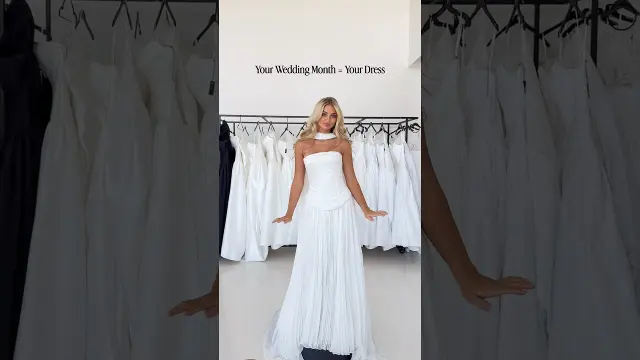
 Wedding Dress Silhouettes Matched to Your Wedding Month
#A-Line Wedding Dress
1 ideas
Wedding Dress Silhouettes Matched to Your Wedding Month
Get new #A-Line Wedding Dress ideas by email
Every Thursday: the week's best ideas, with the newest from #A-Line Wedding Dress.
Related tags
A-Line Wedding Dress: A Complete Guide
An A-line wedding dress is one of the most recognisable shapes in bridal wear: a fitted bodice that flows into a skirt which widens gradually from the waist down, tracing the outline of a capital A. The silhouette is defined by that steady, unbroken flare rather than by a sharp seam at the hips, and it usually reaches the floor in a soft, even sweep.
Where the shape comes from
The term entered everyday fashion vocabulary in the mid-twentieth century, when designers began describing clean, geometric silhouettes in letters of the alphabet. Bridal wear adopted it quickly because the shape is forgiving to cut and easy to wear. Its roots reach further back, though — the idea of a defined waist above a full skirt has appeared in Western dress for centuries, in court gowns, farming clothes and everything in between.
How it is built
Most A-line gowns consist of a structured or semi-structured bodice, a waist seam, and a skirt cut in panels or layers so the fabric falls without clinging. The volume can be modest — barely wider than the hips — or generous enough to read almost like a ball gown. This range is what makes the shape so adaptable: a light crepe or chiffon A-line looks modern and fluid, while tulle, organza or mikado hold a rounder, more sculptural skirt.
Variations are mostly in the details: sleeveless or long-sleeved, high neckline or deep V, plain or covered in lace appliqué, with a sweep train, a chapel train, or none at all. Tea-length and midi versions follow the same line on a shorter hem.
Read more
Why it suits so many people
Because the skirt leaves the waist and hips without tension, an A-line flatters a wide range of body shapes and reads as balanced from every angle. It also moves well, which matters when you are standing, sitting, greeting guests and dancing for many hours. Brides who want coverage often find it in an A-line with a higher back or sleeves; brides who want lightness find it in a single-layer skirt.
Practical tips before you shop
- Try the shape in at least two volumes — a slim A-line and a fuller one — before deciding; the difference on the body is bigger than it looks on a hanger.
- Bring the shoes and undergarments you plan to wear, since both change how a hem falls.
- Ask how the skirt is constructed: layered skirts and long trains add weight, and weight is what you notice at the end of the day.
- Remember that alterations are normal. A waist that sits a centimetre or two off can be adjusted; a silhouette that feels wrong in the mirror usually cannot.
- Move in the dress — walk, sit, climb a step — in the fitting room, not only on the day.
Choose the A-line that lets you forget what you are wearing. That is the one you will still like in photographs years from now.
#A-Line Wedding Dress: frequently asked questions
How do I know whether an A-line wedding dress is the right shape for me?
Start by asking what you want the dress to do: skim away from the waist without clinging, feel balanced from every angle, and stay comfortable through a long day of standing and dancing. An A-line is usually a good match if you like a defined waist with a skirt that widens gently rather than flaring sharply at the hips. If you want a shape that hugs the body closely or one with dramatic structured volume, try those as well before deciding.
Which fabric should I choose for an A-line wedding dress?
The fabric decides how much the skirt moves and how sculptural it looks, so pick it with the mood of your day in mind. Fluid options like crepe or chiffon keep the line soft and modern, while tulle, organza or a crisp structured weave hold a rounder, more architectural silhouette. Ask to see the same shape in a lighter and a heavier fabric — the difference on the body is easier to judge than it sounds.
What should I bring to an A-line dress fitting?
Bring the shoes and undergarments you actually plan to wear, because both change where the hem sits and how the bodice lies. It also helps to bring someone whose opinion you trust but who will let you decide, and to wear something easy to change in and out of. Ask how the skirt is built while you are there: layers, lining and a long train all add weight you will feel by the end of the day.
How should I care for an A-line wedding dress before and after the wedding?
Before the day, keep the gown hanging in a breathable garment bag away from direct sunlight and damp, and let it air after any fitting rather than sealing it away still warm from the body. After the wedding, have it cleaned promptly, since marks that look invisible can darken over time, and tell the cleaner about any beads, appliqué or delicate layers. Store it flat or boxed with acid-free tissue rather than hanging for years, as the weight of a full skirt can strain the bodice seams.
What are the most common mistakes people make when shopping for an A-line dress?
The usual one is judging the shape on the hanger instead of on the body, and only trying a single volume when a slimmer and a fuller version can feel completely different. Another is buying a dress that fits in the mirror but not in motion — always walk, sit and climb a step in the fitting room. Finally, people often expect alterations to change the silhouette when in fact they fine-tune fit, so choose a shape you already like before any adjustments.
Can an A-line dress suit a casual, short or outdoor wedding?
Yes — the shape is defined by its line, not its length or formality. Shorter hems and single-layer skirts in light fabrics read relaxed and easy to move in, which works well for a garden, registry office or daytime celebration. If the ground is uneven or soft, ask for a hem that clears the floor so the skirt does not drag.
Videos come from YouTube and posts from Instagram; titles and summaries are our own. All rights belong to their creators.