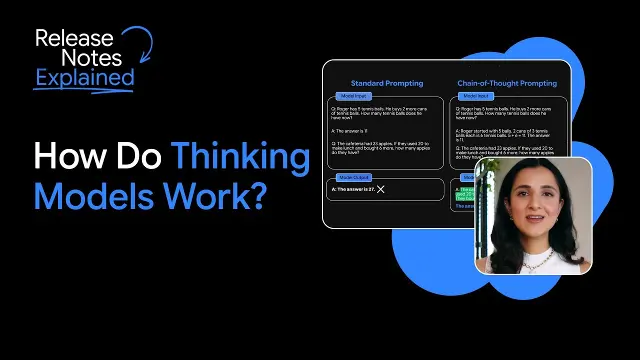
 How Thinking and Reasoning Models Actually Work, Explained
#AI Reasoning
1 ideas
How Thinking and Reasoning Models Actually Work, Explained
Get new #AI Reasoning ideas by email
Every Thursday: the week's best ideas, with the newest from #AI Reasoning.
Related tags
AI Reasoning: How Machines Work Through Problems
Reasoning, in the ordinary sense, is what happens between a question and an answer: splitting a problem into parts, weighing possibilities, noticing a contradiction, and going back to repair it. When people speak of AI reasoning, they usually mean the attempt to get a language model to do that work instead of producing the first plausible-sounding sentence it can.
What it is
A language model predicts text. That single ability carries a surprising amount of implicit skill, because much of human knowledge is compressed into the way sentences follow one another. But prediction is not the same as working something out. A model that answers instantly is answering from pattern, and patterns fail on problems that require several steps to be kept straight at once. Reasoning is the effort to make those steps explicit, giving the model room to compute rather than to recall.
The main approaches
Read more
- Chain of thought: the model writes intermediate steps before committing to an answer, which makes errors visible and gives the calculation somewhere to happen.
- Decomposition: a large question is broken into smaller questions that can be handled one at a time.
- Self-consistency: several independent attempts are generated and compared. Agreement is weak evidence; disagreement is a useful warning that the problem is harder than it looked.
- Verification: the result is checked by another route, such as substituting it back, re-deriving it, or testing an edge case.
- Tool use: arithmetic, code execution or lookup is handed to something that does it exactly rather than approximately.
Where it helps, and where it does not
Multi-step arithmetic, logic puzzles, planning under constraints, and code all reward explicit reasoning, because they have checkable answers. Open-ended judgement and questions about taste or values gain much less. The deeper difficulty is that a fluent chain of steps looks like reasoning without necessarily being it. A model can construct a convincing justification for a conclusion it reached by pattern, and the elegance of the exposition is no evidence of its correctness. Errors early in a chain cascade; long chains drift; and small changes in phrasing can shift the outcome.
For beginners
- Ask for the steps, not only the answer, so you can see where the work went wrong.
- State the goal, the constraints and the desired format up front.
- Ask which assumptions the answer depends on, and what would change it.
- Request a check by a second method rather than a repetition of the first.
- Read the trace instead of skipping to the last line. The conclusion is the least informative part.
- Verify anything that matters outside the conversation.
Treat reasoning text as a draft of someone's thinking, not as a proof. It is most valuable when it makes a problem legible enough that you can judge it yourself.
#AI Reasoning: frequently asked questions
How do I start using AI reasoning on a problem?
Begin by writing out the goal, the constraints and the shape of the answer you want before anything else, since the model works better with a defined target. Then ask for the intermediate steps rather than the final line, so the working is visible and you can spot where it went astray. Finish by asking for a check through a different route than the one already taken.
What do I actually need to get useful reasoning out of a model?
No special setup is required beyond a clear problem statement and a willingness to read the working rather than skim to the conclusion. What matters most is choosing a task with a checkable answer, because multi-step arithmetic, puzzles, planning and code give you something you can verify yourself. For open questions of taste or judgement, expect far less benefit from asking for step-by-step working.
Which reasoning approach should I choose: step-by-step, breaking the problem down, or several attempts?
Use explicit steps when the problem has a clear sequence and you want to see the logic unfold. Decomposition suits large, tangled questions that can be split into smaller pieces handled one at a time, while repeated independent attempts are best when you are unsure how hard the problem really is. If agreement across attempts is shaky or the attempts diverge, treat that as a signal to slow down and check by another method.
How can I tell whether a written chain of steps is real reasoning or just a convincing story?
A fluent explanation is not evidence of a correct one, so look for the places where the argument could break rather than admiring its flow. Try substituting the answer back in, re-deriving it a different way, or testing an edge case the explanation never mentions. Ask which assumptions the conclusion rests on and what would overturn it, then verify anything that matters outside the conversation.
What mistakes do people commonly make with reasoning models?
The most frequent mistake is skipping to the last line and treating the conclusion as the answer, when the trace is where the real information sits. Another is assuming that more visible steps mean more accuracy, though long chains drift and an early slip can carry all the way through. Small changes in wording can also swing the result, so it pays to rephrase a stubborn question rather than repeating it.
Videos come from YouTube and posts from Instagram; titles and summaries are our own. All rights belong to their creators.