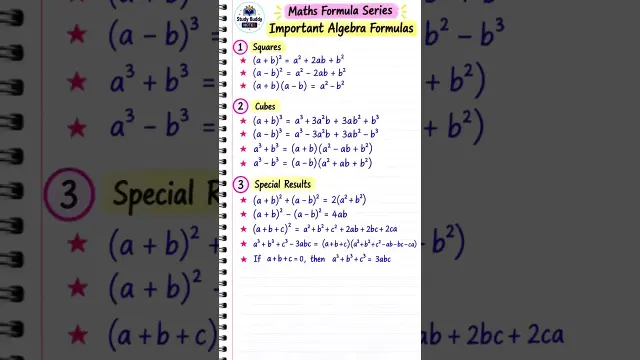
 Quick revision of algebra formulas and identities
#Algebraic Identities
4 ideas
Quick revision of algebra formulas and identities
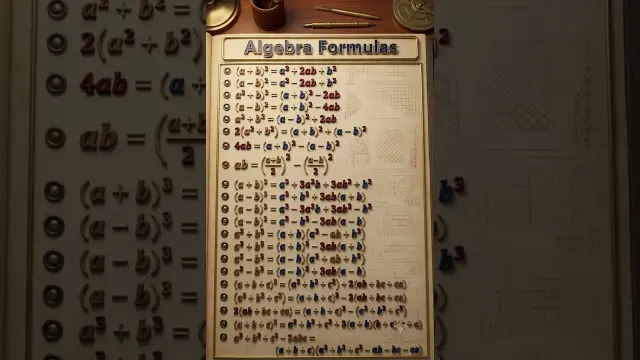 Easy algebra formula chart with basic identities
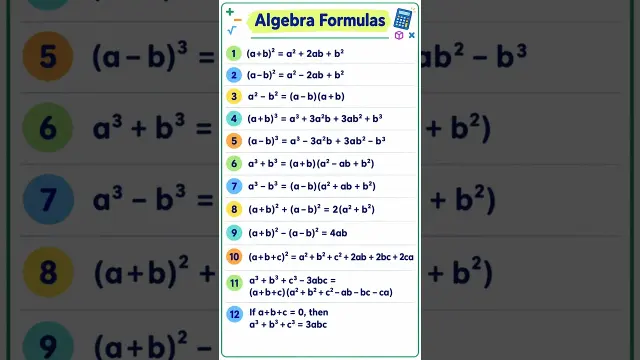 Twelve important algebra identities for school exams
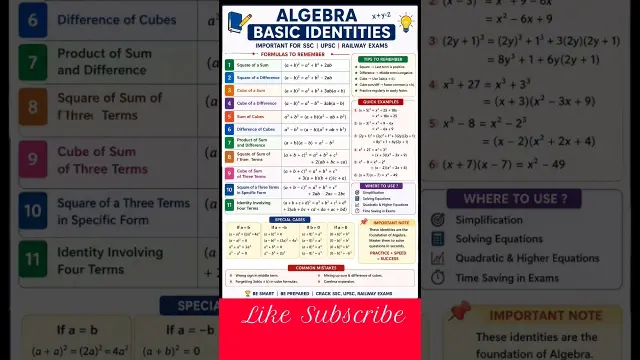 Basic algebra identities for competitive exam revision
Get new #Algebraic Identities ideas by email
Every Thursday: the week's best ideas, with the newest from #Algebraic Identities.
Related tags
Algebraic Identities: The Formulas Worth Knowing
An algebraic identity is an equation that is true whatever numbers you substitute for its letters. That is the whole idea, and it is also what separates an identity from an ordinary equation. The equation 2x + 3 = 11 is true only for one particular value of x. The identity (a + b)² = a² + 2ab + b² holds for every pair of numbers you can think of, positive or negative, whole or fractional. Identities describe the structure of algebra itself rather than a single situation, which is why they keep turning up wherever expressions need to be expanded, simplified or taken apart.
Where identities come from
Most of them are simply the result of multiplying out brackets, written down once and remembered afterwards. If you expand (a + b)(a + b) carefully, the two middle terms are identical and combine, leaving a² + 2ab + b². Nothing mysterious happens; the identity is bookkeeping done properly. There is a geometric way to see the same thing: a square with side a + b can be cut into one square of area a², one of area b², and two rectangles of area ab each. The picture and the formula agree. Learning to derive the identities you use, rather than only memorising them, makes them far harder to forget and far easier to repair in your head if a sign slips.
The core set
Read more
These are the ones worth knowing by heart, in both directions:
- (a + b)² = a² + 2ab + b²
- (a − b)² = a² − 2ab + b²
- (a + b)(a − b) = a² − b²
- (x + a)(x + b) = x² + (a + b)x + ab
- (a + b)³ = a³ + 3a²b + 3ab² + b³
- a³ + b³ = (a + b)(a² − ab + b²) and a³ − b³ = (a − b)(a² + ab + b²)
Everything here works for any values, including negative ones, so treat the signs as part of the pattern and not as decoration.
What they are used for
Identities do three jobs. They expand expressions quickly, which matters when you meet a square of a sum in a longer calculation. They factorise expressions, letting you turn a difference of two squares into two brackets and solve equations that looked stuck. And they make mental arithmetic easier: a number like 51 can be written as 50 + 1, so its square follows from the first identity with very little work. They also underpin later material, from quadratic equations to calculus, so the time spent on them is rarely wasted.
Getting comfortable with them
Work in both directions. See a² − b² and think of the two brackets; see two brackets and think of the difference of squares. Check a new identity by substituting small numbers, such as a = 2 and b = 1, which catches most sign errors immediately. Keep your working laid out so terms do not get lost. And when you revise, derive one or two from scratch instead of merely rereading them, since the act of expanding is what fixes the pattern in memory.
#Algebraic Identities: frequently asked questions
How do I start learning algebraic identities if I am a beginner?
Start with the most common identities and learn what each one does, not just how it looks. Practice by expanding simple brackets and then checking the result in reverse, because that helps you see the pattern instead of memorizing a line of symbols.
What should I know before trying to memorize algebraic identities?
You should be comfortable with expanding brackets, collecting like terms, and working with positive and negative signs. Identities make much more sense when you can see how they come from multiplication, because that is usually where they come from.
Which algebraic identities should I choose to focus on first?
Begin with the square of a sum, the square of a difference, and the difference of squares, since these appear often in simplification and factorization. After that, add the identities for multiplying two binomials and the basic cube formulas, which are useful in more advanced work.
What are the most common mistakes when using algebraic identities?
A very common mistake is dropping a sign or mixing up the middle term. Another is trying to use an identity when the expression does not match the pattern exactly, so it helps to compare the structure carefully before rewriting anything.
How can I remember algebraic identities for revision more easily?
A good way is to use them in both directions: expand a bracket, then factor a result back into brackets. Writing them out from memory and checking with small values can also help catch errors and make the patterns stick.
Videos come from YouTube and posts from Instagram; titles and summaries are our own. All rights belong to their creators.